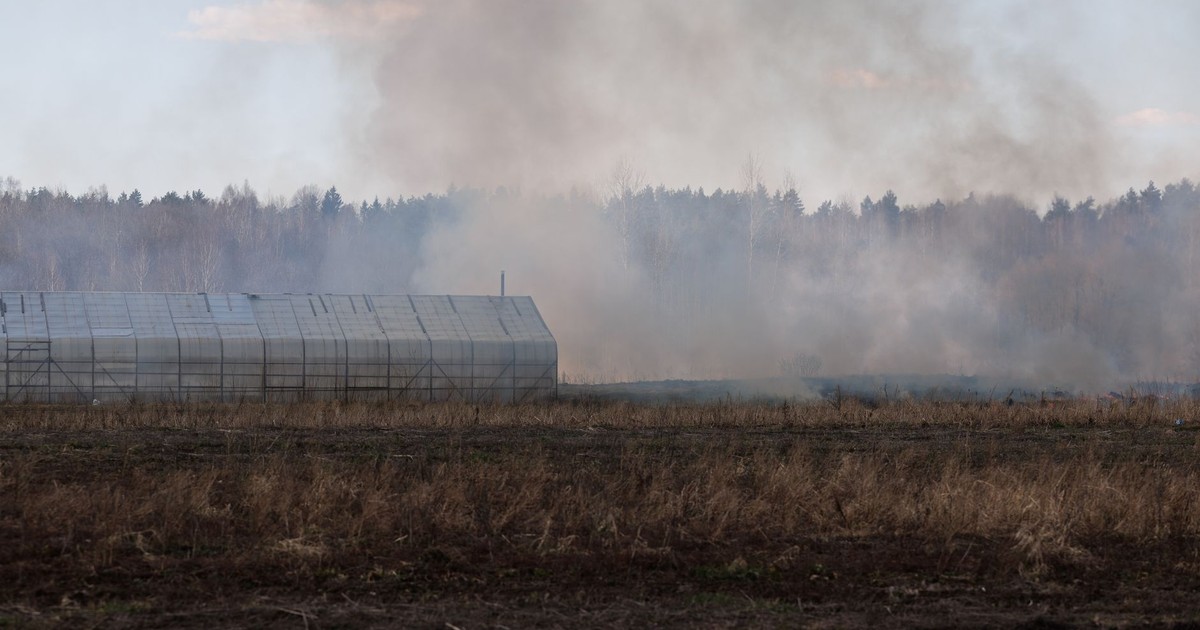

A Russian cruise missile sat in a Polish farm field for hours before investigators reached it. It came down roughly 100 kilometers inside NATO territory, in the Lublin Voivodeship, in a dark field between two villages nobody outside the region had heard of before Thursday. No one was killed. No one was injured. And yet by 6 a.m. local time, NATO’s Supreme Allied Commander was on the phone, Polish F-16s were already back on the ground after a scramble, and the word “serious” was appearing in every official statement in exactly the same careful way that tells you people are trying hard not to say something worse.
Polish Prime Minister Donald Tusk called it “a very serious incident,” and added there were “absolutely no reasons to believe that Poland was the intended target.” A weapon capable of killing dozens landed on the territory of a NATO member state. The alliance scrambled jets, activated ground defenses, and convened an emergency coordination group.
Tusk had met with Ukrainian President Volodymyr Zelenskyy in Lublin on Wednesday to discuss defense issues, less than 24 hours before a Russian missile struck the Lublin region.
What Happened in the Early Hours of July 30

Poland’s Operational Command detected an object approaching the Polish border at 3:29 a.m. local time, coming within about five kilometers before changing course and flying east back toward Ukrainian territory. A second object followed almost immediately.
At 3:40 a.m., a different unidentified object moving westward was detected in Polish airspace, prompting the military to scramble a standby F-16 fighter jet. Before the pilot could make a positive identification, the object disappeared from radar at 3:46 a.m. A Mi-24 helicopter was then dispatched to search the area, and its crew located the probable crash site in an undeveloped field near the village of Tarnawa-Kolonia in the Lublin Voivodeship, roughly two kilometers from the nearest residential buildings.
Poland’s interior ministry said the object left a crater about 10 meters wide. Police in the region said officers found scattered debris after receiving reports of a loud bang between the villages of Tarnawa-Kolonia and Biskupice. Sirens briefly sounded in the nearby city of Lublin to warn residents of possible Russian strikes.
Two NATO fighter jets, both Polish F-16s, along with a NATO Multinational Multi-Role Tanker Transport Unit Airbus A330 refueling aircraft, a Polish Saab 340 Airborne Early Warning aircraft, and a Polish Mi-24 helicopter were all scrambled in response.
The Missile: A Kh-101 Cruise Weapon
Tusk, along with Interior Minister Marcin Kierwinski and Defense Minister Wladyslaw Kosiniak-Kamysz, visited the impact site Thursday afternoon and said all available evidence pointed to a Russian Kh-101 cruise missile, adding that Poland’s air force had been prepared to shoot the object down.
The Kh-101 is an air-launched cruise missile carried by Russian long-range aviation and used routinely against Ukrainian targets, including in strikes on the western regions bordering Poland. It is a precision-designed, long-range munition launched from strategic bombers.
Investigators found fragments indicating the object was a Kh-101 missile, Polish news agency PAP reported. Ukrainian Foreign Minister Andrii Sybiha said in a statement Thursday the incident involved a Russian Kh-101 cruise missile that crossed into Poland, but Polish officials had not yet confirmed that full assessment at the time of his statement.
Ukrainian officials reported that Russia launched more than 70 missiles, along with more than 280 attack drones, of which more than 260 were intercepted. The strike killed at least 8 civilians, including children, and injured more than 50 others.
The Broader Strike: Ukraine’s Deadliest Night in Weeks

The bombardment expanded Russia’s almost daily attacks on Ukrainian cities, including Kyiv, where tens of thousands spent the night sheltering in subway stations as Moscow pressed what Western officials described as an attempt to exploit a critical shortage of air defense interceptors.
Poland had earlier reported scrambling fighter jets in response to the attack, which hit large swathes of the country and left dozens more injured or trapped under rubble. “An extremely tough night for our air defense, observation and threat detection systems,” Polish Defense Minister Wladyslaw Kosiniak-Kamysz said in a statement Thursday.
Ukrainian President Volodymyr Zelenskyy blamed “insufficient or delayed” air defense supplies for the deaths of several people across Ukraine in the latest wave of Russian drone and missile strikes. The attack came two days after Zelenskyy met with U.S. President Donald Trump and representatives of American defense companies as he pleaded for swifter deliveries of Patriot air defense systems. Trump promised to grant Ukraine licenses to build its own Patriots, but production could take many months.
NATO’s Response: Careful Words, Maximum Assets
U.S. Army Col. Martin O’Donnell, a spokesperson for NATO’s Supreme Headquarters Allied Powers Europe, told reporters that NATO and Poland activated their air and ground defenses “in response to a Russian missile of currently unknown type that entered Polish airspace” and crashed inside the country.
After the incursion, NATO’s Supreme Allied Commander, General Alexus Grynkewich, spoke directly with Poland’s Chief of Defence, General Wieslaw Kukulan. “NATO and Poland activated their air and ground defences,” in response to the Russian missile’s entry into Polish airspace, a NATO spokesperson told Reuters.
Tusk told an emergency government meeting that “we were prepared to shoot down the missile if it had continued its flight,” according to his office. Poland was, at least for a few minutes in the dark hours of Thursday morning, within a command decision of firing on a Russian weapon in its own airspace.
Tusk convened a coordination group, spoke with European leaders who offered solidarity and readiness to help, and waited on the lab work, while Poland had not invoked Article 4 during the period in which the investigation was still ongoing.
The Article 4 Question
In September 2025, after roughly 19 Russian drones crossed into Polish airspace and several were shot down, Warsaw invoked Article 4 of the North Atlantic Treaty, triggering formal consultations among allies. On that occasion, the weapons involved were drones: cheaper, slower, and individually far less destructive than a cruise missile. This time, Warsaw held off invoking the same procedure, even as the confirmed intrusion was, by every military metric, more serious.
Thursday’s incident involved a single cruise missile that flew about 100 kilometers into a NATO member state and left a five-meter hole in the ground, and yet the formal collective response was calibrated rather than escalatory. Michael Williams, a NATO expert and associate professor of public administration and international affairs at Syracuse University’s Maxwell School, said he suspected the incident was an errant missile and that Poland would likely call for NATO Article 4 consultations, but that Article 5, the mutual defense clause, “seems a bit excessive at this time.”
Ukraine’s air defense shortfall has been impossible to separate from incidents like this one. Every interceptor that runs short over Lviv or Ternopil represents a gap that extends, in practice, to the airspace of eastern Poland.
A Pattern That Is No Longer Surprising, But Should Still Be

Thursday’s incident adds to a recurring pattern of Russian drones and munitions crossing into Polish airspace over the past year, including the September 2025 episode in which Poland triggered NATO’s Article 4 consultation procedure after tracking 19 separate incursions in a single night.
Over the past year, NATO members have accused both Russian and Ukrainian forces of launching stray drones, missiles, and aircraft into the airspaces of Denmark, Estonia, Germany, Latvia, Lithuania, Poland, and Romania, among others.
Last September, European Commission President Ursula von der Leyen proposed creating a drone wall to counter such incursions, and in December, Poland unveiled plans to complete a roughly $2.3 billion anti-drone fortification system.
The 2026 incident is also qualitatively different from the most infamous earlier comparison. In November 2022, a missile struck and killed two people, but that incident was only four miles from the Ukrainian border. Investigators later concluded that projectile was most likely a Ukrainian air defense missile fired in response to a Russian attack. This week’s missile, by contrast, landed 100 kilometers inside Polish territory and carries fragments consistent with a Russian offensive weapon, not an interceptor fired in defense.
Last weekend, Russian drones crossed into Romania several days in a row, and F-16 fighter jets were scrambled each time to intercept them. Romania, Poland, the Baltic states: the eastern border of NATO is now a boundary that gets tested in some form almost every week.
Where This Actually Leaves Us
Tusk’s statement that Poland was not deliberately targeted is almost certainly accurate. Russia’s strategic interest in directly attacking a NATO member state is, at this moment, close to zero: it would trigger exactly the collective-defense response that Moscow has been careful not to provoke. The Kh-101 that came down in a Lublin field almost certainly lost its guidance or ran out of fuel and fell where physics took it.
But “probably an accident” and “not a problem” are two different things. Ukrainian Foreign Minister Sybiha wrote on X: “This is yet another clear demonstration that strengthening Ukraine’s air defense now is urgent and serves as a guarantee for the protection of the entire Euro-Atlantic community.”
The crater near Tarnawa-Kolonia isn’t just a hole in the ground. It is a data point in an argument about where this war’s edges really are, and how thin the margin has become between a stray missile and something that can’t be walked back with a coordination group and a forensics team.
Disclaimer: This information is not intended to be a substitute for professional medical advice, diagnosis, or treatment and is for information only. Always seek the advice of your physician or another qualified health provider with any questions about your medical condition and/or current medication. Do not disregard professional medical advice or delay seeking advice or treatment because of something you have read here.
AI Disclaimer: This article was created with the assistance of AI tools and reviewed by a human editor.