
The word that keeps coming up when directors talk about AI isn’t “threat.” It’s “apprenticeship.” The fear isn’t simply that machines will take jobs. It’s that the jobs most at risk are the ones that teach you how to make something real.
Studios have been eager to tout the potential benefits of AI to investors while staying quiet about their biggest experiments, afraid to antagonize talent. Writers and actors had already gone on strike for months in 2023, driven in no small part by concerns over AI. The conversation has since moved beyond labor negotiations into something more personal. Directors have started saying, publicly and loudly, what they actually think.
What they think is: this isn’t just about jobs. It’s about what film is for.
The Craft Argument: What Gets Lost When a Machine Does the Work
At the 2026 San Diego Comic-Con, Guillermo del Toro announced that the 3D re-release of Pan’s Labyrinth had been created through a manual conversion process involving approximately 1,000 artists doing the painstaking frame-by-frame work known as rotoscaping. “Obviously,” del Toro said, “I said, ‘Absolutely no goddamn AI.'”
That line got the laugh it was designed to get. What followed was more serious. Del Toro argued that the decision was about protecting something larger than the film itself. “What we’re protecting is the beauty and the redeeming power of art,” he said. “It’s not about who gets the job. We are protecting a lineage of art. If we cut a generation of people from learning their craft, you’re cutting the rest of the history of that medium away from them, for what?”
Most filmmakers who become great directors didn’t start there. They started as assistants, editors, effects artists, camera operators, doing the granular, unglamorous work that taught them how a scene breathes. Del Toro’s worry lands differently when you consider that progression. If AI handles all those entry-level and mid-level creative tasks, the apprenticeship model that has produced cinema’s greatest voices for a century simply disappears.
Del Toro also pushed back on how the debate itself is being framed. Speaking at Cannes, he argued that AI is grouped under one dishonest umbrella. “In a very dishonest way, AI is all under the same name,” he said. “To have a proper discussion, you have to distinguish generative AI and any other function of AI.” Nobody is arguing against AI in weather forecasting or medical diagnostics. What directors are resisting is generative AI, the kind that ingests existing human creative work, learns to mimic it, and then produces imitations on demand, often without the knowledge or consent of the artists whose work trained it.
The Humanity Argument: What Art Is Actually For
Celine Song, director of Past Lives, put the concern differently. Speaking at the 2025 Marrakech Film Festival, Song said she is “very concerned” about the way AI is “trying to encroach” on the experiences that make life both beautiful and worthwhile. “The number one thing that we’re here to defend as artists is humanity,” she said. “We’re here not to think about what makes human life easy, what makes it convenient, but what it’s like to actually live.”
Song’s films work precisely because they sit inside specific, ungeneralizable human experiences: the particular grief of a love that ended before it could begin, the way memory distorts over decades. These aren’t the kinds of emotional states you can prompt your way into. They come from having lived something, or from spending years learning how to pay attention to people who have.
A 2025 Bloomberg investigation found that actors, writers, and directors are worried AI will devalue human work and jeopardize their livelihoods. Rian Johnson, director of Knives Out, told the Hollywood Reporter that the technology is “making everything worse in every single way.” At the same Marrakech festival where Song spoke, filmmaker Bong Joon Ho also raised objections, joking, darkly, that he would organize a military squad to destroy the technology.
The joke was a joke, but the frustration underneath it is real. These are filmmakers at the top of their profession, people who have nothing financially to fear from AI right now. Their opposition isn’t about self-preservation. It’s about what they believe the work is actually supposed to do.
The Generation Gap Nobody Expected
Christopher Nolan has been one of the most outspoken voices on this, but his argument arrives from a direction that surprises people. He isn’t just defending his own generation’s approach to filmmaking. He’s pointing at younger filmmakers and audiences as evidence that the industry’s bet on AI may be landing at exactly the wrong cultural moment. In a 2026 interview with The Telegraph, Nolan told Deadline he had “never seen a more rapid wholesale dismissal of a supposedly foundational jump in technology” in his lifetime, pointing to Gen Z’s rejection of what he called “AI slop.”
Nolan cited 21-year-old Backrooms director Kane Parsons and 26-year-old Obsession director Curry Barker as examples of a new generation choosing the practicalities of cinema over algorithmic shortcuts. Barker’s film, made on a $750,000 budget, grossed over $400 million globally.
Nolan said their rejection of AI has been both immediate and unambiguous. “They see it for what it is very quickly, and it’s much easier for them to identify it, because it grew out of an online world they know really well,” he said. “And while that doesn’t mean that every aspect of the technology is useless or meaningless, in filmmaking it’s hitting at exactly the wrong time.”
He pointed to a broader cultural shift: “after years of driving towards heavily virtual environments, we’re seeing a renewed interest in more tactile, more real forms of storytelling.” Studios are investing billions to bring AI into the creative process at exactly the moment audiences are starting to hunger for the opposite, for work that shows the fingerprints of a human being.
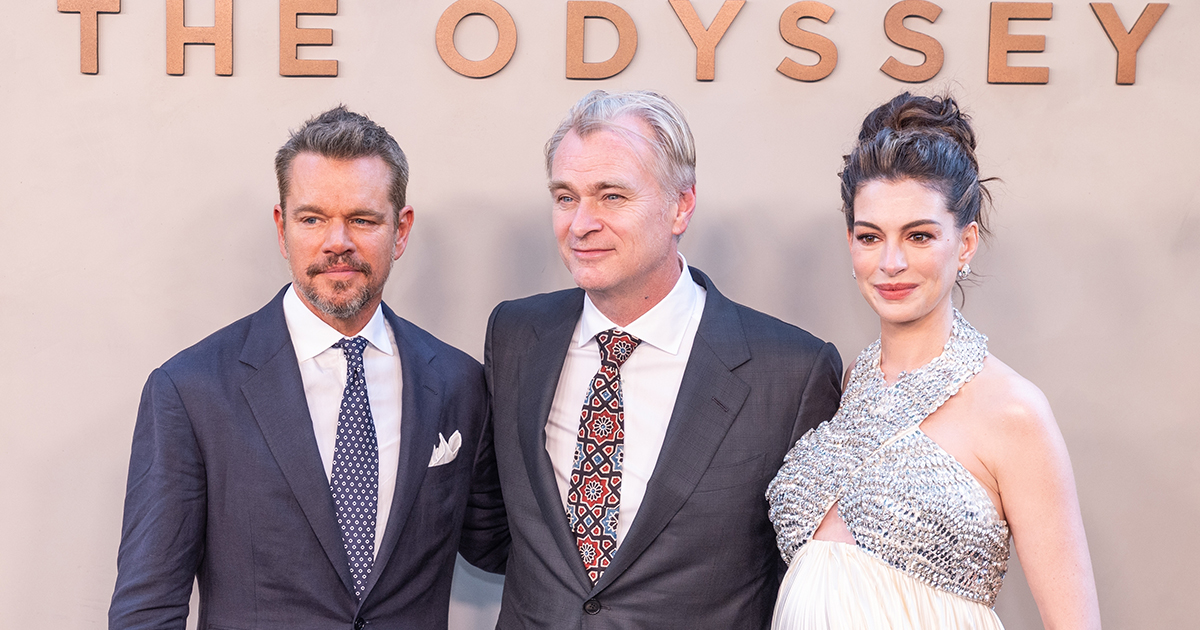
Nolan’s own upcoming film The Odyssey was shot entirely on IMAX 70mm, at an estimated budget of $250 million, as a deliberate statement about the value of physical filmmaking. Whether audiences reward that choice will say something about what kind of movies the next decade actually wants.
The Labor Fault Line
Behind the creative arguments, there’s a harder structural question about who gets paid and for what. Hollywood’s major labor contracts are expiring again in 2026, and the industry is bracing for another potential work stoppage. The 2023 strikes bought writers and actors some protections, but the technology has moved faster than the contracts written to govern it.
At Cannes in May 2026, French director Xavier Gens made the financial case for AI as plainly as anyone has. He told reporters that if he were making his 2024 Netflix hit Under Paris today, he could cut the visual effects budget from 4 million euros to 2 million euros and finish the film up to eight months faster. “I would do it in three months instead of one year,” he said.
That math is why studios are paying attention, regardless of what their directors think. And it’s why the AI film directors concerns extend beyond aesthetics into something more structural. Every dollar saved on visual effects by an AI system is a dollar that used to flow to a team of human artists with mortgages and families.
The controversy reached a flashpoint at the 2025 Oscars, when the use of AI to enhance Adrien Brody’s dialogue in The Brutalist became a major talking point. The CEO of Respeecher, the Ukrainian firm that developed the voice technology used in the film, argued that the use of AI was an effective enhancement of human talent, one that deserved to lose its stigma. The Academy gave the film its highest honor anyway. The debate it sparked hasn’t ended.
SAG-AFTRA’s Basic Agreement now mandates informed consent and compensation for any use of an actor’s likeness, voice, or performance generated or altered by AI. California and New York enacted legislation effective January 2025 requiring contractual consent for digital replicas, and Tennessee’s ELVIS Act of 2024 protects performers’ voices and likenesses from unauthorized AI replication.
The Divide Within the Industry
Not every respected filmmaker is on the same side of this. Some prominent directors have taken steps toward the technology rather than away from it. Martin Scorsese has taken an advisory role with an AI firm, James Cameron sits on the board of a major AI developer, and Ben Affleck sold his AI startup to a streaming company.
Cameron’s position is particularly revealing. Although Cameron was previously critical of AI, he joined the board of directors for Stability AI in 2024, saying the decision stemmed from a desire to understand the technology. He believes filmmakers must engage with AI to cut the cost of big, effects-heavy blockbuster films. His argument is essentially pragmatic: the economics of large-scale filmmaking are unsustainable, and if AI can make those films possible, then refusing to engage with it is a luxury not every filmmaker has.
That’s a reasonable position. But it coexists uncomfortably with del Toro’s point about lineage. Cameron can afford to engage with AI from a position of complete creative and financial security. The VFX artist five years into their career cannot.
What This Actually Means
The AI film directors concerns, taken together, add up to something more than a generational argument about technology. They’re describing a specific risk: that if film becomes primarily an optimization problem (faster, cheaper, more like what audiences have previously liked) it will stop being able to do the thing that makes it matter. The films that genuinely changed people didn’t come from efficiency. They came from a director who had absorbed a particular kind of suffering or wonder and found a way to put it on screen.
That’s not a romantic abstraction. It’s how the craft has actually worked, from the Italian neorealists shooting in rubble after World War II to a Korean director spending years on a story about grief that no studio thought would travel internationally. The process of learning, of doing the work badly for years before you can do it well, is what creates the conditions for the genuinely new.
Studios and tech companies will continue to argue that AI is just a tool, like color or sound or CGI before it. They may be right. But the directors who are pushing back aren’t arguing against cameras or editing software. They’re arguing against something specific: a generative system trained on human creativity that can now approximate it without any of the human experience that produced it. The approximation is good enough to be cheap. The question is whether it’s good enough to be true.
Disclaimer: This information is not intended to be a substitute for professional medical advice, diagnosis, or treatment and is for information only. Always seek the advice of your physician or another qualified health provider with any questions about your medical condition and/or current medication. Do not disregard professional medical advice or delay seeking advice or treatment because of something you have read here.
AI Disclaimer: This article was created with the assistance of AI tools and reviewed by a human editor.