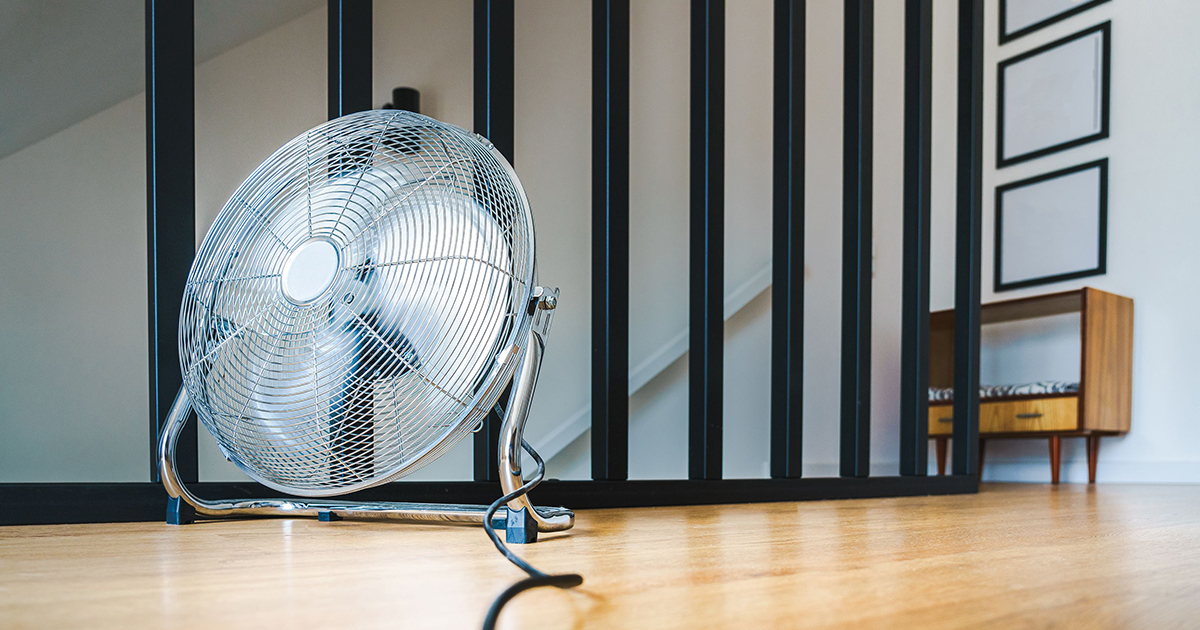

Most people who sleep with a fan on have never given it a second thought. The fan goes on, they fall asleep, and they wake up feeling more or less fine. What medical professionals have been paying closer attention to, though, is everything that happens in between: eight hours of continuous airflow across airways, skin, and mucous membranes that don’t get a break from the moment you close your eyes to the moment your alarm goes off.
The picture that emerges from physicians and sleep researchers is more complicated than the simple “fans are bad for you” headlines suggest. There are real benefits, documented ones, that explain why so many people genuinely sleep better with a fan running. There are also real physiological costs that accumulate over time, particularly for people who already have respiratory sensitivities, allergies, or chronically dry sinuses. Whether sleeping with a fan on is helping or hindering your health depends almost entirely on how you’re using it and what your specific biology is doing while you sleep.
Here is what the evidence actually shows.
The Physiology of Sleeping With a Fan: What’s Happening to Your Body
Airway Dryness and the Mucociliary Defense System
A fan running all night lowers the humidity around your face, and dry air dehydrates the mucous membranes lining your nose, throat, and sinuses. Those membranes aren’t just tissue. They’re an active immune barrier that traps viruses before they can take hold. When that barrier dries out, it becomes less effective at its primary job.
Dr. Julius Goh, an ENT specialist, has explained it this way: “The mucociliary clearance system, the microscopic hair-like cilia that sweep mucus and allergens out of your nasal passages, needs moisture to function. Dry it out and you’re essentially paralyzing your own nasal immune defense. Allergens sit longer. Symptoms worsen.”
Research on nasal physiology found that mucociliary clearance, the process by which tiny cilia sweep mucus and trapped particles out of your nose, slows down measurably when you breathe dry air. When that clearance system slows down, whatever you inhaled overnight stays around longer.
According to Healthline, constant airflow can dry out your nose, mouth, and throat, prompting your body to produce more mucus in an attempt to combat the dryness. Overproduction of mucus can cause congestion, bringing on symptoms like a sore throat, stuffy nose, and coughing. Dry air can also dry up your nasal passages, leading to mucus overproduction, with excess mucus flowing into your sinuses, blocking them and causing headaches.
For most healthy adults, these effects are mild and resolve quickly after waking. For anyone with chronic sinusitis, asthma, or a history of sinus infections, they compound over consecutive nights in a way that can feel indistinguishable from being perpetually half-sick.
Allergen Circulation: The Air Quality Trade-Off
A fan does not filter air. It moves it. Keeping those two things separate matters more than most people act on.
As Dr. William Lu, medical director at digital sleep clinic Dreem Health, puts it: “While fans improve air circulation, they do not affect filtration. Rather than allergens staying in one spot in the room, they move around, leading to more consistent exposure while you sleep.”
Dust mites, pollen, mold spores, and pet dander that may have settled on surfaces can get stirred up and redistributed around the room when the fan is switched on. Every ceiling fan blade and box fan grille accumulates a layer of dust between cleanings, and that dust goes airborne when the motor runs.
According to Dr. Lu, “if your airway is already reactive and sensitive, the combination of circulating allergens and dryness can make symptoms like coughing, wheezing, or congestion worse.”
Dry air from a fan slows the cilia responsible for moving mucus out of your sinuses. When that drainage slows, mucus sits longer, and stagnant mucus is exactly the environment bacteria need to establish an infection. Circulated mold spores and dust can compound this by irritating the sinus lining directly, and indoor mold exposure has been specifically linked to increased respiratory and sinus symptoms in enclosed environments. If you already have seasonal allergies or chronic sinus issues, a fan running nightly can act as a low-grade trigger that keeps inflammation going rather than letting your sinuses fully recover.
Muscle Stiffness and Skin
When cool air is concentrated on one part of your body for a prolonged period of time, it can cause muscles to tense up or cramp due to localized blood flow changes. Because your body often stays in the same position for hours during sleep, you can wake up feeling sore.
Sleeping with a fan can dry out your mouth, nose, throat, skin, and eyes, and may worsen congestion or allergies by circulating dust and pollen. People who sleep with their eyes slightly open, more common than it sounds, are particularly vulnerable to waking with dry, irritated eyes after a night with a fan blowing toward their face.
The Documented Benefits: Why Many People Sleep Better With a Fan
Thermoregulation and Sleep Onset
Core body temperature drops by roughly 1 to 2 degrees Fahrenheit (0.5 to 1 degree Celsius) to initiate and maintain sleep. A fan moving air across your skin helps that process through evaporative cooling, the same principle as sweating. As you fall asleep, your body temperature naturally decreases to promote the sleep-inducing process. Keeping your bedroom cool facilitates this natural occurrence and makes it easier to fall asleep and stay asleep. The National Sleep Foundation notes that experts generally consider 60 to 67 degrees Fahrenheit to be optimal for high-quality sleep.
Fans don’t cool a room the way an air conditioner does. The ambient temperature stays the same, but they create a wind-chill effect on the skin that supports the body’s own temperature drop. For people sleeping in apartments without air conditioning during summer, that practical relief is the point, regardless of the physics.
White Noise and Sleep Consolidation
The steady hum of a fan isn’t just pleasant background noise. It actively does work on your sleep architecture.
The human brain does not fully shut down during sleep. It continues monitoring the environment for sudden changes in sound. Consistent background noise can reduce how often those changes register as disturbances, supporting more consolidated sleep across the night.
A 2017 study published in Frontiers in Neurology found that broadband sound administration reduced the time it took participants to fall into stage 2 sleep by 38%, with additional improvements in sleep quality among those who reported trouble initiating sleep at home. A fan is not a perfectly engineered white noise machine, but it does the same job well enough for most people.
Though many people enjoy the sound of a fan while sleeping, others may find it irritating or distracting. Research suggests noises as low as 48 decibels, and potentially those as low as 33 decibels, can have noticeable effects on sleep. A soft whisper is about 30 decibels; an air conditioner sits around 60. Repeated nighttime awakenings, or waking up feeling unrested, may be signs that the fan is too loud rather than too quiet.
The white noise benefit is real, but it comes bundled with the airflow. If sound masking is the only goal, a dedicated white noise machine delivers the acoustic benefit without the dryness, allergen circulation, or directed airflow.
The SIDS Finding: A Striking Exception
A study published in the Archives of Pediatrics and Adolescent Medicine found that having a fan on during infant sleep was associated with a 72% decrease in SIDS risk compared to having no fan in the room. The decrease in risk jumped to 94% if the fan was being used in a room that was above 69 degrees Fahrenheit.
Researchers analyzed data from mothers of 185 infants who died with a confirmed diagnosis of SIDS, matched with 312 infant controls in the same geographical area. Fan use during sleep was associated with a significantly lower risk of SIDS. The proposed reason: a gentle airflow can reduce the build-up of CO₂ around the baby’s face, which could be critical if ventilation is poor.
The authors acknowledged that recall bias may play a role in the findings, noting that case mothers provided information about sleep habits further from the event than control mothers, which could affect accuracy. This was a case-control study, not a randomized trial, which is the most rigorous type of evidence. Still, fan use appears to be a low-cost, low-risk intervention, and prospective validation to prove that fan use is protective is unlikely to occur given the relative infrequency of SIDS and the number of children that would have to be followed. Pediatricians generally treat this finding as one more low-effort risk reduction measure alongside back-sleeping positioning.
For adults, the CO₂ dispersal benefit still applies in poorly ventilated rooms. The physics don’t change just because you’re bigger.
Who Should Be Most Cautious

Sleeping with a fan is not dangerous for most adults. Sleeping with a fan on won’t make you sick, but if you have allergies or asthma, it could cause symptoms like cough or congestion from the circulating dust.
For people with allergies, asthma, or sensitive sinuses, a fan circulating dust and dander through the sleep environment can meaningfully worsen symptoms and reduce sleep quality over time. Anyone who wakes most mornings with a sore throat, stuffed sinuses, or dry, gritty eyes, and who runs a fan all night, has a reasonably obvious experiment to run.
People with chronic sinusitis face a particular version of this problem. A fan running nightly can act as a low-grade trigger that keeps inflammation simmering rather than letting the sinuses fully recover. The same applies to asthma, which involves airway inflammation and hyper-responsiveness. The airways narrow in response to triggers that can include cold air, dry air, allergens, and airborne irritants, and a fan at night can contribute to several of these simultaneously.
People who sleep with their mouths open are also more exposed to the drying effects of a fan than those who breathe through their noses, simply because the nasal passages provide some filtering and humidifying of incoming air that mouth breathing bypasses entirely.
Practical Steps: How to Get the Benefits Without the Costs

The choice isn’t binary. Most of the documented downsides of sleeping with a fan on are addressable with specific, low-cost adjustments.
Fan placement matters more than fan speed. Keeping the fan two to three feet away protects you from concentrated airflow. An oscillating fan also prevents the flow of air from moving in only one direction. A fan blowing directly at your face all night delivers the maximum drying and allergen exposure. The same fan pointed at the wall or ceiling, or set to oscillate, distributes airflow without concentrating it on your airways.
A timer is underused. If your fan has a timer, try setting it for one to two hours after you go to bed. That way, you can keep the room cool while you fall asleep but stop dry air from flowing all night. This simple step also lowers the risk of drying your skin, eyes, and sinuses. Most people fall asleep within 30 minutes anyway. Running a fan until you’re asleep and then letting it shut off gives you the temperature and sound benefits at the point they’re most needed, without eight hours of continuous exposure.
Fan hygiene is its own intervention. It’s important to clean fan blades regularly to ensure they’re free from dust. The allergen load that a dirty fan circulates at 2am is almost entirely preventable. A wipe-down every two weeks makes a measurable difference for anyone with airborne sensitivities.
Humidity makes up the deficit. Running a humidifier alongside a fan counteracts the drying effect directly. The airflow benefit stays intact; the mucous membrane compromise doesn’t accumulate. Adding a humidifier is a straightforward complement for anyone who can’t tolerate the dryness a fan creates.
For allergy and asthma sufferers specifically, the air purifier is a better companion than a humidifier alone. A HEPA air purifier used instead of, or alongside, a fan actively removes particles from the room. A fan just moves them. Pairing a fan with a HEPA purifier in the same room addresses the allergen circulation problem at the source rather than just managing symptoms after the fact.
What to Do With All of This

A fan is a simple device doing several things at once, and not all of them are pointing in the same direction. The white noise benefit is real and has solid research behind it. The thermoregulatory benefit is real and physiologically grounded. The SIDS risk reduction finding, while limited by study design, is striking enough that it has influenced pediatric guidance for nearly two decades. These are not trivial arguments for the fan.
At the same time, the mucosal drying effect is real, the allergen circulation problem is real, and for anyone whose airways are already reactive, the combination of dryness and increased allergen exposure compounds across nights in a way that the morning sore throat only partially captures. The most common side effects are a sore throat from drying of the throat and nasal passages, dry or irritated eyes, worsened allergies from circulating dust and pollen, muscle stiffness from sustained cool airflow on one spot, and brief wake-ups in lighter sleepers caused by ambient fan noise.
The practical answer is not “fan or no fan” but a set of specific modifications: placement away from the face, an oscillating setting, a timer, regular blade cleaning, a humidifier if dryness is an issue. These preserve what the fan does well while addressing what it doesn’t. For healthy adults without respiratory conditions, sleeping with a fan on presents no serious risks, and for hot sleepers and light sleepers in noisy environments, it may genuinely improve sleep quality.
For the roughly one in four adults who have some form of allergic respiratory condition, the calculation is more individual: the fan may be working against you in ways that don’t announce themselves dramatically, just a little worse every morning, a little more inflamed each night. Addressing that doesn’t require giving up the fan. It requires understanding what it’s actually doing while you sleep.
Disclaimer: This information is not intended to be a substitute for professional medical advice, diagnosis, or treatment and is for information only. Always seek the advice of your physician or another qualified health provider with any questions about your medical condition and/or current medication. Do not disregard professional medical advice or delay seeking advice or treatment because of something you have read here.
AI Disclaimer: This article was created with the assistance of AI tools and reviewed by a human editor.