
Malibu Colony originally started as the Malibu Motion Picture Colony in 1926, which explains its continued appeal to entertainment industry professionals. A century later, the pedigree holds. According to moneyinc.com’s ranking of America’s wealthiest neighborhoods, Malibu Colony stands as the most expensive neighborhood in Los Angeles County. The gated beachfront community sits in Eastern Malibu.
The most exclusive ZIP codes, islands, and gated compounds on the planet share a trait that gets less attention than it should: the price of admission is only the beginning. You can have $50 million sitting in a brokerage account and still not get past the front gate of these expensive exclusive communities. The money matters, but it’s not the whole story. In many cases, the actual barrier is social. Existing residents vote you in, or a private membership committee reviews your application, and no amount of cash overrides a unanimous no. The house is the easy part. The harder part is being the kind of person these communities are designed for.
These nine places are the ones that keep coming up in conversations about where the ultra-wealthy actually live, not where they vacation or where they park money, but where they genuinely reside. They sit on private islands, behind armed checkpoints, and at the ends of gated peninsulas that most people will never see from anything other than a boat. What makes them remarkable in 2026 isn’t just the prices, though the prices are extraordinary. It’s how aggressively they’ve climbed, and what that tells us about the growing gap between the world the very rich inhabit and the one the rest of us live in every day.
Fisher Island, Miami Beach
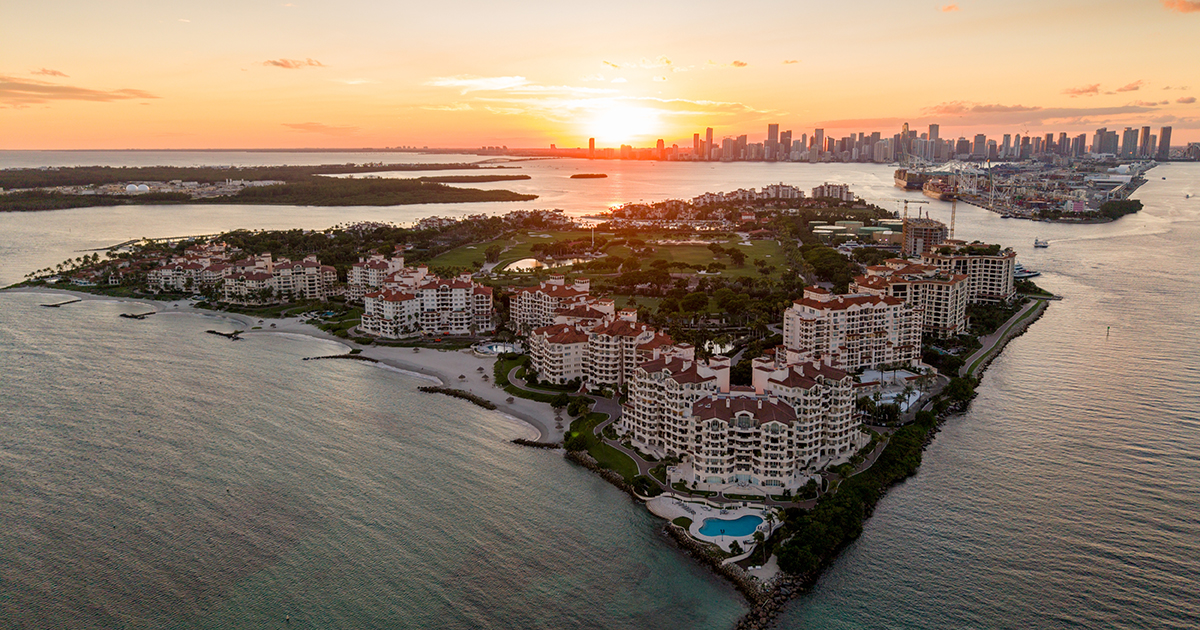
There is no road to Fisher Island. The 216-acre barrier island off the southern tip of Miami Beach is only accessible by boat, private ferry, or helicopter. That’s not a quirk. It’s the feature. The kind of person who chooses to live there has decided, deliberately, that a commute requiring a ferry ride is a reasonable price to pay for the certainty that nobody who doesn’t belong will ever walk past their front door.
In 2025, Fisher Island’s ZIP code 33109 became the most expensive ZIP code in the United States, with a median sale price of $9.5 million, marking Florida’s first time topping the list in the ten years PropertyShark has tracked the ranking. That $9.5 million median represents a 65% increase year-over-year. The island has only around 700 households, strictly controlled ferry access, and consistent demand from ultra-high-net-worth buyers globally, which collectively create a natural floor under property values.
Notable residents have included Oprah Winfrey, Julia Roberts, and tennis champion Caroline Wozniacki. But the more interesting point is what Fisher Island represents as a concept: a neighborhood that has literally engineered its own inaccessibility into the geography. You can admire it from the water. You cannot simply arrive.
Indian Creek Island, Miami
Known as the Billionaire Bunker, this 300-acre island is home to only forty estates, each lining the island’s circumference and providing residents with direct waterfront access. Indian Creek is its own incorporated municipality. It runs a government, runs a police department, and controls who crosses the bridge. The island wraps around a private 18-hole golf course, meaning most homes sit on the perimeter with direct water frontage and very few neighbors.
Home prices typically start above $50 million. A waterfront parcel near Jeff Bezos’s estate was publicly reported to trade for $105 million in June 2025. That is the entry conversation, not the ceiling. In late 2025, a yet-to-be-completed limestone palazzo designed by Ferris Rafauli, the same designer behind Drake’s Toronto compound, was listed at $200 million, which would top the $120 million Star Island sale and potentially become the most expensive property ever sold in Miami-Dade County.
Bezos himself has amassed over $230 million of property on Indian Creek since 2023 and 2024. When the wealthiest person in the world spends a quarter of a billion dollars in a single neighborhood, it tells you something about the neighborhood’s perceived permanence. Indian Creek doesn’t sell privacy as an amenity. It has incorporated it as law.
Star Island, Miami
Star Island has more name recognition than almost any address in South Florida, and that’s both its appeal and its one slight vulnerability. A 35-home man-made island just off the MacArthur Causeway, Star Island has seen homes sell for anywhere from $25 million to well over $100 million, including a publicly reported $120 million estate sale in early 2025, a record for Miami-Dade County. The island carries the most name recognition of any Miami address, with large lots exceeding 40,000 square feet and a guard-gated entrance staffed around the clock.
By median home value, Star Island ranks as one of the most expensive neighborhoods in the United States, according to Bloomberg. Each property encompasses up to 30,000 square feet and is styled with Mediterranean, Spanish, and European designs. The catch, compared to Indian Creek, is that boat tours circle Star Island daily. The gate keeps strangers off the land. It can’t keep them off the water.
Gables Estates, Coral Gables
Sitting inside Miami’s prestigious Coral Gables, Gables Estates has earned the distinction of being among America’s most expensive neighborhoods, where 179 meticulously planned waterfront lots create an enclave of concentrated wealth. The community’s 179 exclusive lots average 56,240 square feet each, significantly exceeding comparable neighborhoods like Trousdale Estates in Beverly Hills or Carbon Beach in Malibu.
What makes Gables Estates interesting is its relative anonymity. It doesn’t appear on the same celebrity gossip circuit as Indian Creek or Star Island, and it isn’t constantly generating headlines. It has the feel of a place where serious money goes to be left alone, not to announce itself.
Beverly Park, Beverly Hills
Beverly Park was completed in 1990 as a 250-acre guard-gated community sitting high above the city and hiding some of the most expensive homes in America. Most people drive right past Beverly Park without knowing it exists. That’s by design. The neighborhood keeps a low profile while housing A-list celebrities, tech billionaires, and entertainment moguls.
Properties range from 2 to 5-plus acres, giving estate-like space that’s nearly impossible to find elsewhere in Los Angeles. The minimum house size mandated by the HOA is 5,000 square feet, which is not a restriction but a floor. In 2025, a Beverly Park estate sold for $63.1 million, landing on Redfin’s list of the ten most expensive home sales in the country that year. The total cost of ownership here can easily exceed $1 million per year for larger estates, and that figure doesn’t include the purchase price itself.
Malibu Colony, California
Malibu Colony originally started as the Malibu Motion Picture Colony in 1926, which explains its continued appeal to entertainment industry professionals. A century later, the pedigree holds. According to moneyinc.com’s ranking of America’s wealthiest neighborhoods, Malibu Colony stands as the most expensive neighborhood in Los Angeles County. The gated beachfront community sits in Eastern Malibu.
The neighborhood’s history of famous residents spans decades, from Frank Sinatra and Barbara Stanwyck to Tom Hanks, Sting, Bill Murray, and Woody Harrelson. The properties here are something slightly different from the fortified compounds of Miami. Many are not enormous, by luxury standards. What you’re paying for is a strip of direct beachfront access in one of the most coveted coastal corridors on earth, behind a gate, with neighbors who understand exactly why privacy has a price.
Sagaponack, The Hamptons
Sagaponack, New York, came in third nationally in the 2025 ranking of the most expensive ZIP codes in the country, with a $5.93 million median sale price. It was displaced from its customary top-two position by Fisher Island and Atherton for the first time. It was still Sagaponack’s tenth consecutive year as New York State’s most expensive ZIP code.
Sagaponack stands as the wealthiest town in the Hamptons region. Meadow Lane in Southampton, directly adjacent, claims the top spot for the most expensive individual street, where properties command a median sale price of $17.6 million. The community has approximately 770 residents, which means almost everyone who lives there knows who their neighbors are, whether they want to or not. In a place this small, and this expensive, anonymity isn’t guaranteed by a gate. It’s maintained by mutual agreement.
Saint-Jean-Cap-Ferrat, French Riviera
The French Riviera has been synonymous with serious money for long enough that even the name functions as shorthand. Saint-Jean-Cap-Ferrat, the peninsula between Nice and Monaco, sits at the top of that hierarchy. Villas here often exceed ten million euros. A contemporary renovated villa of over 400 square meters might list for 18 million euros. Prices can reach up to 60,000 euros per square meter, but for those prices, you receive an exceptional villa with breathtaking Mediterranean views and a century-old landscaped park.
Unlike the gated islands of Miami, Cap Ferrat is not a single guarded community. It is a peninsula with strictly limited development, a tiny permanent population, and the kind of reputation that has been building since European royalty and Russian oligarchs first started choosing it as their preferred address. The scarcity here is geographic and permanent. There is only so much peninsula. Nobody is building more of it.
Lyford Cay, Bahamas
The gated community of Lyford Cay is an exclusive residential enclave on the western tip of New Providence in the Bahamas. The 1,000-acre compound encompasses over 300 properties, an 18-hole championship golf course, twelve tennis courts, a yacht club and marina, a private school, and a clubhouse set on manicured grounds with a private beach. Originally developed in the 1950s, Lyford Cay remains a pristine and extremely private community.
Homes range from $2 million to $40 million, and the enclave counts royalty, presidential families, world-renowned authors, artists, actors, directors, entrepreneurs, and scholars among its residents. What sets Lyford Cay apart from the American communities on this list is its atmosphere. It is deliberately understated, built on the principle that the most exclusive address should never need to announce itself. The people who choose it tend to already know what it means.
The Real Price of Admission
The numbers in this list are almost beside the point. A $9.5 million median price, a $200 million asking price, a $1 million annual ownership cost: these figures are so far outside the experience of almost everyone reading this that they function more as signals than as practical information. What they signal is the degree to which physical geography has become a tool of social separation.
These expensive exclusive communities aren’t just expensive. They are architecturally and logistically engineered to make casual contact with anyone outside their walls essentially impossible. A ferry that only residents can board. A single guarded bridge. A municipal government that exists solely to serve forty families. The most expensive home sale in the United States in 2025 was a Naples beachfront compound that sold for $133 million, according to Redfin’s year-end report. The buyer’s name wasn’t released. That detail, more than any price tag, captures what these places are actually selling.
The argument in favor of them is straightforward: private property, the right to security, the freedom to spend money however you like. All fair. The argument against them is less about envy than about what it means when the people who run economies, influence policy, and shape culture live in literal fortresses, accessible only to each other. The gate doesn’t just keep strangers out. It keeps residents permanently insulated from the ordinary friction of shared civic life. Whether that’s a problem or a privilege depends on which side of it you’re standing on.
AI Disclaimer: This article was created with the assistance of AI tools and reviewed by a human editor.