

The most fought-over question in any long marriage isn’t money or parenting or whose turn it is to call the plumber. It’s the harder one that arrives quietly in the middle of an ordinary Tuesday: did I choose the right person? Most of the time, the answer isn’t written in the big moments. It lives in the daily ones. The way she remembers that you hate cilantro. The way she doesn’t make you feel stupid for being upset about something small. The way she laughs at herself when she gets something wrong.
Research on what makes long-term partnerships genuinely satisfying keeps pointing back to the same place: not grand gestures, but repeated small ones. Habits, in other words. And some people seem to carry these habits so naturally that being married to them changes the whole texture of daily life.
This is about those ten wife habits in marriage. Not a checklist of perfection, but a pattern of behaviors that relationship researchers and couples therapists keep identifying as the real difference-makers.
1. She Expresses Gratitude Out Loud, and Often

The Gottman Institute has observed tens of thousands of couples and found that for every one negative interaction during conflict, a stable and happy marriage has five or more positive interactions. That 5:1 ratio holds across decades of research, and what the positive interactions consist of matters as much as the count: humor, affection, validation, noticing what the other person contributes. Couples who build what researchers call an enthusiastic culture of appreciation are far more likely to stay together, and stay genuinely happy, than those where gratitude is rare or only expressed after something big.
Not the occasional thank-you after someone does something impressive. A consistent, everyday habit of noticing. When one partner expressed gratitude in a given interaction, both partners reported improved connection and satisfaction the following day, not just the receiver. The giver too. Gratitude keeps the person giving it oriented toward what’s working, rather than scanning the relationship for what isn’t.
Couples with high levels of expressed gratitude showed more stable relationships even under financial stress or recurring communication difficulties. A wife who thanks you for making coffee, notices when you’ve been carrying more than your share, and says it out loud rather than thinking it privately is doing more structural work in the marriage than either of you might realize.
2. She Fights Without Contempt
Successful couples maintain approximately five positive interactions for every one negative interaction during conflict. And those positive interactions aren’t grand reconciliations. They’re small insertions of humor, affection, and validation, choosing not to go for the jugular even while disagreeing hard.
The four communication patterns most damaging to a marriage are criticism, defensiveness, stonewalling, and contempt. Of the four, contempt does the most damage. The eye roll, the “you always do this,” the subtle signaling that the other person is beneath you. A wife who fights hard but never uses contempt is not a pushover. She’s someone who has decided that winning the argument matters less than preserving the relationship it’s happening inside.
Every long marriage has recurring disagreements. Couples who stay happy don’t necessarily resolve them. Fully resolving a gridlocked conflict is practically impossible for most couples. Removing enough of the hurt that the problem stops generating fresh pain is the goal, a temporary peace settlement, not a verdict. A wife who understands that principle intuitively will keep the same fights from calcifying into resentment.
3. She Maintains Her Own Life

A wife who has her own friendships, her own interests, her own projects and ambitions isn’t being distant. She’s being structurally sound. Marriages where both partners pour everything into each other and nothing into themselves tend to produce a particular kind of suffocation. The relationship becomes a closed system, and closed systems eventually run out of oxygen.
Pursuing separate hobbies and maintaining a sense of self strengthens individual resilience, which in turn supports the health of the marriage. A wife who still goes to her book club, still calls her old friends from college, still has opinions about things that have nothing to do with the household brings something back into the marriage every time she returns from those separate spaces. She’s more interesting to talk to. More herself. Which means there’s more of her for the marriage to actually be a marriage with.
This also takes the pressure off a husband to be everything. When one partner expects the other to meet every emotional, intellectual, and social need, disappointment becomes inevitable. A wife who knows how to fill her own cup is one who doesn’t need you to be perfect.
4. She Says What She Actually Means

Focus on the Family puts it plainly: when partners hint about tasks they want done, or rely on complaints to convey what they desire, they require the other person to be a mind reader. And yet that’s how a lot of marital tension actually operates. One person hoping the other will notice, interpret, and respond to an indirect signal, and then feeling hurt when they don’t. A wife who just says what she needs, clearly and without weaponizing it, removes an enormous amount of friction from daily life.
This isn’t about bluntness or delivering every thought without filter. It’s about a basic willingness to be honest about what’s happening for her, without making her husband guess. She’s upset? She says so. She needs help with something? She asks directly. She disagreed with a decision he made? She tells him. That kind of directness requires emotional security, because it involves being vulnerable rather than strategic. Marriages where both people speak plainly tend to have far fewer conversations that snowball into something nobody intended.
Sarcasm’s purpose is to deliver a put-down in a socially acceptable way, without being truthful about what someone is actually thinking or feeling. It communicates indirectly rather than directly, protecting the speaker from the pain that comes with vulnerability. A wife who’s willing to be vulnerable instead of sarcastic is giving the marriage a better foundation to stand on.
5. She Takes Her Mental and Emotional Health Seriously

A 2024 study published in PMC/NIH examined 151 married couples and found that psychological resources like optimism and a sense of mastery improved marital satisfaction indirectly, by first strengthening each partner’s perception of marital support, which then lifted satisfaction in both the person holding those resources and their spouse.
That’s not an argument against marrying someone who has struggled with mental health. It’s an argument for the value of a partner who actively engages with her own wellbeing rather than managing it through the relationship alone. A wife who goes to therapy, or reads seriously about emotional regulation, or acknowledges when she’s been under stress and names how that might be affecting her interactions, is someone who understands that how she shows up internally affects how she shows up in the marriage. That kind of self-awareness is a gift to a partner, because it means he isn’t always left trying to diagnose why something feels off.
People who invest in their emotional health over time tend to become easier to be with, not harder. The patterns that create friction in a marriage often go back well before the marriage does. A wife who’s willing to look at those patterns, not to perform growth, but because she actually wants to understand herself, brings that work back to the relationship.
6. She Knows How to Repair After a Fight

Every marriage has ruptures. The variable isn’t whether they happen. It’s whether the couple knows how to close them. Repair attempts are the moments, sometimes small and inelegant, where one person tries to lower the temperature: a hand on the arm, an “I didn’t mean that the way it came out,” a bad joke at just the right moment. Whether or not those attempts land is one of the best predictors of whether a marriage survives conflict well.
Research tracking couples over time found that pairs who couldn’t come down from physiological activation during conflict (the racing pulse, the locked jaw, the inability to hear what the other person was actually saying) saw their marriages deteriorate even when things looked fine on the surface. Couples who couldn’t repair were eroding. And repair requires someone willing to re-enter the room first.
A wife who knows how to re-enter the room after a fight, make the first move toward repair without making it a performance, and hold onto what she was actually arguing for without holding onto the argument itself is rarer than she should be. What the opposite looks like is its own useful lens, and repair capacity is one of the clearest dividing lines between marriages that grow and ones that slowly harden.
7. She Is Genuinely Curious About Her Partner

Long marriages can calcify into a kind of assumed knowledge. You think you know what your partner thinks about politics, money, other people, their own life. And sometimes you do. But sometimes you stopped asking ten years ago, and the person you’re married to has kept changing while you held onto an older version of them.
A 2025 study published in Frontiers in Psychology examined how the way couples engage with their shared memories relates to marital quality and psychological wellbeing. Researchers found that couples who approached their relationship narrative with openness and interest, rather than obsessively rehearsing grievances or fixed storylines, reported higher marital quality and better overall wellbeing. Staying curious about the shared story, rather than calcifying it, turned out to matter.
A wife who asks follow-up questions. Who remembers what you said three weeks ago about something bothering you at work and asks how it turned out. Who disagrees with your opinion on something and actually wants to know how you got there, not just to win the disagreement. That kind of ongoing curiosity doesn’t come from a communication workshop. It comes from genuinely finding the other person worth knowing. And being found worth knowing, consistently, over a long period of time, is one of the deepest things a marriage can offer.
8. She Handles Stress Without Exporting It

Stress is not something that can be contained within a single person. When one partner is overwhelmed, anxious, or running on empty, it moves into the air of the household. A wife who can recognize when she’s activated, name it, and manage it without directing it at her husband or her children is doing something that requires real self-awareness and, honestly, real effort.
Psychological resources move between partners in both directions. One person’s inner stability genuinely affects the other’s experience of the marriage. In practice, that means one person’s chronic stress doesn’t just stay in their lane. It shapes the emotional atmosphere the whole household is living inside.
A wife who separates the bad day at work from the dinner table. Who can say “I’m just having a hard week, it’s not about you” and mean it. Who doesn’t use her husband as the container for everything she can’t process alone. Everyone has seasons of genuine difficulty where they need more support than they can give back. But a pattern of one partner exporting their stress onto the other is one of the ways marriages slowly hollow out.
9. She Shares Responsibility Without Keeping Score
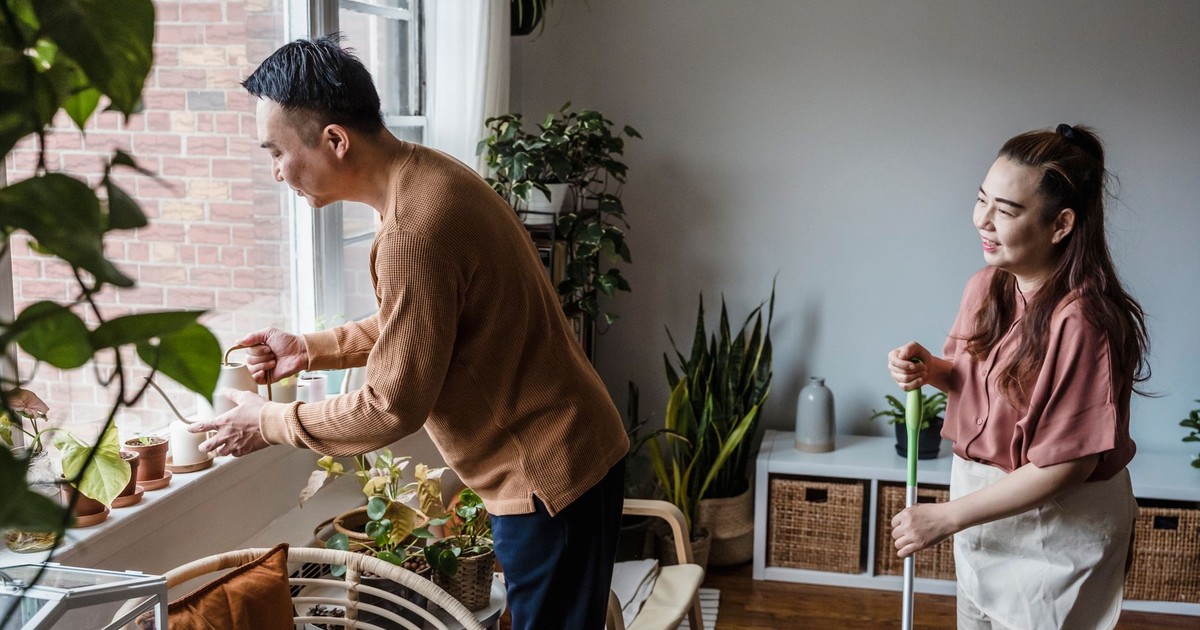
Few things in a marriage generate more low-grade resentment than the feeling that you’re doing more than your share and your partner either hasn’t noticed or doesn’t care. The reverse is also true: being married to someone who is perpetually tracking the ledger, announcing their contributions, and documenting yours, is its own kind of exhausting.
Intimacy researchers consistently identify mutual contribution as one of the most proximal predictors of long-term marital satisfaction, given its role in fostering emotional closeness and what gets called dyadic resilience, basically, the shared capacity to absorb difficulty together rather than separately. Sustaining that over decades is genuinely hard, particularly as the balance of who carries what shifts across different stages of life. The couples who tend to maintain it are often the ones who’ve developed a flexible, unspoken understanding of contribution. Not perfect equality at every moment, but a shared sense that both people are in it and both people are carrying it.
A wife who picks up the slack when you’re struggling without announcing it. Who doesn’t catalog every school run, every dinner made, every difficult phone call handled. Who trusts that the marriage will even out over time because both of you are trying, rather than treating every week like an audit. That absence of scorekeeping is a form of generosity that makes the whole structure of daily life lighter.
10. She Makes the Marriage a Conscious Choice, Repeatedly
The marriages that last decades with genuine warmth in them are almost never ones where both people just got lucky and never felt the pull of anything else. They’re ones where someone kept choosing. Not dramatically, not every day with a speech about commitment. But in the ordinary repeated decisions about where to invest attention, energy, and care.
Relationship researchers identify nurturing fondness and admiration as essential for a strong, resilient marriage, maintaining a sense of respect and appreciation for one another through the inevitable ups and downs of a shared life. A wife who actively practices that, who doesn’t allow the familiarity of marriage to become indifference, is making the relationship a living thing rather than an arrangement.
She’s the one who still makes a plan for your anniversary rather than treating it as another Wednesday. Who reads something interesting and sends it to you because she thought of you specifically when she found it. Who, when the marriage hits a genuinely hard stretch, says “what do we do about this” rather than retreating into silence or threat. That orientation toward the marriage as something worth protecting and tending is not a trait some people are born with and others aren’t. But some people have developed it, and it changes everything about what being married to them feels like.
Read More: 15 Signs of a Good & Caring Husband That Every Girl Should Know
What You’re Actually Describing
The thread running through all ten of these wife habits in marriage is that none of them are about being easier to live with in a superficial sense. They’re not about being agreeable, conflict-free, or always in a good mood. Several of them are actually harder than their opposites. Saying what you mean is harder than being indirect. Repairing after a conflict is harder than winning it. Maintaining your own life is harder than merging completely.
What they share is a certain kind of intentionality. A wife with these habits is someone who is paying attention to the marriage as a thing that exists between two people, not just as a backdrop to individual life. She keeps choosing it, in the gratitude she expresses, in how she handles conflict, in the curiosity she keeps alive about her partner. Some of these patterns go back further than the marriage does. A woman who has done the work of understanding herself, of learning how to repair, of developing the discipline to express what she needs rather than hoping it gets noticed didn’t arrive at those habits by accident. And the research keeps confirming what people in good marriages already know: the daily habits are where the whole thing either holds or doesn’t.
Disclaimer: This information is not intended to be a substitute for professional medical advice, diagnosis, or treatment and is for information only. Always seek the advice of your physician or another qualified health provider with any questions about your medical condition and/or current medication. Do not disregard professional medical advice or delay seeking advice or treatment because of something you have read here.
AI Disclaimer: This article was created with the assistance of AI tools and reviewed by a human editor.