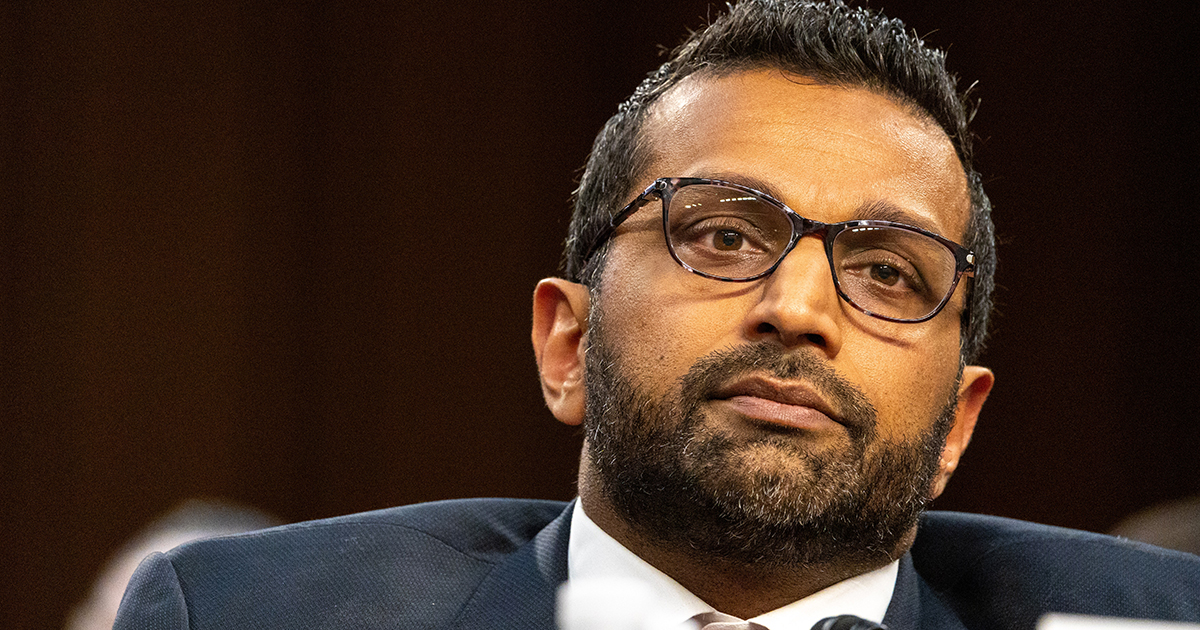

Before FBI Director Kash Patel flew to Milan in February 2026, he told reporters almost nothing about his plans. What they got instead was a viral video: Patel in the Team USA men’s hockey locker room after the Winter Olympics gold medal game, beer in hand, jersey on, celebrating in a way that looked far less like official business and far more like a very well-connected fan’s dream trip. The FBI’s explanation was that he was there in an official capacity. But the image lodged itself in the public imagination, and the questions that followed it have not gone away.
By July 2026, those questions had grown into a formal bipartisan congressional investigation. Not just Democrats firing letters across the aisle, but one of the most powerful Republicans in the Senate quietly demanding answers of his own, before his colleagues on the other side even knew he’d asked.
The pattern of Kash Patel spending scrutiny has built steadily since he took office in February 2025: travel perks, luxury vehicles, bonus payments to political allies. Each episode has been dismissed by the FBI as routine, legal, and mischaracterized. But the accumulation of those episodes, and the fact that a senior Republican has now broken from the public defense line, is harder to wave away.
The Letter That Changed Things

Senate Judiciary Chair Chuck Grassley asked FBI Director Kash Patel to defend his use of FBI aircraft and his purchase of BMW vehicles, in a letter obtained by CNN. The powerful Republican chairman was conducting his own oversight of Patel’s controversial spending of taxpayer dollars.
In the May 5 letter, Grassley asked Patel to list each flight he took on an FBI aircraft, share their cost, and whether the flights were for personal or official purposes, and if any flight was personal, whether Patel had reimbursed the government. FBI directors are required by a post-9/11 regulation to use government aircraft for all travel, personal trips included. The justification is national security: the president needs to be able to reach the FBI director at any moment. Reimbursing the government at the commercial airfare rate equivalent is the standard way of distinguishing personal from official travel.
Grassley gave Patel a voluntary deadline of May 19 to respond. He framed his inquiry in terms of principle rather than politics. “For decades, regardless of which political party is in the White House, I have worked to ensure that taxpayer dollars are protected from waste, fraud, and abuse,” Grassley wrote. When Democrats seized on the letter after it became public, Grassley pushed back at their framing, saying on X that his oversight was consistent across administrations, unlike what he characterized as selective Democratic interest.
His letter mirrored Democratic concerns almost point for point. Rep. Jamie Raskin of Maryland and Sen. Dick Durbin of Illinois, the top Democrats on their respective Judiciary committees, confirmed they had launched a formal investigation into Patel’s use of public resources. The pair said in a press release that they had obtained Grassley’s May letter, in which he “raised serious concerns” about Patel’s “use of government aircraft, his purchase of a fleet of luxury BMW vehicles, and whether he has reimbursed taxpayers for personal travel.”
A Gulfstream, Some BMWs, and a Snorkeling Excursion
Raskin and Durbin accused Patel of repeatedly seeking “special perks” while traveling on official business, citing reports that he requested a taxpayer-funded helicopter tour in East Asia, participated in jet skiing and a VIP snorkeling excursion around the sunken USS Arizona in Hawaii, and used an FBI aircraft to attend the Winter Olympics in Milan, where he celebrated with the U.S. men’s hockey team after its gold medal victory.
The Pearl Harbor episode is particularly vivid. The letter from Democrats references an incident when Patel was allowed by the military to take a VIP snorkeling trip in Pearl Harbor around the wreckage of the USS Arizona, where 1,177 sailors and Marines aboard the battleship were killed on December 7, 1941. The excursion was first reported by the Associated Press and confirmed by Patel’s spokesman, who defended it as “a historical tour to honor heroes who died.” Raskin and Durbin wrote in their letter: “Your VIP snorkeling experience in Hawaii was not an isolated incident.”
The BMW controversy began in December 2025, when the FBI confirmed it had purchased several armored BMW X5 SUVs for Patel’s personal use, breaking with the Suburban fleet used by his predecessors. Patel reportedly ordered the purchase believing the BMWs would be “less conspicuous” than the traditional Chevrolet Suburbans. Patel’s spokesman said the move saved the government money, but declined to release documents substantiating that claim, later adding that the BMWs had previously been purchased by the State Department and were “sitting idle and unused in their warehouse.”
Grassley’s letter pointedly asked Patel to “explain why you decided to purchase BMW vehicles instead of Chevy Suburbans.” The FBI’s public response leaned on the cost savings argument, but without documentation. For lawmakers trying to do independent oversight, an assurance without a paper trail is exactly the kind of thing that turns a curiosity into a formal investigation.
Whistleblower accounts add to this picture. A source told Raskin and Durbin that Patel was overheard telling FBI field staff: “If you have golf, hockey, fishing, or hunting and beautiful sights, you’re going to see a lot of me.” The lawmakers wrote that Patel “demoted personnel in Brussels because they failed to ensure you were adequately entertained,” adding the pressure “may have led to the resignation” of the FBI’s head of international operations. The FBI denied that personnel actions were connected to entertainment demands.
Democrats accused Patel of opening an FBI attaché office in Wellington, New Zealand, “in part to justify a sightseeing trip you took there.” The FBI did not address that specific allegation in its public responses.
The Bonus Allegations

The travel disputes were already unresolved when a separate controversy surfaced in June 2026. According to a June 2026 Forbes report, Raskin accused Patel of operating a “personal slush fund” for “loyalist MAGA henchmen,” alleging Patel used the FBI’s bonus fund to make approximately $1 million in payments to members of the FBI chief’s Director’s Advisory Team, as well as agents on Patel’s security detail.
House Judiciary Democrats launched their bicameral investigation on July 9, 2026, citing both the travel and bonus concerns. Democrats said agents received bonuses of roughly $8,000 every two-week pay period for five consecutive payments. Raskin said the committee could confirm that Patel had depleted the FBI’s reserve accounts for bonus payments fast enough to cause some payments to bounce back from exhausted accounts.
Raskin said that information received by the committee showed Patel’s office issued recurring bonus payments to agents on his “Director’s Advisory Team” and members of his security detail, payments that in some cases exceeded statutory pay limits. That internal unit was formed in 2025 to examine the conduct of federal law enforcement officials who had investigated President Trump and his allies.
The FBI did not respond to an initial request for comment on the bonus allegations. Patel has denied all wrongdoing across the board. His spokesman Ben Williamson said Patel’s travel has been “fully consistent with Executive Branch requirements and policies that extend over decades across all Administrations,” and claimed Patel has reimbursed all personal travel and expenses in keeping with Office of Management and Budget rules — an assertion Grassley’s letter treated as unverified, demanding that Patel provide records proving any such reimbursements and asking point-blank: “If yes, provide all records.”
The Irony That Won’t Go Away
Before becoming FBI director, Patel himself criticized the use of the FBI plane by his predecessor Chris Wray, suggesting it should be grounded. “Chris Wray doesn’t need a government-funded G-5 jet to go to vacation,” Patel said on Glenn Beck’s podcast in 2024. “Maybe we ground that plane, $15,000 every time it takes off.” He is now the one flying on it. The same rules that applied to Wray apply to Patel, and the FBI has maintained that Patel follows them to the letter.
The FBI pushed back in bulk on the July 9 Democratic letter, calling the allegations “completely false” and pointing to what the Trump administration has “expressly promised Americans” about cracking down on waste, fraud, and abuse of government spending. The FBI also shared an infographic on X detailing Patel’s “personal travel and cost savings,” claiming he had taken fewer trips than former FBI Directors Christopher Wray and James Comey.
In April 2026, The Atlantic published a report alleging a pattern of “erratic behavior and excessive drinking” and frequent absences from the FBI. Patel forcefully denied those allegations and, as CNBC reported, filed a $250 million defamation lawsuit against the outlet. The Atlantic called the suit “meritless” and said it stood by its reporting. Separately, Patel has faced allegations of directing SWAT personnel to protect his girlfriend, country musician Alexis Wilkins, and using the FBI jet for personal trips to attend her performances.
What’s Actually at Stake
The technical rules around FBI director travel are not really the point. Patel is legally required to fly on government aircraft, and he says he reimburses the government correctly. Whether that reimbursement is adequate, whether individual trips were genuinely official or personal, whether bonus payments crossed statutory limits are questions that investigators with subpoena power could answer. Democrats on the minority side of the Judiciary committees don’t currently have that power.
Democrats currently have no authority to compel document production, but would gain it if they retake the House in the fall. Until then, the investigation is largely a political and reputational exercise: letters requesting information that Patel’s office can decline to provide, hearings where Democrats ask pointed questions and the FBI pushes back with its own statistics.
Grassley’s involvement is harder to contain. His oversight request was not a press release. It was a private letter, sent in May, demanding specific records: flight logs, cost breakdowns, BMW purchase justifications. When that letter became public and Democrats folded it into their own investigation, Grassley’s response was to defend the independence of his inquiry rather than the innocence of Patel. Patel has previously called Grassley a consistent defender of his work, and Grassley has said as much. But the senator has emphasized that Congress needs the information to conduct an “independent and objective review.”
An FBI director who once called for grounding the government jet, who now uses it, is a story. An FBI director whose own party’s most powerful oversight senator is quietly demanding flight logs and car purchase records is a different one. Whether the investigation produces consequences depends on who controls the House after November. What it has already produced is a paper trail.
The Part That Doesn’t Resolve Neatly

Oversight investigations launched by the minority party rarely end with a dramatic reckoning. They tend to end with an election. If Democrats retake the House in November, subpoenas become possible and documents that Patel’s office has so far declined to produce could be compelled. If Republicans hold the House, the investigation stays exactly where it is: a stack of unanswered letters and a set of allegations that the FBI calls false.
What’s already in the record doesn’t disappear regardless of the outcome. The Grassley letter is real. The bonus allegations have been formally transmitted to Patel in writing. The Pearl Harbor snorkeling trip happened and was confirmed by Patel’s own spokesman. The BMW purchase happened. The Milan trip happened. The FBI’s position is that all of it was legal, reimbursed, and within policy, and that may be entirely true. But “legal and within policy” is not the same as “appropriate for the director of the most powerful law enforcement agency in the country.” Patel once built a political brand on holding that standard. The question now is who holds it for him.
AI Disclaimer: This article was created with the assistance of AI tools and reviewed by a human editor.