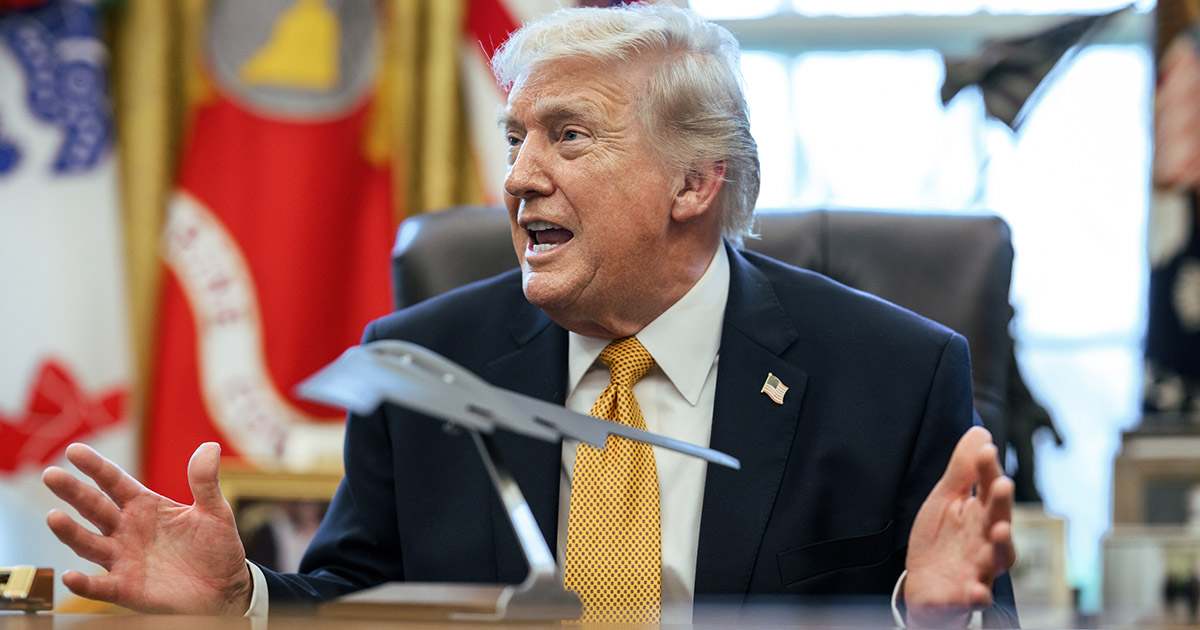

The argument that keeps repeating in Washington’s diplomatic circles isn’t about ideology or trade policy. It’s about what happens in the room when something doesn’t go the president’s way.
During French President Emmanuel Macron’s visit to the White House in February 2025, about two weeks into Trump’s second term, the two leaders were attempting to dial into a group video call led by then-Canadian Prime Minister Justin Trudeau. Technical difficulties prevented Trump from speaking on the call. In response, he threw the tablet he’d been using over the Resolute Desk and onto the floor. Macron, head of state of a nuclear-armed NATO member, was sitting in the room.
The White House offered no comment when the story emerged. It didn’t come from opposition researchers or from hostile journalists working off secondhand tips. It came from an official who was present, speaking as part of a months-long investigation into the state of America’s relationships with its closest democratic allies since Trump returned to power.
The Incident: What the Report Says
A Wall Street Journal investigation published in July 2026 laid out the specifics: Trump and Macron were using the electronic device to join a call led by Trudeau when they encountered tech problems. Unable to speak on the call, Trump lobbed the device over the Resolute Desk and onto the floor, an official who was present told reporters. Neither the White House nor Trump commented on the account.
The outburst is documented as one episode inside a far larger story about European leaders scrambling to manage an increasingly unpredictable U.S. president. The investigation drew on classified assessments from European intelligence agencies and detailed notes taken by participants at multiple gatherings. One assessment from a southern European intelligence service reportedly described the challenge plainly: officials were not dealing with an administration that had processes, but with “a single volatile individual.”
A Separate, Equally Tense Call With Trudeau
The tablet-throwing incident is distinct from a heated phone call between Trump and Trudeau in early March 2025. That call, over the 25% tariffs the Trump administration had imposed on Canadian goods, grew heated and included profanity from Trump, according to the same investigation. The discussion, which lasted 50 minutes, was characterized by Trudeau publicly as a “colorful call” but also “very substantive.” Behind the diplomatic gloss, the sourcing told a different story. Trudeau had tried to contact Trump the Monday night before the tariffs were set to take effect. Trump did not take that call.
Trudeau resigned as prime minister in January 2025 and was succeeded by Mark Carney in March. The sequence of events captures the texture of the U.S.-Canada relationship during the opening months of Trump’s second term: a missed call, a heated exchange over tariffs, a separate episode where a tablet sailed over the Resolute Desk.
The Broader Context: European Leaders in Crisis Mode
In January 2026, close to 30 European heads of government met for a fraught midnight session in Brussels to plot a future free from security and economic dependence on the U.S. Attendees gathered without aides and took precautions to keep the meeting private. One leader present compared it to group therapy. Heads of government of sovereign nations gathered at midnight to discuss survival in what functioned as a diplomatic pressure-release valve.
The trigger for that gathering was not purely the tablet incident, but the broader catalogue of Trump’s behavior. The meeting came after Trump threatened to use military force to take Greenland, an autonomous territory of NATO member Denmark. NATO’s own survival was now openly on the agenda in capitals that had never had to consider that question before.
“Flattery Diplomacy” and the Art of Managing Trump
NATO Secretary General Mark Rutte, who has been referred to as the “Trump whisperer,” worked to salvage the American-led alliance by praising Trump, a tactic the European press coined “flattery diplomacy.”
The approach was systematic. Rutte leaned heavily on praise and even mimicked Trump’s signature style of texting in all-caps, an effort that left other world leaders jokingly referring to him as “an actor who never broke character.”
Finland’s president and Norway’s prime minister are understood to have traded notes on how to word their texts to Trump, down to which phrase to write in capitals. Norway’s leader, Jonas Gahr Støre, has at times had his Finnish neighbor, Alexander Stubb, hit send on messages instead, cautious that name-checking his own country might retrigger Trump after the president’s failure to secure himself the Nobel Peace Prize.
The linguistic contortions extended into substantive policy framing. European Commission President Ursula von der Leyen started calling economic sanctions on Russia “tariffs” after Trump expressed his disapproval of her push to penalize Moscow over the war in Ukraine. When Trump echoed Russian President Vladimir Putin’s concerns about a ceasefire in Ukraine, European leaders began framing their peace plan as a move to “stop the killing” rather than a ceasefire, to match Trump’s language.
When Flattery Stopped Working
By late last summer, the flattery diplomacy had gone stale when a group of leaders visited the White House to try and forge a peace deal for Ukraine. During that meeting, the leaders concluded they wouldn’t be able to get Trump to support the Western position on Ukraine or any other policy. One person present at the meeting described it as “an excruciating experience” that signaled how little influence America’s allies retained over the current administration.
The Zelenskyy Confrontation: A Pattern Made Public
The tablet incident occurred behind closed doors, but Trump’s confrontational behavior toward foreign leaders was also playing out in full view of the cameras. On February 28, 2025, Trump, JD Vance, and Volodymyr Zelenskyy held a highly contentious bilateral meeting televised live in the Oval Office, intended to discuss continued U.S. support for Ukraine and expected to conclude with the signing of a mineral resources agreement, but it ended abruptly and without a clear resolution.
During the meeting’s final ten minutes, Trump and Vance repeatedly criticized Zelenskyy, at times drowning out his voice. Media outlets described it as an unprecedented public confrontation between an American president and a foreign head of state.
Trump told Zelenskyy, “You’re not acting at all thankful” for the support Ukraine had received from the United States, adding that the Ukrainian leader had been disrespectful and telling him, “You’re gambling with World War III.”
The signing of a key minerals agreement with Ukraine and a scheduled news conference were abruptly canceled and the Ukrainian leader’s visit cut short after the meeting descended into insults and chaos. NBC News reported that Trump and other U.S. officials asked Zelenskyy to leave the White House. Zelenskyy abruptly departed, and a planned joint news conference was called off.
A March 2025 Economist/YouGov poll found that 51% of Americans felt Trump was disrespectful toward Zelenskyy, while 32% felt Zelenskyy was disrespectful toward Trump.
Both episodes show the same pattern: a president whose frustration escalates into confrontation, with allied leaders left to manage the fallout.
A Documented History of Outbursts
Former White House aides have previously described episodes involving shouted outbursts, profanity, and objects being thrown when meetings or conversations didn’t go as planned. The reporting on the Trump tablet Oval Office incident suggests those episodes have continued into his second term.
The Oval Office has not been the only stage. In April 2025, Trump threw a tantrum during a press availability, repeatedly berating CNN anchor Kaitlan Collins and launching into a familiar rant against the network. Trump grew irritated as Collins pressed him on why he had refused to bring home a Maryland man wrongfully deported to El Salvador, snapping at her mid-question: “How long do we have to answer this question from you?”
The pattern across these incidents is consistent whether the object is a journalist’s question, a foreign leader’s pushback, or a tablet that won’t connect to the right call: frustration at being blocked or questioned, an immediate escalation, and no apparent concern for the audience watching.
The Alliance in the Balance
The investigation lands at a moment when the structural architecture of the post-World War II Western order is under genuine stress. NATO members held meetings to discuss whether the alliance could survive without the U.S., with crunch talks sparked by Trump’s threats to leave amid his sweeping retaliatory tariffs and his threats to invade Greenland.
Then-presumptive German Chancellor Friedrich Merz proposed a significant increase in defense spending in Germany, citing the “rapidly changing situation,” especially after the clash between Trump and Zelenskyy in the White House. In March 2025, German lawmakers approved an amendment to the Basic Law, allowing the government to implement the most massive rearmament in Germany since World War II. By June 2025, NATO allies had agreed at the Hague Summit to increase their annual defense-spending target to 5% of GDP by 2035, a concession on an issue Trump had pushed for years.
Allied nations are rearming on a scale not seen since 1945, partly as a direct response to uncertainty about whether the United States will still show up. A tablet thrown over the Resolute Desk is not itself a geopolitical event. But it is the human detail that makes the larger story legible.
What This Actually Means
The Trump tablet Oval Office incident is best understood not as an isolated story about a gadget and a bad connection, but as a documented data point in a much longer record. Sourced to officials who were present and cross-referenced against months of diplomatic behavior by allied governments, the reporting describes a president whose frustration with being blocked or circumvented produces rapid escalation, regardless of who is in the room.
For European and Canadian leaders, the practical implication has already been absorbed: the old rules of allied diplomacy, built on shared assumptions and mutual respect between offices, no longer apply. The playbook has been rewritten around managing one man’s reactions: carefully worded texts, deliberately adopted language, secret midnight crisis sessions, and leaders trading notes on which words to put in capital letters.
Whether the tablet survived the encounter is not reported. What survived, and what the investigation put on the record, is a detailed account of how the most powerful office in the world is being managed from the inside out, by allies who have concluded that patience and careful wording are now the primary tools of transatlantic diplomacy. Some of these patterns go back to the first term. But naming them openly, in classified assessments and sourced investigations, is new. That’s usually where the harder conversation starts.
AI Disclaimer: This article was created with the assistance of AI tools and reviewed by a human editor.