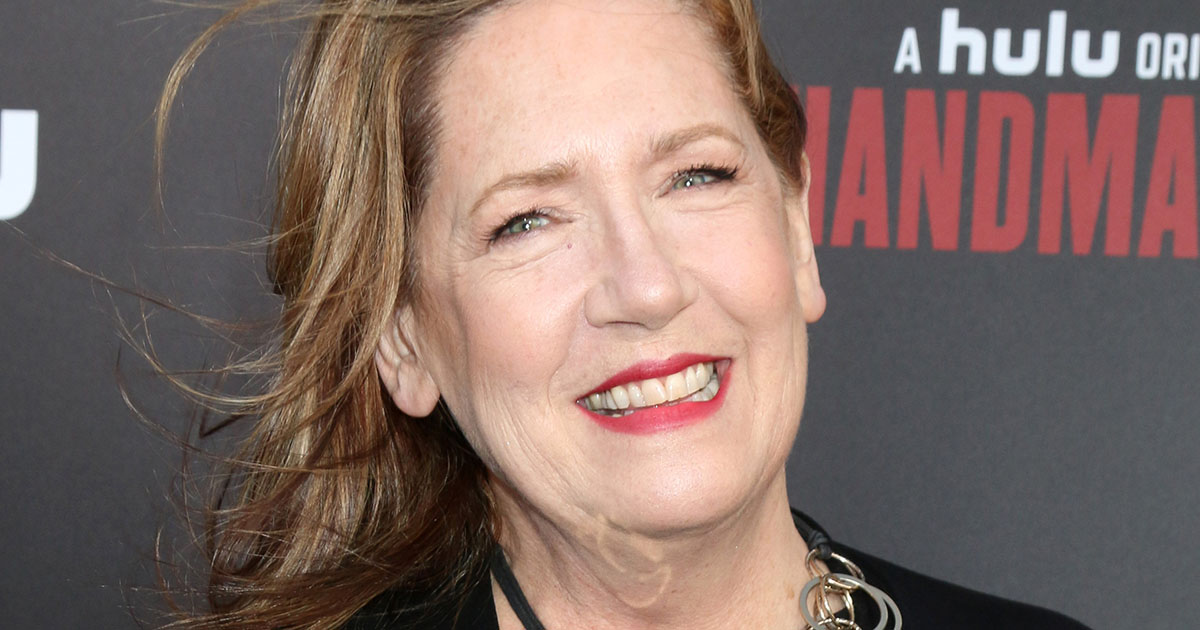
Two women were in the middle of building a dystopia when the real world caught up with them. Ann Dowd and Elisabeth Moss were six months into filming The Handmaid’s Tale on a Toronto soundstage when Donald Trump won the 2016 presidential election. The show they were making, about a theocratic America in which women are stripped of rights and forced into reproductive servitude, had not yet aired. The phrase that would become its resistance motto had not yet entered popular culture. And yet the morning after the election, Moss texted Dowd that exact phrase, in Latin, before either of them had faced a single interviewer about what the show meant.
Dowd has now spoken publicly about that text exchange in candid terms, recalling the moment during a 2026 appearance on Jesse Tyler Ferguson’s podcast Dinner’s On Me, recorded at the Peninsula Hotel in Beverly Hills. The conversation ranged across her career, her return to the role of Aunt Lydia for the sequel series The Testaments, and how the world had shifted since The Handmaid’s Tale first premiered. But it was her account of that November morning nine years ago that has generated the most attention.
The detail that keeps people stopping is not just that Moss reached out. It’s what she wrote.
What Ann Dowd Revealed on Dinner’s On Me
Dowd recalled the night of the 2016 election in stark terms: “He had just been elected. I remember when we were shooting early on… that night before he was elected, I remember thinking, ‘This can’t be. This is going in the wrong direction.'”
She went to bed without watching the final ballot counts come in, unable to take any more of it. The next morning brought no relief. She opened her front door to find The New York Times on the floor, announcing Trump’s win. Her instinct was immediate: reach out to the woman she was spending her working days alongside, the actress who was literally embodying resistance to authoritarian oppression on a Hulu set in Toronto.
Dowd texted Moss and said, “What are we going to do? This can’t be.” Moss wrote back: “Don’t let the bastards grind you down.”
That alone would have been a striking detail. But Moss didn’t write it in English. She wrote it in Latin. The phrase she used was “Nolite Te Bastardes Carborundorum,” the line that would become the resistance motto of the show’s fictional underground movement.
The timing was remarkable: the show hadn’t yet aired, the phrase hadn’t yet entered popular culture, and yet here were the two lead actresses of a dystopian series about women fighting back against a totalitarian government, using that very show’s rallying cry to brace themselves against a real-world political result. One woman reaching to another because she couldn’t think of who else to call.
The Phrase Itself: A Joke That Became a Symbol
“Nolite te bastardes carborundorum” is, technically speaking, a phrase that means nothing. It’s a made-up expression in mock Latin, what linguists call a “schoolboy’s joke,” and if it were real Latin, it would roughly translate to “don’t let the bastards grind you down.”
The phrase first appeared in Atwood’s 1985 novel, though it isn’t actual Latin. It’s a riff on the older mock-Latin saying “illegitimi non carborundum,” generally translated as “don’t let the bastards grind you down,” where “carborundorum” is derived from carborundum, an English industrial grinding abrasive, not a Latin root at all.
Atwood told Time magazine that the phrase long predated the novel. “It was a joke in our Latin classes,” she said. “So this thing from my childhood is permanently tattooed on people’s bodies.”
In the show’s first season, the phrase appears carved into the closet wall of the room where June, Moss’s character, is held captive. It was left there by the handmaid who occupied the room before her. When June finally worked up the nerve to ask Commander Waterford what the words meant, he translated them for her. That scene gave the phrase its emotional anchor within the narrative: a message passed between women across time, in a place where women had no other means of communication.
In Atwood’s novel, the handmaid Offred finds the words graffitied at the bottom of her wardrobe by a previous handmaid, a protest against Gilead’s patriarchal regime. The phrase went on to become a feminist slogan, frequently seen on placards at women’s rights protests alongside the red dresses and white bonnets of the handmaids’ costume.
The fact that Moss knew it cold, knew it in its mock-Latin form, and reached for it the morning after the 2016 election says something about how deeply both actresses had already absorbed the world they were building on screen.
A Show Born Into Political Turmoil
The Handmaid’s Tale premiered just three months after Trump was inaugurated in January 2017. The proximity was not lost on anyone watching. The hierarchical dystopia of Gilead, in which fertile women are forced to bear children for upper-class couples, resonated powerfully with those alarmed by the administration’s attacks on civil liberties and ongoing legislative efforts to strip federal funding from reproductive health organisations, and the handmaid’s uniform became a provocative costume for activists protesting the rollback of women’s rights.
Women’s rights activists began cosplaying as handmaids at political protests within just three weeks of the show’s premiere, and the trend continued through subsequent events, including Brett Kavanaugh’s 2018 Supreme Court nomination hearing, where it became a viral phenomenon.
Ann Dowd played Aunt Lydia Clements across the full run of the series from 2017 to 2025, winning the Primetime Emmy Award for Outstanding Supporting Actress in a Drama Series for the role. Elisabeth Moss, who won an Emmy Award for Outstanding Lead Actress in a Drama Series in 2017 for the role of June, also won that same year as a producer of The Handmaid’s Tale for Outstanding Drama Series.
The two women’s bond went far deeper than professional respect. Moss has said that she and Dowd developed “a very deep and meaningful friendship” before the later seasons of the show, describing Dowd as “like a soulmate” to her. That November 2016 text exchange reads differently against that backdrop – not co-workers being collegial, but something closer to the way you’d text your closest friend on a terrible morning.
Ann Dowd and the Character She Couldn’t Let Go
There is a particular complexity to Dowd’s position in all of this. While Moss was playing June, the show’s moral center and its avatar of resistance, Dowd was playing Aunt Lydia: the woman who disciplines the handmaids, enforces Gilead’s rules, and in the early seasons at least, does the regime’s cruelest work with apparent conviction. Dowd’s character oversaw the handmaids; Moss’s June was a mother trying to escape to Canada with her husband and daughter.
Dowd played Aunt Lydia for six seasons, describing the role as “a complete gift,” while also acknowledging that her character had “done wrong things and awful things.” She told The Daily Beast‘s Obsessed podcast that she was “stunned” by the revelations about Lydia in The Testaments, and “deeply grateful because boy did it answer some questions.”
Every public reflection Dowd has given on the show carries that same tension: eight years inhabiting a woman who represented the worst of institutional compliance, while simultaneously processing, off camera, a political reality that the show was being used to resist. On the Dinner’s On Me podcast, Dowd reflected not only on returning to the role for The Testaments but also on how the world had shifted since the show first premiered, and she discussed the story of a prediction that kept her going through years of professional struggle before the show brought her wide recognition.
The Testaments: Gilead Continues
The Handmaid’s Tale aired its final episode in May 2025, and in April 2026, its sequel series The Testaments began streaming on Hulu. Created by Bruce Miller, The Testaments premiered with its first three episodes and runs for 10 episodes in its inaugural season. Based on Margaret Atwood’s 2019 novel of the same name, the series is set in the dystopian theocracy of Gilead years after the events of The Handmaid’s Tale, and follows two teenage girls: the devout Agnes and Daisy, a recent arrival from Canada whose presence begins to unravel long-buried truths.
The show’s creator, Bruce Miller, said the new series wouldn’t just be a repeat of the original, aiming for “younger voices” and “a completely different feel and a completely different vibe, but it’s still Gilead.” The new series follows those two teens as they move through Aunt Lydia’s prep school for future wives, with Ann Dowd reprising her role alongside newcomers Chase Infiniti and Lucy Halliday.
Moss, who serves as executive producer on The Testaments, has spoken about Dowd’s performance in the final stretch of the original show: “The vulnerability that I think Ann brings to this season, it’s always been there… but I don’t know of anyone else who could do it the way that she did it.”
Dowd has said that her last day on The Handmaid’s Tale “was wonderful, and then at the end I just cried,” adding that “saying goodbye is another matter” and that she counts herself “very fortunate” to continue in the Gilead universe.
Read More: 7 Psychological Reasons People Prefer Texting Over Calling
What the Text Actually Tells Us
The Ann Dowd and Elisabeth Moss text exchange has been reported as a feel-good story about co-stars supporting each other, and it is that. But it’s also something more specific about the way The Handmaid’s Tale arrived in the world.
Most television dramas are made in careful insulation from the political moment. They air, they get reviewed, they attract an audience or they don’t. Hulu’s adaptation of The Handmaid’s Tale was not originally envisioned as contemporary political commentary. It became that anyway, because history moved fast enough to catch it. By the time Dowd picked up that newspaper off her floor in November 2016, she and Moss were already six months into building Gilead on a Toronto soundstage. The world they were dramatizing had started, in some ways, to look like the world outside.
Moss’s choice to respond in Latin, using the show’s own language of defiance, suggests she understood that even then. Whether she intended it as dark humor, genuine solidarity, or something between the two, it landed as a kind of commitment: we keep going, we finish the show, and we say what it needs to say. That the phrase Moss reached for that morning went on to become a feminist rallying cry used at real Senate hearings is either deeply satisfying or deeply unsettling. Probably both, at the same time, without one canceling the other out.
Dowd has been playing Aunt Lydia for nearly a decade now. The character enforces oppression with conviction, right up to the point in The Testaments where she finally, irreversibly, does not. That arc has been Dowd’s too. Not in the sense of complicity, but in the sense of someone who spent years inhabiting the thing she feared, night after night on a set, and texted her friend on the worst morning of that particular year to ask: what are we going to do? The answer that came back is the one she’s been performing ever since.
AI Disclaimer: This article was created with the assistance of AI tools and reviewed by a human editor.