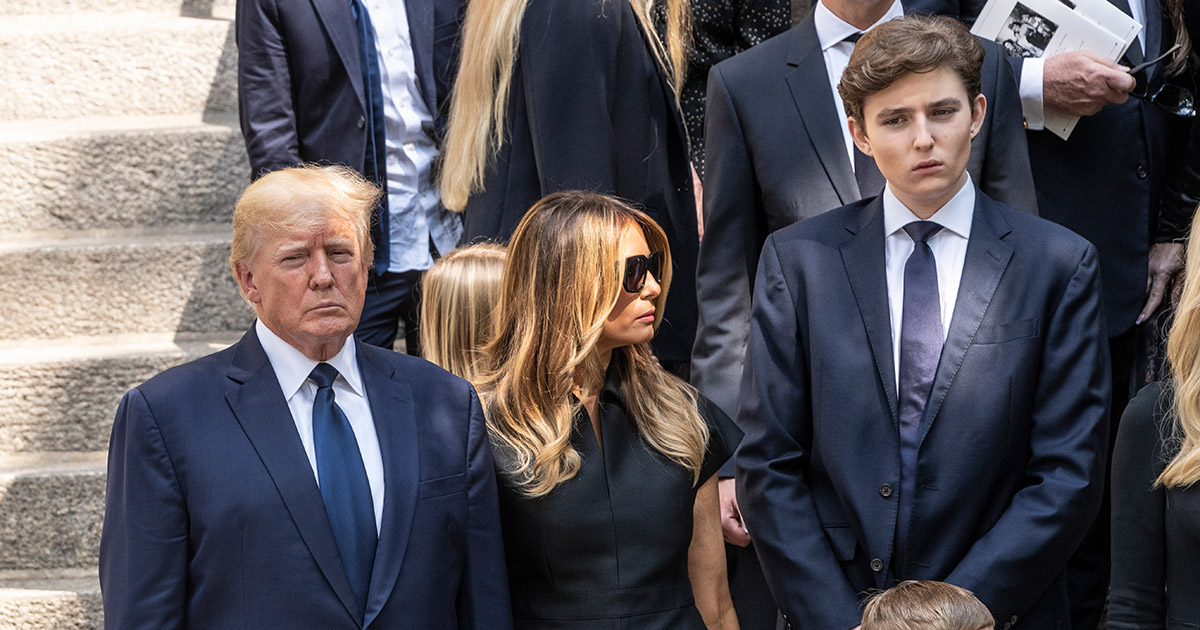

Most nicknames for a president’s children come out during a campaign rally or a friendly interview. This one came out of a private phone call, in a moment of genuine fear, and it only became public because two journalists spent years inside the Trump White House documenting what happened when no cameras were rolling. The word was “honey.”
That single word, reportedly spoken by Donald Trump to his son Barron after the assassination of Charlie Kirk in September 2025, is the detail from Maggie Haberman and Jonathan Swan’s book that keeps resurfacing in conversation. Not because it’s politically significant, but because it’s so plainly human. A father telling his panicking son to calm down, and reaching for a term of endearment that no one outside their family had ever heard him use.
For a family that has conducted almost every aspect of its life in front of cameras and crowds, it’s a rare glimpse at something unguarded. And for Barron in particular, a young man who has managed to remain almost entirely private despite growing up in the most public household in the country, it fills in a corner of the picture that most people hadn’t seen.
What the Book Reveals About the Trump Barron Nickname
Regime Change: Inside the Imperial Presidency of Donald Trump, co-authored by New York Times reporters Maggie Haberman and Jonathan Swan, is a 496-page account published by Simon & Schuster covering Trump’s first year back in office as an unconstrained leader. Among the details it contains is a private exchange between Trump and Barron following Kirk’s death, in which Barron called his father in a state of panic, worried that Trump would be “targeted again” after the July 2024 assassination attempt in Pennsylvania.
The fear had a specific shape to it. Kirk, like Trump, loved to speak in front of large crowds and had been doing exactly that when he was shot. Barron, then 19 years old, urged his father to reconsider his public appearances. Trump responded, “Calm down, honey, calm down,” and was reportedly unnerved himself. The Trump Barron nickname revealed in the exchange, “honey,” carries a different register from what had previously been reported. As Barron was growing up, Trump had called him “little boy,” while Melania reportedly used “little Donald.” Neither of those is the word you reach for when someone you love is frightened and you’re trying to hold them steady.
Who Charlie Kirk Was, and Why Barron’s Call Mattered
To understand the weight of that phone call, it helps to understand who Kirk was to the Trump family and to the political moment surrounding his death.
Charlie Kirk was assassinated at Utah Valley University in Orem, Utah on September 10, 2025, while speaking at an outdoor campus debate planned by Turning Point USA, the conservative youth organization he co-founded and led. Kirk, aged 31, was a close ally of President Trump and a highly influential figure in the MAGA movement. Shortly after the debate began, with around 3,000 people in attendance, Kirk was fatally shot in the neck with a single bullet by a sniper positioned on the roof of a nearby building.
A manhunt for the shooter ended the following day when Tyler James Robinson, a 22-year-old from Washington, Utah, surrendered to the local sheriff. Prosecutors charged Robinson with aggravated murder on September 16 and announced they would seek the death penalty, alleging a politically motivated attack.
Trump expressed his grief and anger in a direct-to-camera video from the Oval Office, saying Kirk had “inspired millions.” Kirk’s assassination followed a series of violent political incidents, including the June 2025 shootings of two Democratic Minnesota legislators and their spouses, the April 2025 arson attack on Pennsylvania governor Josh Shapiro’s residence, and the two assassination attempts on Trump himself in July and September 2024.
Barron had watched all of this unfold alongside his father. When Kirk was killed on a college campus, speaking in front of thousands, the fear that it could happen again to the man he called every few days became very concrete, very fast.
The Invisible Son Who Was Never Invisible
The frantic phone call is consistent with everything else reported about Barron Trump over the past two years: a young man deeply present in his father’s world despite being almost entirely absent from his public one.
After Trump left the White House at the end of the first term, Barron moved to Florida and graduated in 2024 from Oxbridge Academy in West Palm Beach, a private preparatory school for grades 6 through 12. The graduation became a minor political episode, with Trump’s hush money trial judge granting him a day off from court to attend. Trump arrived in a motorcade, sat front row, and stayed for the entire ceremony.
What followed was less expected. Young men’s surge toward Republican voting in the 2024 election was credited in part to Barron’s advice to his father’s campaign about reaching podcasters and online influencers. At an event at Capital One Arena after the inauguration, Trump credited Barron directly with suggesting he appear on The Joe Rogan Experience. The appearance drew an enormous audience and was widely cited as a turning point in Trump’s appeal to younger male voters.
The young man his own mother once described as someone for whom it’s impossible to be a normal student had, without a single public statement or campaign appearance, shaped one of the most consequential communication decisions of the 2024 presidential race.
A Sophomore Year Unlike Anyone Else’s

Barron initially enrolled in NYU’s Stern School of Business in fall 2024, spending his first year commuting between Trump Tower and NYU’s Manhattan campus. Then, for his sophomore year, something shifted.
Barron transferred to New York University’s campus in the nation’s capital ahead of the fall semester of his second year at the school. According to a report from People magazine, the youngest Trump spent his first year commuting between Trump Tower and NYU’s Manhattan campus, but transferred because he was “doing a semester” at NYU’s Washington, D.C. campus, which is near the White House. The D.C. campus hosts only about 60 to 100 of NYU’s 29,000 undergrads.
The D.C. campus is focused on politics, policy, and business, in a city where the curriculum naturally extends beyond the classroom walls. For Barron, the practical benefit is obvious: he can live in the White House, be close to his father during a turbulent presidency, and still maintain a full academic program. The September 2025 phone call is easier to understand in that context. He wasn’t calling from New York. He was, in all likelihood, minutes away.
The Father-Son Dynamic That Most People Miss
One of the things the book does, almost incidentally, is complicate the public image of Trump as a father. His older sons, Donald Jr. and Eric, are fixtures in his political and business world. They appear at rallies, run companies, give interviews. Their relationship with their father plays out partly in public. Barron’s doesn’t.
The book offers rare insight into how Barron reached out immediately after Kirk’s assassination out of genuine fear for Trump’s safety. The exchange that followed was private, unscripted, and unguarded. A president of the United States, reportedly shaken himself, telling his college-age son to calm down and using a term of endearment that no one outside their family had heard before.
Melania Trump previously told Fox & Friends in December 2024 that “I don’t think it’s possible for him to be a normal student.” In hindsight, that reads less like resignation and more like a precise description. Barron’s college experience is not normal. But his relationship with his parents, at least as this book documents it, is something genuinely close.
The “little boy” who grew to 6’7″ and steered his father toward The Joe Rogan Experience is not a footnote in the Trump story. He’s an active, present part of it, just not one that unfolds in front of cameras.
What to Do With All of This
A single word in a private phone call does not rewrite what anyone thinks about Donald Trump’s presidency. But it does add a layer that public life consistently strips away: the fact that behind every political figure is a set of relationships that operate on completely different terms, where the only thing that matters in a given moment is whether the person on the other end of the line is okay.
Barron called his father the day his friend was killed on a college campus because he was scared. Trump said “calm down, honey.” Neither of those things maps onto the versions of this family that tend to circulate in the news. Some of the most telling details about people come out not in front of cameras but in moments of crisis, when there is no time to perform anything. That’s the value of the Haberman and Swan reporting, whatever else the book contains. It caught one of those moments, and it turns out to be the one people keep coming back to.
AI Disclaimer: This article was created with the assistance of AI tools and reviewed by a human editor.