
Just before midnight on a Tuesday in late May 2026, Donald Trump posted three things to Truth Social in the span of sixty seconds. The first was a photo of himself at a rally, captioned “The Greatest Attraction.” The second was a vintage black-and-white image of himself alongside the late Whitney Houston, taken in 1980. The third was a picture of himself in a suit, standing in front of split mirrors creating a kaleidoscopic reflection effect, with the caption “Trump 007.” No context. No explanation. Just eyes emoji from the official White House account the next morning.
Trump has a long history of making flattering comparisons between himself and famous figures, from Elvis Presley and Winston Churchill to, most recently, Jesus Christ. But the James Bond post landed differently, partly because of its timing, and partly because the Bond franchise is genuinely in the middle of a real casting search right now, making the self-nomination feel less like a joke and more like something the President actually wanted people to take seriously. Whether he did is, of course, another matter entirely.
What followed the post was a predictable cycle of mockery, counter-memes, and exasperated commentary. But underneath all of that is a story worth paying attention to: Trump’s relationship with celebrity mythology, his genuine connection to the Bond franchise, and why the internet’s collective eye-roll may be missing the point.
The Post Itself: What Actually Happened
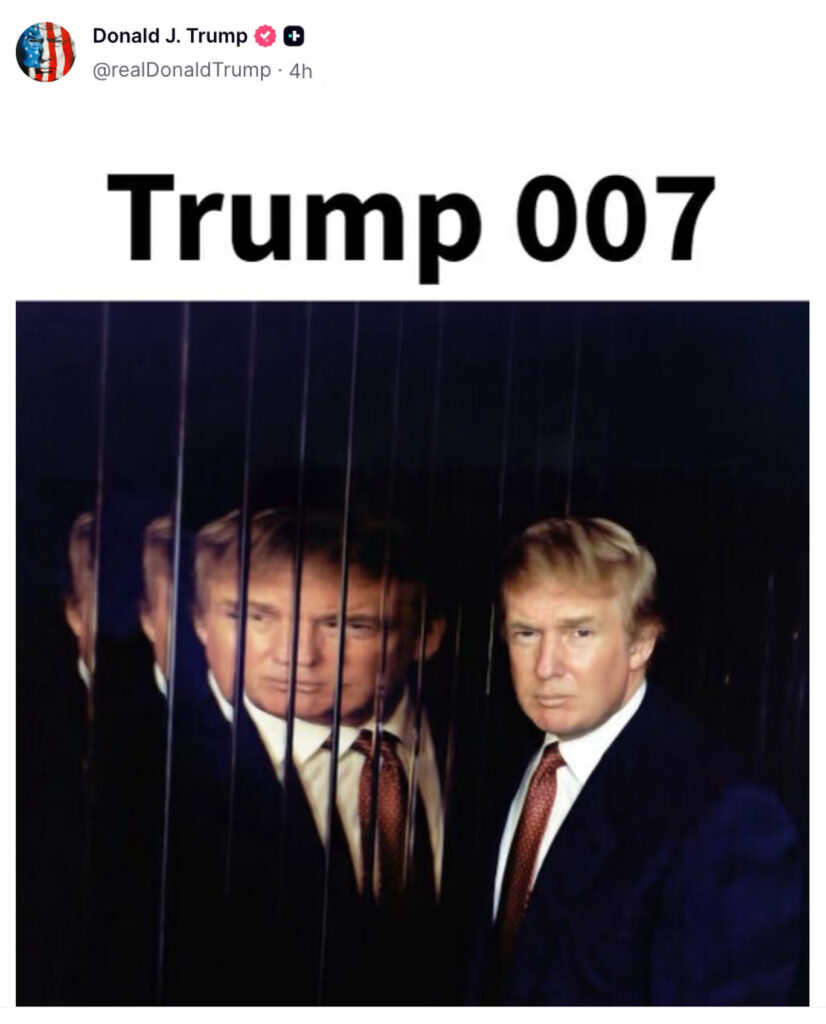
In the space of just one minute late on Tuesday evening, the 79-year-old, who turns 80 next week, published three unusual posts to his Truth Social platform. The first was captioned “the greatest attraction” and displayed an image of himself hosting a rally. The second was a photograph of him alongside Whitney Houston from 1980. And in the third, Trump drew a comparison between himself and James Bond through an image showing him in a suit standing across from split mirrors, accompanied by the caption “Trump 007.”
Trump cast himself in a new ultra-masculine role in this late-night post on Truth Social. The president, who turns 80 in less than two weeks, shared an apparently AI-generated image of himself standing beside a reflective, mirror-like surface that creates multiple versions of his face. The text at the top reads “Trump 007,” directly invoking the James Bond franchise. Trump wears a smart suit and tie, with a serious expression, and the reflections and dramatic lighting hark back to old Bond movies. It is unclear if the president is suggesting that he is a spy or rather a suave sex symbol.
The Bond post was the culmination of a broader posting spree that also saw the president share an old black-and-white photo of himself with Whitney Houston, call himself the “greatest attraction,” and re-share a letter demanding the pardon of a disgraced ex-congressman found guilty of insider trading. Which is an unusually wide range of messaging, even by late-night Truth Social standards.
The White House Joins In
Trump wasn’t the only one playing the Bond card. The White House posted an image on social media of Trump as a silhouetted 007 in a faux movie poster, overlaid with text that says “Make America Great Again.” The caption on the official White House account was simply a pair of eyes emoji, which is either a deliberate wink at the absurdity or evidence that no one in the comms team thought it needed further explanation.
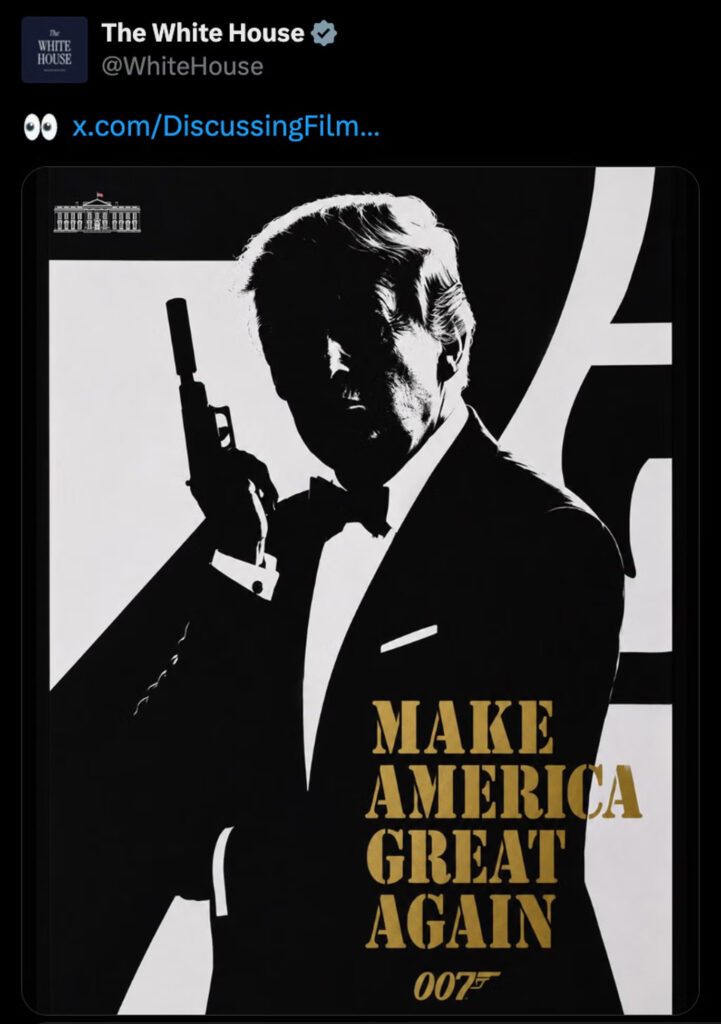
With Amazon MGM Studios – owned by the president’s friend Jeff Bezos – putting out an official casting call for a new Bond as the studio seeks a replacement for Daniel Craig, the White House had already nominated Trump for the role in tongue-in-cheek fashion. Its official account posted its own meme, more elaborate than Trump’s, on May 16, consisting of an illustration of the president wearing a tuxedo and brandishing a silenced pistol in silhouette. The timing was not subtle. The studio’s casting search had been announced publicly just days earlier, and whoever runs the White House social accounts clearly decided Trump deserved a spot in the conversation.
According to The Daily Beast, Trump’s 861 posts and reposts in May were his most ever in a single month this term. Pushing back, the White House told the outlet that the reason for the volume is simply that Trump’s platform is “hotter” than ever. “Truth Social has never been hotter, and it’s because President Trump offers his unfiltered and direct thoughts to the American people, without the biased media taking him out of context,” White House spokeswoman Olivia Wales said.
Why the Bond Casting Search Made This the Right Moment

The Trump-as-Bond post didn’t come out of nowhere. Amazon MGM Studios announced in February 2025 that it would develop the next chapter of the Bond franchise, the first since No Time to Die brought Daniel Craig’s tenure to a close in 2021. Although they remain co-owners through a new holding company, Barbara Broccoli and Michael G. Wilson gave up their right to make the films when the Amazon MGM deal closed on 24th March 2025, ending over 60 years of the Broccoli family’s involvement in the Bond estate.
Amazon MGM Studios revealed the official casting news in an X post on May 14, 2026. “The search for the next James Bond is underway,” they wrote. “While we don’t plan to comment on specific details during the casting process, we’re excited to share more news with 007 fans as soon as the time is right.” The studio tapped casting director Nina Gold – known for Game of Thrones, The Force Awakens, and The Crown – to lead the process to find Daniel Craig’s successor. At Cannes, Gold told Deadline that whoever they cast must “ooze sex appeal,” with the actor expected to take on the role for at least three films. The internet immediately began speculating about names. The White House, apparently, had its own suggestion.
The Bond franchise’s ownership transition also connects Trump to someone in his orbit. In a nod to the Amazon MGM deal, Amazon founder and Executive Chairman Jeff Bezos wrote in a post on X, “Who’d you pick as the next Bond?” Whether that relationship influenced the White House’s enthusiasm for amplifying the Bond casting moment is an open question, but this wasn’t exactly a franchise the President had reason to feel distant from.
Trump, Bond, and the Tariff Carve-Out
Here is where the story gets genuinely strange. Long before the mock posters, Trump had already made his feelings about the James Bond franchise explicit in a very different context. While discussing a U.K. trade deal in the Oval Office in 2025, Trump assured reporters that “James Bond has nothing to worry about” with his planned 100% tariffs on foreign-made films. Earlier that month, Trump had announced that the U.S. Trade Representative and the Commerce Department were going to impose a 100 percent tariff on movies made outside of the United States. The White House later issued a statement saying that “no final decisions on foreign film tariffs have been made,” making the matter even more confusing.
The reasoning Trump offered for Bond’s exemption was, to put it generously, personal. Trump made clear that even if there is pressure to tax U.K. entertainment imports, his friendship with the late Sean Connery means he feels Bond movies won’t be impacted by any new policies. “Sean Connery was a friend of mine,” Trump explained. In 2018, while visiting the UK, Trump was reported as saying, “I met James Bond and I got all my approvals” – telling Theresa May that Connery had helped him win approval for his controversial golf course in Turnberry. At the Aberdeen course opening, Trump quoted Connery directly: “Let the bloody bloke build his golf course.” Once he said that, everything came into line.
The UK’s Mirror newspaper stated in 2018 that “There is no evidence to support his claim.” The Guardian reported that Martin Ford, the Aberdeenshire councillor who chaired the planning committee that initially refused Trump’s application, said: “Mr Connery was not involved in the due process that led to the granting of planning permission for a golf resort at Menie.”
So the President of the United States, while imposing sweeping tariffs on the global film industry, carved out an exemption for one specific British spy franchise because its original star once told Scottish planners – at least in Trump’s telling – to let him build a golf course. This is either the most honest piece of trade policy in modern history or the least.
The Internet’s Response: From Eye Rolls to Parody
The AI-generated movie poster, which features the “Make America Great Again” slogan above “007,” wasn’t exactly building a case for a Trumpy Bond. As one commenter pointed out: “You do know Bond is a British spy?”
The responses online ranged from dry to savage. One commenter replied on X: “Trump as James Bond would be wild: walks into a villain lair, immediately announces ‘great conversation, very productive’ gives the villain a 10-day extension, a 2nd extension, and probably a golf invite, and by the end credits he’s still very close to a deal.”
Another user shared an image of a potbellied Trump with the caption, “Pie Another Day.” One commenter uploaded an AI-generated picture of Trump as an obese James Bond holding a Big Mac instead of a gun.
On Reddit’s entertainment forum, cynics posted: “Yeah, From Russia with Love, indeed,” “James Bond/007 isn’t American (or real)…You couldn’t think of one cool American?” and “He’s the bad guy 007 fights, right?”
A Pattern, Not a One-Off
For anyone who has been paying attention, the Bond post didn’t come from nowhere. Trump has engaged in serial mythologizing through AI-generated imagery, previously sharing pictures of himself dressed as the Pope and as a Christ-like healer.
In May last year, Trump depicted himself as the pope just two weeks after the death of Pope Francis, who was later replaced by American-born Pope Leo XIV. President Trump shared an AI-generated image of himself dressed as the pope, sparking outrage from Catholic officials. That was followed by something even more provocative. In April 2026, Trump sparked bipartisan backlash by posting – and later deleting – an AI-generated image on Truth Social that depicted him as a Jesus-like figure in a white robe, healing a sick man. Trump told reporters that he thought it was “me as a doctor.”
Vice President JD Vance, in an interview with Fox News, said, “I think the President was posting a joke and of course he took it down, because he recognized a lot of people weren’t understanding his humor in that case.” Vance added that he believes Trump “likes to mix it up on social media.” “I actually think that’s one of the good things about this president, is that he’s not filtered,” Vance said.
The James Bond post, considered alongside the pope image and the Jesus post, forms a recognizable sequence. Each one reaches for a different archetype: the holy man, the martyr, the magnetic entertainer, the secret agent. Each archetype commands awe, fear, or devotion. Sometimes all three.
The Whitney Houston photo adds a different texture. Trump regarded himself as a friend of the deceased singer and was present at her wedding to Bobby Brown. The image featured the caption, “Whitney Houston and Future President Donald J. Trump.” The post followed Trump’s announcement that he’d instructed his “representatives” to look into making him the headliner at a 16-day “Great American State Fair” later this month, as his plans for the United States’ 250th anniversary celebration began falling apart. Trump described himself as “the Number One Attraction anywhere in the World” and boasted about getting larger audiences than Elvis Presley.
Read More: Trump’s social media history explained
The Real Story Underneath the Meme
The Trump-as-Bond post wasn’t random. It landed during an active franchise casting search run by a studio owned by someone in Trump’s orbit. It followed a year in which Trump had already publicly exempted Bond from trade policy, invoking a deceased Scottish actor to justify it. And it arrived as part of a late-night social media sprint that covered Whitney Houston, rally crowds, and a congressional pardon request in sixty seconds.
Some observers suggested the Whitney Houston photo could be an attempt to prove that celebrities like him, following the news of artists dropping out of his America 250th celebrations. “But even if not, he’s a narcissist and craves approval,” one X user commented. “The bailout of singers for his 250 partisan event probably stung deeply. He’s trying to prove to himself with that photo that celebrities love him.”
That reading may be a little convenient, but it isn’t unreasonable. Trump has always treated celebrity proximity as a form of currency, and the Bond brand carries a very specific kind of cultural capital: suave, powerful, immune to consequence, charming to women, terrifying to enemies. The silhouette of a man with a gun and a tuxedo is one of the most durable masculine fantasies in popular culture. Putting your own name above it is not a neutral act.
The internet laughed, and that’s fair. Bond is British. Bond is fictional. Bond is not 79 years old, turning 80 in less than two weeks. But the laughter might also be doing some work to avoid a slightly more unsettling question: what does it mean when the most powerful office on earth is being used, at eleven forty-four on a Tuesday night, to post mirror selfies with spy movie captions? Not just once, but as part of a documented and accelerating pattern.
Bond himself would probably find that more interesting than the casting search.
AI Disclaimer: This article was created with the assistance of AI tools and reviewed by a human editor.