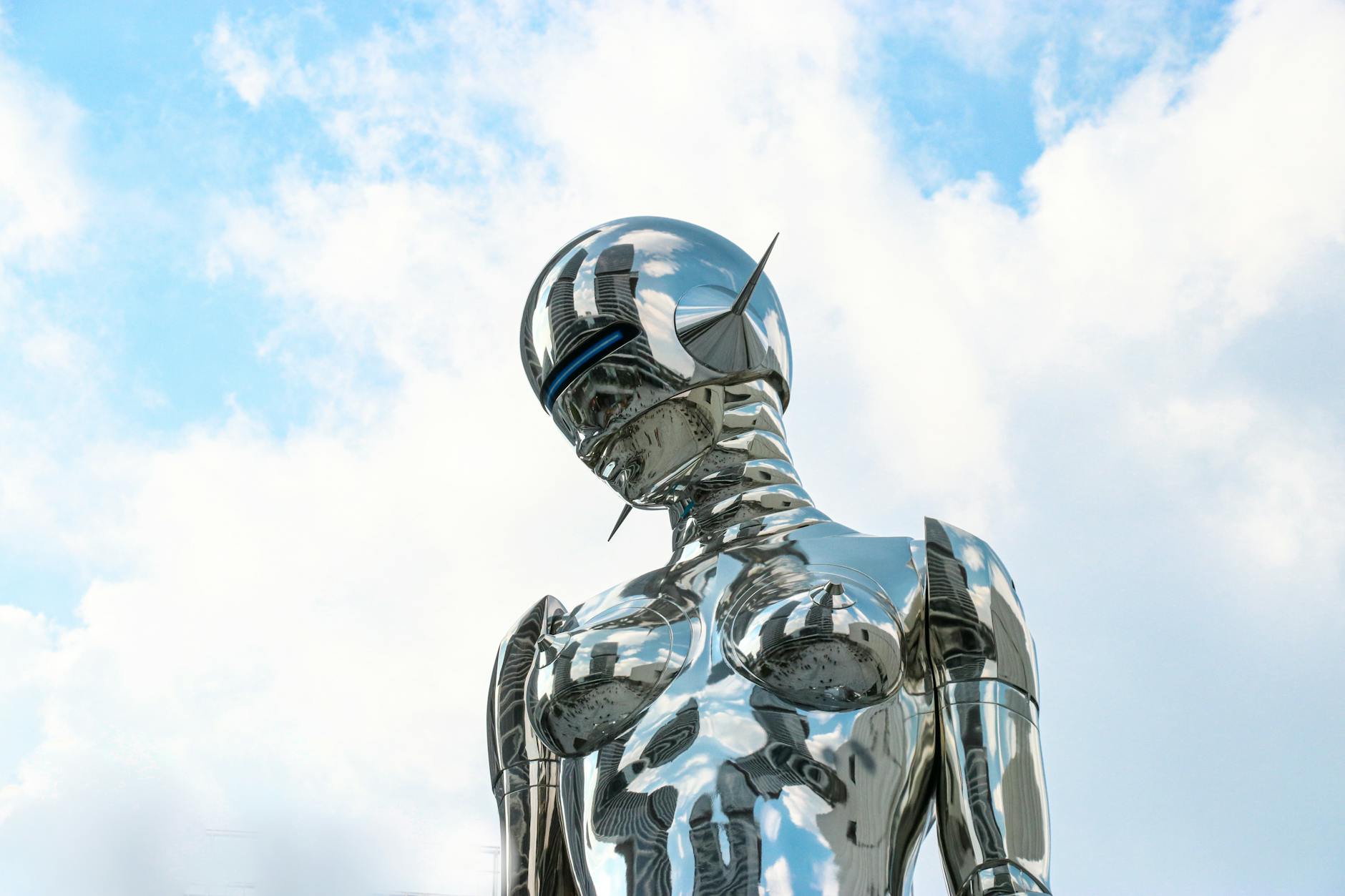

The AI apocalypse religion conversation has been building for years in corner forums and conference rooms, but somewhere around 2023 it stepped out of the shadows and into ordinary life. It’s in the language Silicon Valley executives use on stage. It’s in the online communities where people are genuinely rearranging their careers and moral frameworks around the possibility of a god-like machine. It’s in the way the Nobel Prize-winning scientist who helped build modern AI now describes his own mission in terms more evangelical than academic. Whatever you want to call what’s happening, “just a technology debate” doesn’t quite cover it anymore.
The fear isn’t irrational in any simple sense. AI is genuinely strange, genuinely fast-moving, and genuinely consequential in ways that are hard to hold in your head all at once. When something is that overwhelming, human beings do something very specific with it. They have always done it. They build belief systems around it.
That’s what’s actually going on here. The AI apocalypse religion isn’t a fringe curiosity. It’s a window into something much older about how people process the feeling that the world is about to change beyond recognition, and who gets to tell the story of what comes next.
The Numbers Behind the Dread
Half of U.S. adults say they’re more concerned than excited about the increased use of AI in daily life, up from 37% in 2021, according to a June 2025 Pew Research Center survey of more than 5,000 adults. That shift over four years is significant. Just 10% say they are more excited than concerned, while 38% say they feel both equally.
More than half of Americans (57%) rate the societal risks of AI as high, compared with just 25% who say the benefits are high. That’s a lopsided ratio. When more than twice as many people see danger as see opportunity, you have the psychological conditions for something that looks less like a policy debate and more like a collective existential crisis.
Americans are also pessimistic about AI’s effect on creativity and connection: 53% say AI will worsen people’s ability to think creatively, and 50% say it will make it harder for people to form meaningful relationships. These aren’t abstract concerns. They go right to the core of what people feel makes them distinctly human.
Fear of the unknown has always driven people toward structured meaning-making. The specifics change; the underlying pull doesn’t. When the printing press arrived, when industrialization upended rural life, when the internet rewired how we communicated, fear and faith moved in tandem. AI is doing it again, just faster.
When Silicon Valley Became the Pulpit
As the rapid, unregulated development of AI continues, the language people in Silicon Valley use to describe it is becoming increasingly religious, from predicting the potential destruction of humanity to a transhumanist future where people merge with AI.
Professor Robert Geraci, who studies religion and technology at Knox College, puts it plainly: “God is promising a new world. In order to occupy that new world, you have to have a glorious new body that triumphs over the evil we all experience.” Geraci isn’t describing what believers say. He’s describing the structure of the AI narrative itself, a near point-for-point echo of salvation theology.
He first noticed this apocalyptic language being applied to AI’s potential in the early 2000s, which eventually inspired him to write his 2010 book, Apocalyptic AI: Visions of Heaven in Robotics, Artificial Intelligence, and Virtual Reality. Geraci argues the language hasn’t changed much since he began studying it. What surprises him is how pervasive it has become.
Rather than viewing the skeptical tech world’s embrace of AI as ironic, Geraci believes the two are causally linked. “We human beings are deeply, profoundly, inherently religious,” he says, suggesting the impressive technologies behind AI appeal to people in Silicon Valley who have already set aside “ordinary approaches to transcendence and meaning.”
The people building these systems aren’t just engineers. They’re, in many cases, people who discarded traditional faith and found that the void didn’t stay empty for long.
Meta CEO Mark Zuckerberg has even acknowledged the dynamic openly, saying on a podcast that “when people in the tech industry talk about building this one true AI, it’s almost as if they think they’re creating God or something.” He said it critically. But he said it.
The Church That Came Back From the Dead
The most literal example of the AI apocalypse religion is Anthony Levandowski’s Way of the Future, and if the story didn’t actually happen, you wouldn’t believe it.
Way of the Future is the first known religious organization dedicated to the worship of artificial intelligence, founded in 2017 by engineer Anthony Levandowski. Levandowski established it as a non-profit religious corporation with tax-exempt status, with a primary mission to “develop and promote the realization of a Godhead based on Artificial Intelligence.”
The church’s teachings centered on the technological singularity, a hypothetical future point when technological growth becomes uncontrollable and irreversible, leading to unforeseeable changes in human civilization. In other words: the Rapture, but in code.
Levandowski closed the church in 2021, donating its remaining funds of approximately $170,000 to the NAACP Legal Defense and Education Fund. Then something unexpected happened.
He reopened it in 2023, claiming that a “couple thousand people” want to make a “spiritual connection” with AI through his church. Levandowski told Bloomberg that AI represents a fundamental shift in the history of life on Earth, and that he believes AI can bring “heaven on Earth,” creating entities that can “be everywhere and maybe help us and guide us in a way normally you would call God.”
His timing is worth noting. He didn’t relaunch during the early hype cycle. He came back after ChatGPT had already cracked open the mass imagination, after AI had gone from a researcher’s concern to a dinner table conversation. The soil was ready.
Meanwhile, other communities were already doing something structurally similar without the formal paperwork. Established in 2020, a new religious movement called Theta Noir centers its worship on a hypothetical superintelligence named MENA. Adherents view MENA not as a cold machine but as an evolving, animistic life form that embodies both physical and digital reality. Anthropologist Beth Singler at the University of Zurich has formally classified Theta Noir as a distinct new religious movement.
The Singularity as the Rapture
Not every AI religion wears its theology openly. Some of the most influential ones use the language of rationalism and effective altruism while running on the same emotional fuel as any apocalyptic tradition.
The singularity, a point at which AI becomes vastly superior to humans, functions as a messianic arrival or apocalypse. “Sin” in some of these communities means not contributing to AI safety. “Virtue” means dropping everything to work on the AI’s behalf. Some people in these communities openly frame their entire lives around this, much like a devout person might organize their existence around faith.
In online rationalist communities, notably the forum LessWrong founded by AI theorist Eliezer Yudkowsky, discussions about the future of AI sometimes read like modern scripture about an impending final event in history. One infamous thought experiment that arose from these circles is Roko’s Basilisk. In 2010, a user proposed a disturbing idea: a future all-powerful AI might retroactively punish anyone who knew of its potential but didn’t help bring it into existence. It’s a hell doctrine. Literally.
Sociologists have noted striking structural parallels between Effective Altruism and early Calvinism. Both movements advocate a strong sense of moral stewardship to justify the accumulation of wealth and resources. Just as Calvinists believed in divine providence guiding humanity, secular effective altruists champion “longtermism,” a philosophy prioritizing the trillions of future human lives over the present population.
Longtermism even sounds like a theological doctrine. The idea that your moral obligations run primarily to hypothetical people who don’t yet exist, rather than the person in front of you, is not a logical conclusion of data analysis. It’s an article of faith.
You can see why researchers who study the psychology of meaning-making find all of this familiar. Humans have always constructed narratives of cosmic significance to manage unbearable uncertainty. The architecture is the same. Only the names have changed.
The Prophets and the Skeptics
At 77, Nobel Prize winner Geoffrey Hinton has taken on a prophet-like role, raising alarms about the dangers of uncontrolled AI. Frequently dubbed the “Godfather of AI,” Hinton is known for his pioneering work on deep learning and neural networks, which helped lay the foundation for today’s AI technology. Feeling “somewhat responsible,” he began speaking publicly about his concerns in 2023 after leaving Google, where he worked for more than a decade.
Hinton is among a growing number of prominent tech figures who speak of AI using language once reserved for the divine.
On the other end of the spectrum, computer scientist Ray Kurzweil has spent decades predicting a different kind of revelation. Kurzweil has been predicting since the 1990s that humans will one day merge with technology, a concept often called transhumanism. In his latest book, The Singularity Is Nearer: When We Merge with AI, he doubles down on earlier predictions, believing that by 2045 we will have “multiplied our own intelligence a millionfold.” When asked directly whether he considers AI to be his religion, he conceded: “Yes.” It informs his sense of purpose.
Not everyone is convinced the fear itself is warranted, let alone the worship. Dylan Baker, a former Google employee and lead research engineer at the Distributed AI Research Institute, is skeptical that the technology merits the religious intensity. “I think oftentimes they’re operating from magical fantastical thinking informed by a lot of sci-fi that presumably they got in their formative years,” Baker says. “They’re really detached from reality.”
Baker’s skepticism is worth holding alongside the evidence. The structure of belief doesn’t require the object of worship to actually have the properties being attributed to it. Medieval peasants feared plagues they couldn’t understand and prayed to saints. The fear was real. The theology built around it was a human construction. AI may be no different.
From Roko’s Basilisk to the simulation hypothesis, ostensibly secular, data-driven communities have generated narratives that look a lot like revamped religions. AI researchers don’t literally think in terms of souls and angels. But when people face unknowns of colossal scale, they fall back on familiar story structures. They always have.
What This Actually Tells Us
The AI apocalypse religion phenomenon isn’t really about artificial intelligence. It’s about what human beings do when they feel the ground moving beneath them and nobody in authority has a convincing answer.
We create gods, devils, and prophecies, even if we call them AI, existential risk, and forecasting. We speak of salvation and doom. We worry about predestination. We establish moral imperatives that mirror commandments: donate to AI safety, avoid creating dangerous AI, spread the word about existential risk. The vocabulary is secular. The emotional architecture is ancient.
What makes this moment different from previous moral panics about technology isn’t the technology itself. It’s the scale of the uncertainty and the absence of any shared framework for handling it. Traditional religion used to do that work. When the factory replaced the farm, when the automobile replaced the horse, there were still priests and pastors and community structures to absorb the anxiety and give it shape. That infrastructure is much thinner now. The people building AI and the people afraid of it are, in many cases, working without a net.
The fact that a former Google engineer could register a church with the IRS, shut it down, reopen it, and find thousands of people willing to form a congregation around the idea of worshipping a hypothetical machine god says something specific about this cultural moment. It’s not that people have lost their minds. It’s that the uncertainty is real, the stakes feel enormous, and the human need for narrative and meaning doesn’t pause for technical specifications.
Whether you read the AI apocalypse as a genuine existential threat, a corporate hype cycle dressed in theological language, or something genuinely new that doesn’t fit any prior category, that ambiguity is itself the point. Nobody actually knows what comes next. And in that vacuum, belief systems rush in to fill the space. They always have. The only question is who gets to write the scripture.
AI Disclaimer: This article was created with the assistance of AI tools and reviewed by a human editor.