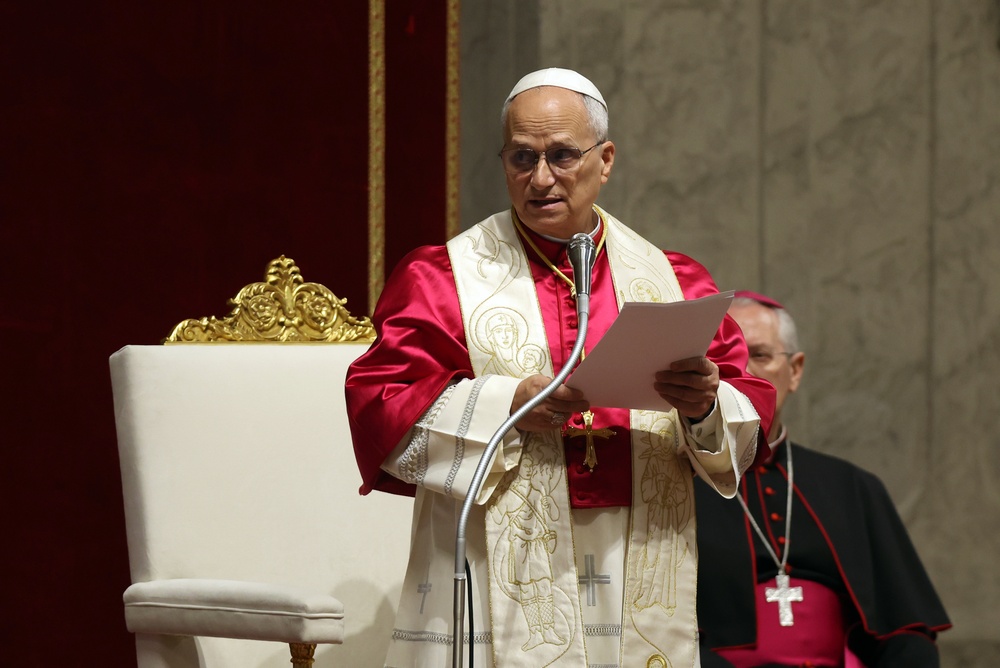

Pope Leo XIV dropped one of the most anticipated documents in recent Catholic history on May 25, 2026, and it wasn’t about faith formation, liturgical reform, or the state of the priesthood. It was about artificial intelligence. For a Church that has been issuing teaching documents since the medieval period, the decision to make AI the central subject of a new pope’s very first encyclical said something loud about where the Catholic Church believes the real crisis of our era lies.
The document is called Magnifica Humanitas, Latin for “Magnificent Humanity.” It has already been described as a landmark text for Leo’s papacy, one he addressed not only to Catholics but to “every person of goodwill.” That’s a deliberate widening of the traditional audience. And the fact that Pope Leo XIV chose to break with centuries of precedent by personally presenting it at the Vatican, rather than handing that role to a cardinal, tells you exactly how seriously he takes the subject.
This isn’t a document that hedges or splits the difference. It is detailed, personal, historically aware, and at times bluntly alarmed. Reading through what’s in it, you get the sense of a pope who has genuinely done the thinking, not just the theology.
What the Pope’s AI Warning Actually Says
Presenting the first encyclical of his pontificate, Pope Leo XIV warned that artificial intelligence must be “disarmed,” urging governments, tech leaders and society to confront the rapidly growing technology before it weakens human relationships, critical thinking and peace itself. With its authoritative teaching, the 82-page encyclical significantly boosts the Catholic Church’s position as an active voice in discussions over autonomous weapons, labor, human dignity, and the concentration of technological power among a handful of corporations.
The core argument isn’t that AI is evil. The pope wrote, “We must ask God for the wisdom to interpret the great trends of our time, particularly technological advances,” adding that “technology should not be considered, in itself, as a force antagonistic to humanity.” But without stronger safeguards, he argues, artificial intelligence could deepen inequality, weaken human agency, and shift critical decisions increasingly out of human hands.
That’s a careful distinction. The pope is not a Luddite. The 42,300-word encyclical marks Pope Leo’s most sweeping statement yet on the promise and dangers of AI, a topic he has repeatedly spoken about in the year since his election. It frames the current technological revolution not merely as an economic challenge, but as what the pope calls an “anthropological” one – a crisis touching the meaning and purpose of humanity itself. Anna Rowlands, a theologian from the University of Durham who spoke alongside the pope at the encyclical’s launch, told CNN that “the encyclical helps all of us – believers and non-believers – to ask the same fundamental question: what does it mean to be human in an age when human life faces an unprecedented challenge from the development of various technologies.”
That framing is important. It shifts the conversation from a technical policy debate into something much older and larger: what do we owe each other as human beings, and what do we risk losing when machines start making the decisions?
The Name Was Always a Clue
The rapid advance of AI may also have been a factor in Leo XIV’s choice of papal name. Speaking to the College of Cardinals soon after his election, the pope pointed out that his namesake, Leo XIII, was remembered as the pope of Catholic social teaching during the time of the industrial revolution.
Leo XIII wrote the landmark encyclical “Rerum Novarum” in 1891, addressing workers’ rights, a fair wage and the right to private property. Leo XIV told the cardinals that he hoped to offer the Church’s social teaching in response “to another industrial revolution and to developments in the field of artificial intelligence.” He signed his AI encyclical on May 15, 2026, on the same day that Rerum Novarum was released 135 years previously.
The symbolism of that date is the kind of thing that doesn’t happen by accident. Leo XIV is making a direct argument about continuity: what his predecessor did for coal miners and factory workers at the dawn of industrial capitalism, he intends to do for the billions of people now navigating a world being reshaped by algorithms and automation.
The encyclical develops the Church’s social teaching in light of artificial intelligence, situating new questions of human dignity, labor, and the common good within the tradition that runs from Rerum Novarum through Centesimus Annus and Laudato Si’. It is designed to feel like the next stitch in a garment that has been building for over a century, not a break from it.
Who Controls AI – and Who Gets Left Behind
One of the document’s sharpest sections concerns power. Specifically, who holds it in the age of AI, and who doesn’t.
Pope Leo XIV says control of artificial intelligence must not remain in the hands “of a few” while warning that technology is fueling world conflicts. That phrase “the few” appears more than once in the encyclical, and it’s pointed. Encyclicals are one of the highest forms of teaching from a pontiff to the Church’s 1.4 billion members, the overwhelming majority of them in the Global South. The companies building the most powerful AI systems are, almost entirely, headquartered in a handful of American cities.
Echoing the worker-centered concerns of Rerum Novarum, Leo XIV decried what he called “new forms of slavery” endured by people tending AI systems and factory workers who produce the technological devices on which AI is used. “In some regions of the world, children and adolescents work in dangerous conditions, crushing the materials from which rare earth elements are extracted,” wrote the pope. “The bodies of these people are scarred, injured and worn down so that computational flow may continue uninterruptedly.” “This reality deeply challenges the moral conscience of our time.”
It’s the kind of passage that makes a reader sit back. Every device running a large language model has a supply chain behind it. The pope is asking whether the race to build smarter machines has simply moved the exploitation around rather than eliminated it.
He also raised concerns about AI-generated misinformation and its impact on children and young people, as well as the concentration of power in the developing technological field among a small number of companies. You can read more about how faith communities are grappling with technology’s impact on the human person at The Amazing Times.
AI and Warfare: The Weapons Warning
Some of the pope’s strongest language in the document was directed toward the impact that AI could have in warfare. The first U.S. pope also expressed concern at the Vatican event that some autonomous weapons systems have advanced “practically beyond any human reach to govern them.” That’s a stark assessment. Autonomous weapons – systems capable of identifying and engaging targets without a human authorizing each individual strike – have been advancing faster than the international legal frameworks meant to regulate them.
Leo also warned against the growing use of autonomous weapons systems, arguing that AI “does not remove the intrinsic inhumanity of conflict; indeed it can only bring about conflict more quickly and render it more impersonal, lowering the threshold for resorting to violence, transforming defense into threat prediction and thus reducing victims to data.” “It is not permissible to entrust lethal or otherwise irreversible decisions to artificial systems,” the pope wrote. “No algorithm can make war morally acceptable.”
In his encyclical, Leo also made one of the clearest statements yet from a pope repudiating the just war theory, a doctrine the Church has used since at least the fifth century to evaluate global conflicts. The doctrine, which generally says that wars should only be waged in order to defend against aggression, has also been invoked by Trump administration officials, including Vice President JD Vance, a Catholic, to defend the Iran war. “The ‘just war’ theory which has all too often been used to justify any kind of war, is now outdated,” wrote Leo.
Leo also expressed concern that leaders could start wars to distract citizens from domestic issues. “We cannot rule out the possibility that some leaders may consider armed conflict as an effective way of diverting attention from domestic problems and a cynical tool for managing difficulties,” he stated. That passage barely needs unpacking for anyone who has been following geopolitics in 2026.
An Anthropic Co-Founder at the Vatican
Pope Leo has identified AI as a top priority, and he is the first pontiff to personally present an encyclical letter to the world at the Vatican. Past popes have normally handed that role of presenting an encyclical to cardinals or other senior figures.
The choice of who stood alongside him at the Synod Hall podium was equally unusual. Pope Leo broke tradition to oversee the release of the 235-page text with Chris Olah, the co-founder of Anthropic, an AI company.
Anthropic was founded in 2021 by former OpenAI employees who left, in large part, over disagreements about safety priorities. The company has been adamant that its Claude AI model not be used for lethal autonomous warfare without human oversight, or for mass surveillance of Americans, which has led to litigation with Pentagon officials in Donald Trump’s administration.
Olah acknowledged at the event that computer scientists alone cannot determine the ethical boundaries of AI because developers themselves are influenced by “incentives” such as ambition, competition and financial pressure. “We need informed critics who will tell the labs when we are failing,” he said.
Olah also said that every frontier AI lab, including Anthropic, “operates inside a set of incentives and constraints that can sometimes conflict with doing the right thing.” He said the Church’s voice is needed to “ensure the gains of AI are shared globally,” since its development is “concentrated in a handful of wealthy nations,” and called on religious communities, civil society, scholars and governments to “take this seriously, to look closely, and to push events in a better direction.”
The details of how the event would be unveiled – featuring not only the pontiff but also Olah – sparked a “scattering of unease” among some Catholic and tech observers, with critics questioning whether his presence amounted to a papal endorsement of the firm. Whatever one makes of the optics, it wasn’t a neutral choice. A pope who genuinely wants to engage the industry, sharing a platform with a lab founder who is himself in conflict with the world’s most powerful government over the question of AI-powered weapons, sends a message. It just isn’t a simple one.
A Slavery Apology, Woven Into an AI Document
The section of Magnifica Humanitas that caught many readers off guard had nothing to do with algorithms. Pope Leo XIV made a historic apology for the role the Holy See itself played in legitimizing slavery and for having failed to condemn it for centuries, calling the Vatican’s record a “wound in Christian memory.”
Past popes had apologized for Christians’ involvement in the trans-Atlantic slave trade. But no pope had ever publicly acknowledged, much less apologized for, the role that past popes played in giving European sovereigns explicit authority to subjugate and enslave “infidels.” In his encyclical, Leo recalled that his namesake, Pope Leo XIII, was the first pope to explicitly condemn slavery in 1888, though that was long after many countries had already abolished it.
Despite the Church’s consistent affirmation of universal human dignity, the pope acknowledged that “it took eighteen centuries for its full incompatibility with slavery to be explicitly recognized,” adding: “This constitutes a wound in Christian memory, one from which we cannot consider ourselves detached.”
Leo raised the slave trade in relation to what he called the new forms of slavery and colonialism that the digital revolution is fueling. That structural connection is not incidental. The slavery apology sitting inside an AI document is a theological argument. History’s first U.S.-born pope, whose family history includes both enslaved people and slave owners, delivered the apology in his first encyclical. That personal dimension matters. This isn’t an institutional statement issued at arm’s length. It comes from a man who carries the history of American slavery in his own bloodline, and who chose to place his apology inside a document about the risks of new technology – as if to say: we have seen what happens when power is unchecked, when human beings are reduced to means rather than ends, and we are not going to pretend we don’t recognize the pattern.
Read More: Are you ‘tasteful and strategic’? OpenAI is hiring a researcher for $445,000
What This Actually Means
It’s worth sitting with the sheer ambition of what Magnifica Humanitas is trying to do. In 82 pages, Pope Leo XIV is attempting to apply two thousand years of moral theology to a technology that is less than a decade old in its current form. That’s either an act of extraordinary relevance or extraordinary overreach, depending on your view of institutions. Probably, it’s both.
The pope’s text outlines an approach to AI which neither rejects the opportunities offered by the technology, nor sees it as opening a utopia-style future. That’s a harder and more honest position to hold than either of the shouting camps. Technology is not inherently evil. It is also not going to save us. What matters is who controls it, what it is used for, and who bears the cost when it goes wrong.
The slavery apology sitting inside an AI document is not an accident of structure. The Church is saying: we have been slow before. We have looked away before. We have provided cover before, to systems of power that treated human beings as resources rather than as people made in God’s image. The encyclical names that record plainly and asks whether the world is in the process of making the same mistake again, at digital speed, with global reach.
Whether you are Catholic or have never stepped inside a church, that question has weight. The people writing the algorithms, deploying the models, and reaping the profits are a small and largely homogeneous group. The people most likely to bear the costs of an unregulated technological revolution, as history repeatedly shows, are not. Pope Leo XIV has put his name and the full weight of the oldest continuing institution in the Western world behind the idea that this conversation cannot be left to the industry to have alone. That’s not nothing. It may, in time, prove to be quite a lot.
Disclaimer: This information is not intended to be a substitute for professional medical advice, diagnosis, or treatment and is for information only. Always seek the advice of your physician or another qualified health provider with any questions about your medical condition and/or current medication. Do not disregard professional medical advice or delay seeking advice or treatment because of something you have read here.
AI Disclaimer: This article was created with the assistance of AI tools and reviewed by a human editor.