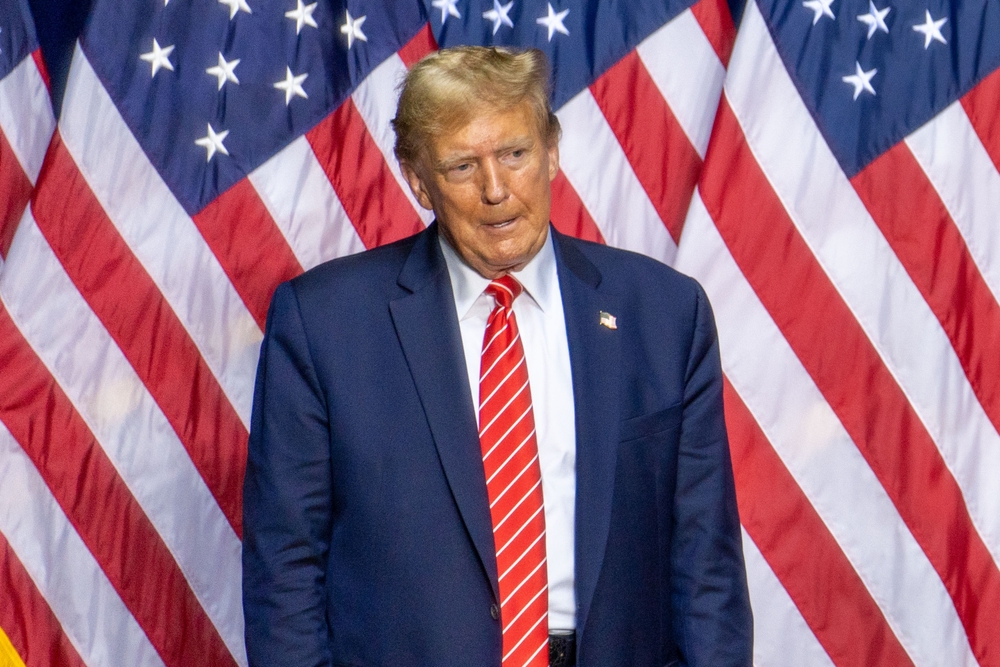

The rally in Suffern, New York on the evening of May 22, 2026 was billed as an economics event. The banner said “Fighting For American Workers.” The stated purpose was to stump for a vulnerable House Republican ahead of November’s midterms and tout the administration’s record on tax cuts and cost-of-living relief. What it became, predictably, was something else entirely.
President Donald Trump took the stage at Rockland Community College and promptly wandered off script, arriving at the same territory he visits at nearly every public appearance: transgender people in women’s sports. The event, ostensibly organized around the economy, saw Trump veer into familiar talking points, including transgender athletes in women’s sports, voter identification, crime, and what he has taken to calling “Dumocrats.” Then came the grunting. Then came the heckler. And then came the taunt that ended up on every newsfeed.
The clip is by now familiar enough that you probably caught it before you finished reading the headline. Trump depicted a female weightlifter straining to lift a bar, producing exaggerated grunts and noises, before switching to a breezy impression of a transgender competitor picking up the same weights without effort. The crowd loved it. Right in the middle of the routine, someone in the audience pushed back.
What Happened at the Suffern Rally
The president appeared in Suffern, New York, to support Republican Rep. Mike Lawler, who is up for reelection in November’s midterm elections. The Cook Political Report considers the election in New York’s 17th Congressional District, which covers several suburban New York counties in the Hudson River Valley, a toss-up race. It is exactly the kind of district where a presidential visit is a calculated gamble, and where optics matter.
Trump held a rally in Suffern that featured many familiar scenes, including protesters and his trademark one-man skits bashing trans athletes. Protesters interrupted Trump several times, and social media video clips posted by the Sunrise Movement showed the hecklers protesting funding for ICE and the Iran War, with one holding a sign calling the president a “War Criminal.” The president’s supporters shouted, cursed, and demanded the hecklers “sit down” as security reacted.
About 20 minutes into the speech, another heckler interrupted Trump’s anti-trans swimming routine, just as he was describing a competitor he claimed had “a wingspan sort of the size of Shaquille O’Neal.” The protester shouted that Trump was “separating families.” Trump shot back: “Go home to mom! Go home! Take him home to Mommy! He’s going to be in trouble.” The crowd obliged with a thunderous chant of “USA.”
As the protester was escorted out, Trump called out, “Don’t hurt him! Don’t hurt him! I do that for legal reasons… Now I can say ‘I’m innocent.'” Then he picked up exactly where he left off. “You know what he doesn’t say is, his mom’s watching on television now and she’s loving it,” Trump said, before continuing his story.
Trump had asked the crowd, “Do you want to hear the swimming story or not?” joking that his wife, first lady Melania Trump, did not want him to tell it. He told it anyway.
A Routine He Has Delivered Over and Over
The Suffern performance wasn’t improvised. Trump has repeated the anti-trans athletic routine at a campaign event in Manchester, New Hampshire in April 2023, at the University of Alabama commencement in May 2025, at a Kennedy Center address to House Republicans in January 2026, and at The Villages in Florida on May 1, 2026.
The White House’s own Rapid Response 47 account shared a clip of the Kennedy Center version on X, captioning it “@POTUS on his imitation of trans athletes in women’s sports: My wife HATES when I do this.” That post went viral, drawing widespread mockery and concern online.
Critics noted the impression is based on a false premise, as the administration has repeatedly cited two Olympic boxers, Imane Khelif and Lin Yu-ting, as examples of transgender competitors, despite both athletes being cisgender women who were born female and have competed as women their entire careers.
During the January 2026 version at the Kennedy Center, Trump said he wanted to be “more effusive” before proceeding to produce what one reporter described as “gasps, panting, moaning and other noises that are difficult to describe in writing.”
The Numbers Behind the Rhetoric
PRRI’s 2025 American Values Atlas, based on interviews with more than 22,000 adults throughout 2025, found that 72% of Americans support nondiscrimination protections for LGBTQ individuals, though that figure has slipped from 80% in 2022. Democrats lead at 90%, independents sit at 76%, and even Republicans come in at 56%, though that last number has dropped 10 percentage points since 2022.
GLAAD’s Trump Accountability Tracker documents at least 470 policies and statements targeting LGBTQ Americans since Trump took office in January 2025, including 50 instances of Trump personally using the phrase “transgender for everybody,” deployed to dismiss political opponents in unrelated speeches, interviews, and topics.
Transcripts of all presidential remarks since January 2025 show fewer than 25 mentions of “affordability,” the majority of which criticize opponents rather than propose solutions to the issue that polls show is the number one concern of Americans. So: 50 mentions of “transgender for everybody.” Fewer than 25 mentions of the thing keeping voters up at night.
On the policy side, the administration has moved far beyond rhetoric. Since returning to office, Trump has stripped transgender people of the ability to serve in the military, curtailed access to gender-affirming care for transgender veterans and young people, and made it harder for transgender people to get valid identity documents. As of 2025, more than half of U.S. states, mostly Republican-led, had enacted state-level bans on gender-affirming care for minors. In December 2025, Attorney General Pam Bondi instructed the FBI to begin offering cash bounties for information leading to the identification and arrest of transgender activists promoting what she referred to as “radical gender ideology,” describing such activists as “domestic terrorist groups.”
In May 2026, the White House published its “United States Counterterrorism Strategy,” which stated that national counterterrorism activities would “also prioritize the rapid identification and neutralization of violent secular political groups whose ideology is anti-American, radically pro-transgender, and anarchist.” That is the backdrop against which the Suffern crowd was laughing.
The Rally’s Political Subtext
New York’s 17th Congressional District, which includes Putnam and Rockland counties and parts of Dutchess and Westchester counties, is a textbook competitive purple swing seat. Lawler, who represents the swing suburban district north of New York City, brushed aside concerns that Trump’s appearance might pose a risk to his candidacy.
Democrats running to unseat Lawler have been told by their own party to be careful. With increasing pressure to take back the House of Representatives, Democrats angling to flip the district say the right candidate cannot repeat the party’s great mistake of 2024: running on a purely anti-Trump platform. Lawler has burnished his bipartisan credentials by strategically voicing disagreements with the president, deviating from Trump on issues like the World Trade Center Health Program and the state and local tax deduction cap.
Which makes the Suffern rally a peculiar political spectacle: a president who badly needs to boost a vulnerable ally in a purple district spent a significant portion of his speech doing anti-trans impressions and trading barbs with protesters in front of C-SPAN cameras. Trump was expected to highlight the higher cap for the state and local tax, or SALT, deductions in last year’s tax-and-spending package, the Republican lawmaker said. The grunting and the “go home to mommy” bit was not, presumably, part of the plan.
Read More: Trump is Now in Way Over His Head
A President Whose Numbers Are Falling
The heckler’s willingness to stand up in a hostile crowd and shout reflects something the polls are already showing. A Fox News national survey conducted May 15-18 among 1,002 registered voters put Trump’s overall job approval at 39%, with 61% disapproving, marking the highest disapproval figure recorded in Fox News polling during Trump’s presidency.
While Trump continues to command majority support among Republicans, the data shows backing from his own party has weakened steadily over the past year, particularly on economic issues. Between February and May alone, Republican net approval fell by 14 points in Fox News surveys. Pollsters say the shift is being driven almost entirely by voter anxiety over affordability and inflation.
Disapproval of Trump’s handling of the economy has risen from 56% a year ago to 66% last month and now 71%, the highest level in this polling series. On inflation, just 24% approve of Trump’s performance, down from 35% in January.
Republican pollster Daron Shaw, who conducts the Fox News poll, said: “Despite consistently strong GOP support, the president’s numbers are leaking a bit. Make no mistake; it’s all about affordability. Independents jumped ship in 2025, and now non-MAGA Republicans and other core constituencies are wavering.”
Set against that context, an economics rally that devolved into trans-bashing sound bites and crowd taunts looks less like confident governance and more like a reflex. When the economy is difficult to defend, the performance fills the space.
What to Make of All This
Pull back from the Suffern footage for a moment and a few separate things come into focus. One is about spectacle. Trump has always understood that a crowd needs something to react to, and the transgender athlete routine reliably delivers that. It’s been road-tested at enough venues now that it functions more like a set piece than a policy argument. Transgender women in sport is a topic he has made central to nearly every major public address since returning to office in January 2025, and the routine has become a fixture. The heckler added live drama. The crowd chanted. The escort out happened. The president quipped about the protester’s mother. His supporters got exactly what they paid attention for.
The second is about proportion. The gap between the frequency of the transgender rhetoric and the frequency of any concrete economic remedy is not a subtle one. More than three-quarters of Americans, 77%, say the economy is in bad shape, up from 73% last month and 71% a year ago, while just 23% rate it positively. An event billed as a worker’s rally that spends prime airtime on anti-trans impressions is not a messaging accident. It’s a choice.
The third is the one that sits uncomfortably with the rest. Strong majorities of Americans support nondiscrimination protections for LGBTQ individuals, at 72%, yet the rhetoric at rallies like Suffern keeps escalating anyway. Public opinion and political performance are pulling hard in opposite directions right now. Whether that gap will matter in November, in Lawler’s district or anywhere else, is the question nobody on either side has a clean answer to yet.
What’s not in doubt is that the routine will travel. Another rally, another crowd, another set of grunts, another heckler getting told to go home to mom. The script is set. The question is how long it keeps working.
AI Disclaimer: This article was created with the assistance of AI tools and reviewed by a human editor.