

You sleep eight hours and still need a nap by 2pm. You took a long weekend and came back feeling exactly the same as when you left. You cut the alcohol, downloaded the meditation app, bought the magnesium gummies. Still: a low, grinding tiredness that doesn’t shift. If that sounds familiar, the explanation probably has very little to do with your sleep hygiene and a lot to do with the world you’re living in.
American fatigue has become something genuinely different from what it was two decades ago. This isn’t the tiredness that follows a few late nights or a brutal week at work. It’s the kind that sits in your chest even after a full weekend of rest, the kind that makes the simplest tasks feel like a negotiation. Researchers, employers, and public health experts have all started paying close attention, and what they’re finding is that the exhaustion so many Americans report right now has roots running deeper and wider than most people realize.
Seven specific shifts have quietly changed daily American life over the past 20 years. Not one of them is about sleep hygiene, and not one of them can be fixed with a better bedtime routine.
1. The Workday Never Really Ends
Twenty years ago, leaving the office meant, for most people, leaving work. The laptop didn’t come home. The boss didn’t have your cell number. Work was a place you went, not a state you inhabited. That boundary has largely dissolved.
Total national work hours rose more than 10% between 2007 and 2024, reaching nearly 297 billion hours. That’s not just more people working – it’s more hours being squeezed out of existing workers. Remote and hybrid models, which expanded rapidly after 2020, were supposed to improve flexibility. In many cases they did. But workdays under these arrangements often extend into evenings and weekends. The boundaries that used to separate work-brain from rest-brain are gone, leaving many people in a chronic low-level state of readiness that the nervous system registers as stress.
The problem isn’t just the hours. It’s the absence of true psychological detachment from work during off-hours. When the phone buzzes at 9pm with a work email and you check it, your brain doesn’t get to rest. It stays primed. Over weeks and months, that unrelenting low hum of availability is physically exhausting in ways that a single good night’s sleep won’t fix.
The structural issue is that longer hours don’t produce proportionally better outcomes – they produce burnout. Stagnant wages mean more hours are needed to cover basic costs, and labor shortages mean fewer workers are left to cover the same number of shifts. For many Americans, working more isn’t a choice. It’s the math they’re stuck with.
2. Financial Pressure Has Become a Constant Background Hum
Money stress has always existed. But the financial anxiety of 2026 is different from what it was in 2005, and the gap has real consequences for exhaustion. The cost of housing, childcare, healthcare, and groceries has outpaced wage growth across most of the country. For many households, the margin between getting by and not getting by has shrunk to a level that requires constant management.
That vigilance is draining. When the brain is preoccupied with low-grade financial worry, even activities that should be restorative – a movie, dinner with family – get hijacked. Sleep is especially vulnerable. Money worries don’t switch off at bedtime; they tend to sharpen at exactly the moment the day’s other distractions fall away. A July 2025 national survey by AMFM Healthcare, which polled 725 U.S. adults, found that 87% feel anxious about their finances and 79% say that anxiety has grown since the start of the year – with 77% reporting that economic pressure has disrupted their sleep.
For younger Americans the pressure is especially concentrated. When financial precarity isn’t a temporary crisis but an ongoing condition, the body never fully steps down from its stress response. Cortisol – the primary stress hormone – stays elevated. Sleep quality suffers. The tank never refills.
3. Screens Are Stealing Sleep, and Not Just Because of Blue Light
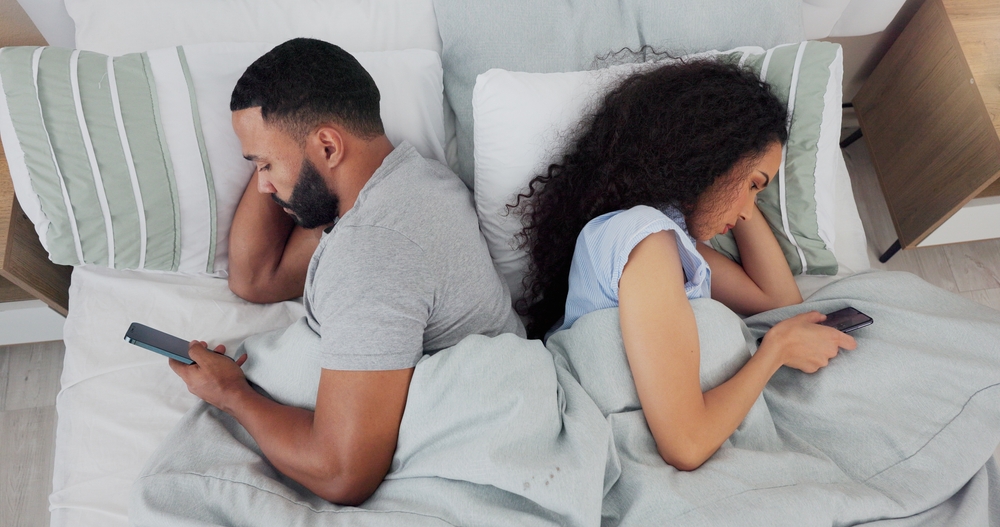
The average American adult now spends somewhere around seven hours a day looking at a screen. Phones, laptops, tablets, televisions – they’ve become the dominant medium through which people relax, connect, consume news, and wind down. The problem isn’t only the light they emit. It’s what happens inside the brain when it engages with them close to sleep.
The mechanism isn’t purely about blue light suppressing melatonin, though that plays a role. Interactive activities – browsing social media, online shopping – are the most disruptive. Social media platforms are specifically designed to hold attention for as long as possible, stimulating the brain’s reward circuitry in ways that make it difficult to disengage. Switching off the phone doesn’t instantly quiet a brain that’s been algorithmically stimulated for two hours. The mental activation carries over into the early phases of sleep, reducing the depth and restorativeness of rest even when the total hours look fine on paper.
Twenty years ago, none of this existed in its current form. The smartphone wasn’t in people’s bedrooms. The evening wasn’t filled with an infinite scroll calibrated to keep eyes open. That change alone has meaningfully degraded sleep quality for millions of Americans, and no amount of advice about blackout curtains addresses it.
4. Loneliness Is Draining Energy at a Population Scale
Loneliness doesn’t feel like a physical condition. But researchers increasingly understand it as one – a particularly depleting one. The social isolation spreading across American life over the past two decades acts on the body much like chronic stress does: it keeps threat-detection systems on alert, disrupts sleep, and elevates the stress hormones that make rest feel impossible.
The Cigna Group’s Loneliness in America 2025 report, which surveyed more than 7,500 U.S. adults, found that 57% of Americans are lonely. Researchers found that younger generations – Gen Z and Millennials – are lonelier than older ones, despite being more technologically connected. That last detail matters. Digital connectivity has not replaced the deeper, more restorative sense of belonging that comes from sustained in-person relationships. If anything, it has obscured the deficit, making people feel they should be less lonely than they actually are.
The physical toll of this disconnection is measurable. People with high levels of loneliness are far more likely to report chronic illness, anxiety, and persistent fatigue. When someone feels fundamentally disconnected from the people around them, the body doesn’t rest well. Social connection isn’t a nice-to-have. It’s a biological need, and its absence costs energy in a way that no amount of optimized sleep can compensate for.
5. The News Cycle Has Become a Physiological Stressor
There has always been bad news. But the volume, velocity, and availability of distressing information today is categorically different from what it was 20 years ago. In 2005, most people checked the news once or twice a day. In 2026, it arrives in real time, through phones that are within arm’s reach almost continuously. Wars, political crises, economic anxiety, and cultural conflict all land in the same palm-sized feed where people also look at family photos and restaurant recommendations.
The brain doesn’t efficiently distinguish between threats that are immediately relevant and ones that are distant. News of a geopolitical crisis thousands of miles away still activates the same stress response in a reader scrolling at midnight. The APA’s 2025 Stress in America survey, conducted among more than 3,000 U.S. adults, found that 76% say the future of the nation is a significant source of stress, and that more than four in five adults stressed by societal division reported at least one physical symptom of stress – including fatigue – in the past month.
The phrase “news fatigue” has entered common usage for a reason. When the thing you’re consuming for information is also the thing winding you up before bed, keeping you anxious during the day, and delivering fresh provocations before you’ve finished processing the last ones, the cumulative result is a body that rarely gets to fully exhale. Chronic exposure to distressing media is one of the least-discussed contributors to widespread American exhaustion, and it’s a relatively recent one.
6. Workplace Burnout Has Become Structural, Not Just Personal
For years, burnout was treated as a personal problem. People burned out because they were bad at managing their time, or not resilient enough, or failed to set sufficient limits. The framing placed the burden entirely on the individual experiencing it. That understanding has shifted, and the numbers behind the shift are difficult to dismiss.
Wellhub’s 2025 State of Work-Life Wellness report, based on a global survey of more than 5,000 employees, found that nearly half of workers identify work stress as the primary cause of their deteriorating mental health – ahead of concerns about inflation, information overload, or anxiety about AI. Burnout-driven productivity losses and voluntary turnover cost companies an estimated $322 billion annually. The generational picture is sharp: Gen Z and Millennial workers report the worst burnout numbers, and they’re experiencing it earlier than any previous generation.
Researchers have noted that much of what workers experience as burnout stems from occupational structure – workloads have increased, staffing levels have declined in many sectors, and the expectation of constant responsiveness has intensified. Ping-pong tables and meditation apps, however well-intentioned, don’t address any of that. What they do is allow the structural causes to persist while placing the responsibility for recovery back on the individual. It’s an exhausting loop, and recognizing it as structural rather than personal is at least a more honest starting point.
Read More: 10+ signs someone has gone too long without real love and support
7. The Disappearance of Mental Downtime
This one is subtle, but real. Americans in 2026 are, in a practical sense, never alone with their thoughts in the way previous generations routinely were. The commute that used to be mentally idle is now a podcast or a text chain. The walk to the coffee shop is an opportunity to check email. Even bathroom breaks have become phone time for many people. The unstructured mental space that the brain once used to process, reset, and recover has been filled with a continuous stream of content.
Psychologists use the term “cognitive overload” to describe what happens when the brain is asked to process more information than it can efficiently handle – its working memory and executive function systems get overwhelmed, and the result is a feeling of mental exhaustion that sleep alone doesn’t resolve. The modern information environment produces it continuously. Screens, notifications, and the expectation of constant availability combine to keep the brain’s processing systems running almost without interruption.
The version of rest that involves lying on a sofa watching television while half-reading texts is not actually rest in the neurological sense. Genuine recovery requires genuine disengagement – periods where nothing is being consumed or responded to. That has become one of the rarest commodities in American life, and its scarcity goes largely unacknowledged in conversations about why everyone feels so tired.
What’s Actually Going On Here
The instinct, when confronted with persistent exhaustion, is to look for a single cause and a single fix. Get more sleep. Exercise more. Cut back on alcohol. Those things matter. But the picture that emerges from looking honestly at what has changed over the past two decades is more complicated, and more unsettling, than a sleep hygiene problem.
What’s happening is a convergence. Work has expanded into all available time. Financial pressure keeps stress hormones elevated. Screens have colonized the hours that used to be restorative. Loneliness is eroding the deep social connection the body needs to feel safe enough to rest properly. A relentless news cycle keeps threat-detection systems running. Structural burnout gets dressed up as a personal failing. And the mental white space that once let the brain decompress has been filled with a continuous stream of content.
None of these forces operate in isolation. They amplify each other. The person who is financially stressed sleeps worse, which makes them more reactive to bad news, which makes the doom-scrolling worse, which further degrades sleep, which increases the feeling of burnout at work. The loop runs in every direction simultaneously.
Knowing this doesn’t make any of it easier to fix. But it does make it less personal. If you’re exhausted and you’ve tried everything people tell you to try and you’re still exhausted, the problem is probably not you. It’s the conditions you’re living in. That’s a meaningfully different place to start from – and honestly, for most people, it’s the first time the exhaustion has actually made sense.
AI Disclaimer: This article was created with the assistance of AI tools and reviewed by a human editor.