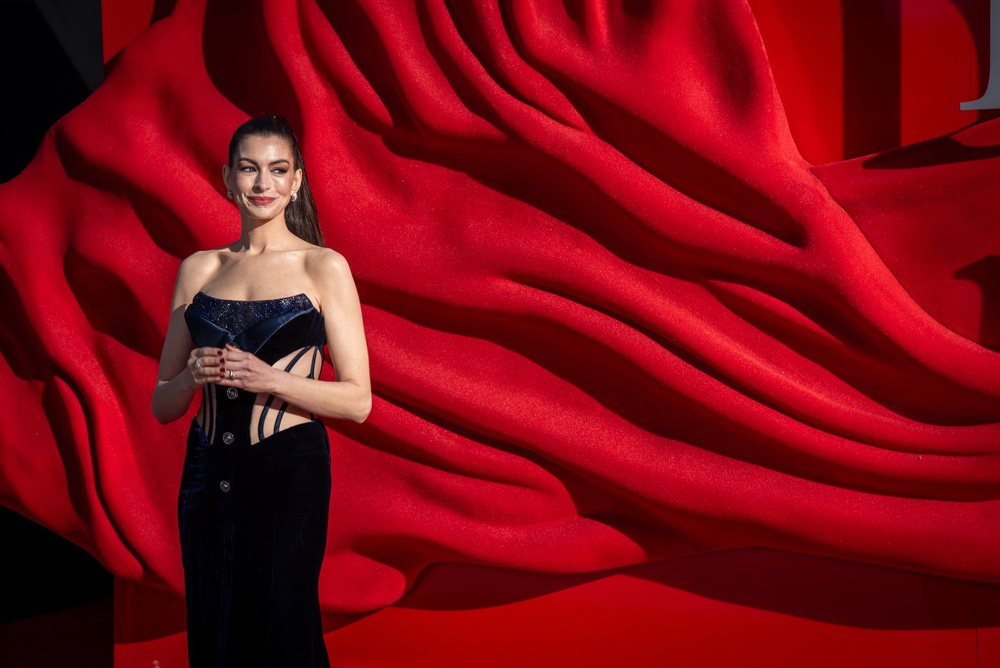

You’ve probably noticed the comment sections by now. Someone posts a photo of Anne Hathaway on a red carpet, and within minutes the replies fill with the same question: did she get work done? The speculation has been relentless, the armchair diagnoses delivered with extraordinary confidence, and the certainty – as Hathaway herself would later point out – almost completely unearned.
The answer was hiding in plain sight, literally pinned to the back of her head. She showed everyone exactly what was going on, and the rumors still didn’t stop. If anything, they got louder.
A 43-year-old woman at the peak of her career had to publicly demonstrate her own hairstyling routine to a skeptical internet, and still found herself defending the result two months later. That this was necessary at all says more about the machinery she’s been navigating than anything about her face.
The Viral Moment That Started It All
It began at the 2026 Academy Awards, where Hathaway’s hairstylist Orlando Pita revealed a “secret” technique on social media while getting her ready for the ceremony. She wore an embroidered Valentino gown and Bulgari jewelry to the event, and her face – sharply lifted, bright-eyed, almost unnervingly luminous – immediately became a topic of its own.
The technique involves pulling small interior braids tightly from the temple area and securing them discreetly at the back of the head. The tension creates the illusion of lifted brows, sharper cheekbones and a more “snatched” face shape, all without injectables or surgery. Hathaway laughed her way through the behind-the-scenes video, with Pita explaining, “One on each side, and we bring it together in the back” – and Hathaway adding, “And you look a little more awake.”
It should have been a sweet, funny moment from a celebrity getting ready for one of the biggest nights of her year. Instead, it became Exhibit A in a trial she hadn’t agreed to.
The actress’s youthful appearance had been the talk of the town in recent months after she displayed a tighter visage during press tours for The Devil Wears Prada 2. Despite sharing her simple trick to help her look “more awake” in the Instagram video in March, speculation that she had undergone plastic surgery didn’t slow down.
What She Actually Said
In a new profile for Elle published on May 21, Hathaway opened up about the facelift speculation that had followed her in recent months – and the Instagram video she posted to address it head-on.
The Elle interview is part of the magazine’s Summer 2026 “Women of The Odyssey” issue, which spotlights the female cast of Christopher Nolan’s upcoming film, in which Hathaway plays Penelope. It’s a profile about a career in full bloom, an actress finding her footing at 43 with a body of work and a level of self-possession she couldn’t have claimed a decade ago. The facelift question was, in some ways, a sideshow to all of that. But it was a sideshow that had gotten too loud to ignore.
Hathaway pushed back on how casually people speculate about cosmetic procedures online. “Also, by the way, these are huge medical decisions that people are presuming,” she said. “I wanted to show that, like, ‘No, I didn’t make a huge medical decision. It’s just two braids.'”
When asked whether posting the hair tutorial felt like a pointed denial, she rejected the framing. She told Elle: “But we’re at a time when people feel very confident in assuming what they think is fact, and sometimes what they think is accurate and sometimes it’s not. My preference would be to never comment on anything and to just live in the mystery and not draw attention to myself, but the speculation has gotten so loud that you do feel the need to just get your truth out there.”
She also left the door wide open – and in doing so, arguably made her most interesting point. “And, by the way, the other thing about all this is, I might still get a facelift someday,” she noted. Not a threat. Not a provocation. Just a quiet acknowledgment that cosmetic surgery is a personal decision, not a moral failing, and that she owes no one a lifetime contract never to make it.
How the Braid Trick Actually Works
For anyone who hasn’t watched the video, the technique is genuinely worth understanding – both as a styling tool and as context for why the before-and-after photos looked so dramatically different.
It involves pulling small interior sections of hair tightly from the temple area and securing them discreetly at the back of the head. The tension creates the illusion of lifted brows, sharper cheekbones and a more “snatched” face shape. Think of it as a cousin to the classic high ponytail, but hidden underneath the rest of the hair so there’s no visual evidence of the mechanism.
The trick works a little like a snatched high ponytail does, tugging the scalp upward and setting it into place with hair that has been cleverly secured into position. The crucial difference is that it’s invisible – and that invisibility is precisely what caused the confusion. People were looking at the result without seeing the method.
Grazia Daily spoke to celebrity hairstylist Tom Smith, who commented on the technique. “Anne Hathaway just shared one of the last true Hollywood hair secrets! The hair facelift! For every medic claiming she has a new facelift/bleph/procedure… sometimes there’s just a great hairstylist at work!”
Orlando Pita has used the trick on Hathaway at multiple events, including The Devil Wears Prada 2 premiere in London, to provide a tighter, more contoured appearance without needing face tape. The tension creates the illusion of lifted brows and sharper cheekbones without surgery, injectables, or salon treatment.
That said, American Salon has flagged a practical warning worth knowing if you’re thinking of recreating the look at home. While the results are instant, the risks can be long-term if not managed correctly. According to Danielle Louise, hair and beauty expert for Fresha, the delicate temple area is highly susceptible to damage. “If people are pulling the hair too tightly around the temples, they risk causing tension headaches, breakage, and over time, traction damage around the hairline,” she warns.
Louise’s guidance is direct: “If the style hurts, it’s not being done correctly. This should be an occasional styling trick, not something you rely on every day. The temple area is delicate, and repeated tension can weaken the hair over time.”
The Longer Shadow: The “Hathahate” Era
What gives Hathaway’s composure in this moment its particular weight is where she’s been before.
The actress has said that co-hosting the 2013 Oscars and taking home the honor for best supporting actress for Les Misérables marked a tipping point where her online and media reputation turned “toxic.” The viral phenomenon dubbed “Hathahate” had no actual cause, other than the actress enjoying a surge in exposure and popularity that got her dubbed “annoying” by some, taking her from It Girl to Not-It Girl thanks to online backlash.
After winning the Oscar, roles dried up. Casting decisions were being made based on the mood of comment sections rather than her record as an actress. A career that had looked unstoppable stalled, almost entirely because of what the internet had decided about her.
This is how pile-ons tend to work. Someone becomes visible enough to attract attention, and a crowd forms around the project of reducing them. Pier Massimo Forni, who founded the Civility Initiative at Johns Hopkins University, spent years studying the psychology of online incivility and noted that the pleasure of belonging to a like-minded group can override any individual’s sense of fairness – the momentum becomes self-sustaining, and people join in simply because others already have.
Hathaway has spoken before about how that period shaped her. In the Elle interview, she connected it directly to who she is now.
“One of the things about younger me is she was really scared, and I think that fear made me harsh with myself,” Hathaway shared. “I shudder at the thought that I might have inadvertently been harsh with other people while I was being harsh with myself. I actually get nauseous thinking about it.”
Saying that out loud, in a magazine interview, requires a specific kind of honesty. The approved celebrity narrative is resilience and coming out the other side stronger, tidily resolved. Hathaway isn’t offering tidy resolution. She’s saying she made mistakes under pressure and she still feels sick about it.
The facelift rumors, then, are less a new story than the same old story in different clothes. A woman who is visible enough to be talked about becomes a surface for people to project certainty onto. The comments feel confident. The analysis feels thorough. The consensus can be wrong and it spreads anyway.
What She’s Actually Been Up To
The Devil Wears Prada 2 star, who rose to stardom in The Princess Diaries and became a household name with roles in films like Les Misérables and The Dark Knight Rises, has been one of the busiest people in Hollywood this year. The Elle interview itself is tied to her upcoming role in Christopher Nolan’s The Odyssey, where Hathaway stars as Penelope, the loyal wife of Odysseus who spends decades resisting more than 100 suitors while waiting for her husband’s return from war.
Life outside the red carpet sounds, by her account, genuinely good. She told Elle: “Adam and I are soaking it up. I’m having the most wonderful time with my family, living in the city of my dreams, and work seems to be going really, really well.”
She’s also spoken about stopping drinking alcohol, describing it in her April 2026 Harper’s Bazaar cover story as one of the changes that has allowed her to feel genuinely well, rather than just functional. She credited giving up alcohol as a key part of how she’s been able to stave off the aging process. “It all just works better for me without it,” she noted. Not every woman who looks good at 43 has a secret procedure. Some of them have been quietly doing the less glamorous work.
Read More: 90s Movies That Are Even Better Than You Remember
What This Whole Thing Is Actually About
Here’s the uncomfortable part that doesn’t get said enough. Hathaway’s braid tutorial was charming. Her Elle interview was measured and honest. Her “I might still get a facelift someday” line was, frankly, the most sensible thing anyone has said out loud on this topic in years. She handled the whole thing with more grace than the situation required.
And yet the conversation was still necessary. A woman at the height of her career had to explain her hairstyle to strangers on the internet and make a case for why their medical assumptions about her face were both incorrect and presumptuous.
The double standard that has always followed women in Hollywood – age naturally but not visibly, age visibly but be honest, be honest but not too honest, and certainly never say “I might still get one someday” – isn’t going anywhere. What Hathaway did was refuse to play the game on its own terms. She showed the braid, she copped to the speculation growing louder than she could ignore, she pointed out that surgery is a massive medical decision people were casually presuming she’d made, and she walked away having both denied it and un-shamed it in the same breath.
The facelift she says she hasn’t had is generating more column inches than most of her films. That says something – not about her, but about the machinery she’s been navigating since she was twenty. The fact that she can talk about it the way she now does, without the fear she describes in her younger self, is the actual story here. Two braids and a lifetime of learning how not to disappear under the weight of other people’s certainty.
AI Disclaimer: This article was created with the assistance of AI tools and reviewed by a human editor.