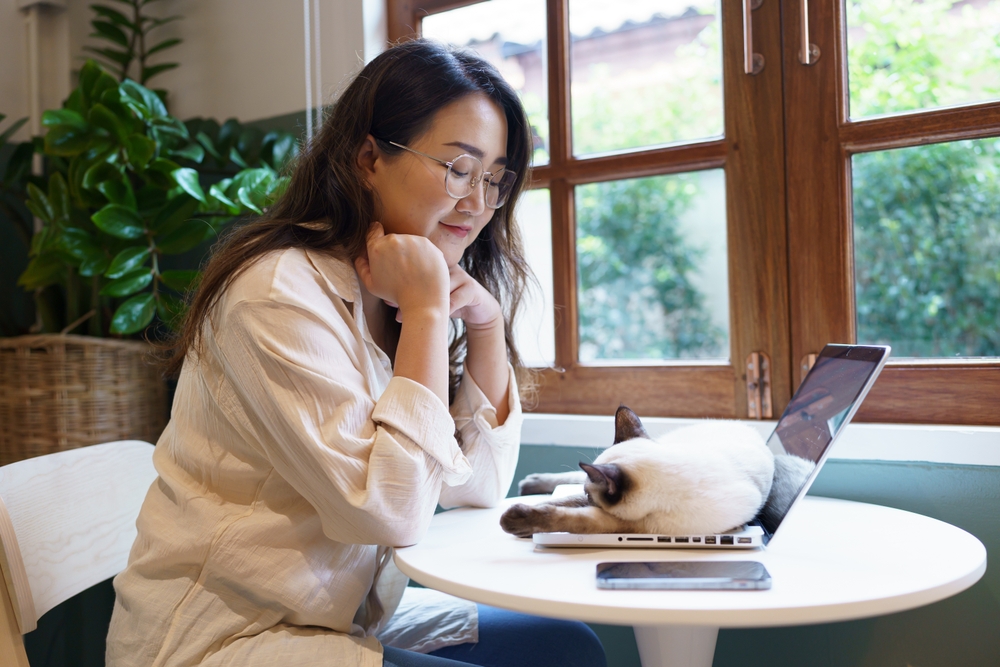

You close the last tab of a video call, open a new document, and start typing. Thirty seconds later, there’s a weight on your wrists. A chin on the keyboard. A tail draped across the trackpad with what can only be described as deliberate calm. Your cat, who has been asleep in another room for the past three hours, has materialized the exact moment you need to concentrate. It feels like mischief. It might actually be something far more interesting.
Cats have lived alongside us for roughly 9,000 years, and we still don’t fully understand what drives them. The laptop habit is a perfect case in point. Most owners assume it’s about warmth, or attention, or sheer feline obstinacy. All of those are partly true. But the real story layers those reasons in a way that says something genuinely surprising about how cats perceive us, our objects, and their place in our homes.
Understanding it changes nothing, practically speaking. Your cat will still sit on your keyboard. But knowing why shifts the whole thing from annoying to oddly touching.
The Heat Logic (And Its Limits)
A cat’s normal body temperature sits between 101°F and 102.5°F. That’s higher than our own resting temperature, which means the average room in the average house is quietly a little chilly for them. A radiator helps. A sunny windowsill helps more. But a running laptop, generating a steady low-level warmth right in the middle of your lap, is ideal.
Cats are most comfortable at temperatures much higher than the human-preferred room temperature of around 68°F – their thermoneutral zone sits between roughly 86°F and 100°F. This is the range where they don’t need to expend any energy to heat up or cool down. A laptop in use sits comfortably within that range on its warm underside, which is exactly where a cat rests when it plants itself across the keyboard. The cat isn’t just comfortable. It’s metabolically efficient. Zero effort required to stay warm.
But here’s where it gets more interesting. BBC Science Focus spoke with Dr. David Sands, an animal behaviorist with over 25 years of clinical experience, who pointed out a flaw in the warmth argument. The radiator is warmer. The radiator doesn’t move. The radiator is right there. And yet the cat chooses the laptop, specifically, consistently, and almost always when you’re using it. That requires a different explanation.
The Scent You Can’t Smell
Cats experience the world nose-first in a way humans genuinely cannot relate to. A cat’s sense of smell is far more powerful than ours, with about 200 million scent receptors in its nose compared to our mere 5 million. Every object you touch regularly absorbs your scent. Your coat, your pillow, your favorite chair, and your laptop keyboard, which your hands are on for hours every single day, all carry a concentration of your personal chemical signature that your cat can read as clearly as you’d read your name on a page.
The real attraction of a laptop to cats is the scent you regularly deposit there. “You won’t be able to sniff it, but a cat can smell you all over the keyboard.” But it doesn’t stop at attraction. While it’s possible a cat sits on a laptop because it enjoys the owner’s scent, another explanation goes further: the cat may actually want to deposit its own scent and supplant yours. It’s all about ownership.
When a cat sits on your belongings, they are engaging in a form of communication. Cats have scent glands in their paws and face that release pheromones, effectively marking items as part of their territory. This behavior helps create a sense of security and familiarity in their environment.
When your cat settles onto your laptop, those paw glands are actively depositing scent markers that you’ll never detect but that are completely legible to any other cat in the vicinity. Your laptop, in cat terms, is now their laptop. You are a useful human who happens to operate it.
If you’ve ever been charmed by your cat’s habit of rubbing its face against your chin, or nudging its head against the corner of your phone, the same logic applies. When cats headbutt objects or rub their face against things, they’re engaging in a behavior called bunting, which activates the facial scent glands and is both a marking behavior and a sign of affection. The affection is real. So is the ownership claim. Cats don’t see a conflict between the two.
Feline action runs deeper than territory. It’s how cats create their felt sense of home, marking a space as familiar, safe, and theirs by layering their chemical signature onto everything they care about. Your laptop, used every day while you sit in one place and radiate warmth and smell like yourself, is one of the most consistently you-scented objects in your house. Of course they want to sit on it.
The Attention Calculation
There’s a third force operating here, and it’s arguably the most socially sophisticated. Cats pay attention to what you pay attention to. They notice when you shift your focus away from them, and they adjust accordingly.
As researcher Kristyn Vitale has explained via Snopes.com, “If a cat is not getting enough social interaction, they may engage in attention-seeking behavior, such as meowing at the person or approaching the person and spending time near them. If a person is working on their laptop all day, it makes sense a cat would approach the area where the human spends time as a way to solicit attention from their owner.”
Vitale adds: “Some cats may sit on the laptop to be closer to their owner, while other cats may sit on the laptop because it is warm or for some other reason.” In other words: it’s never just one thing, and different cats weight the reasons differently. A particularly social cat who has been alone all day will show up the moment you open a screen because she’s learned, through repetition, that it works. Every time you’ve picked her up, given her a chin scratch, or even just said her name while moving her off the keys, you’ve reinforced the behavior. The cat has trained you as much as the reverse.
Notice, too, that cats rarely sit on a closed laptop left on the table overnight. The device only becomes compelling when you’re using it, when it’s warm, when it has your hands on it, and when your eyes are pointed somewhere other than them. They see you staring at the screen for hours, your hands moving rhythmically, and they realize the laptop is the primary competitor for your attention. By parking themselves on the keyboard, they are literally putting a social block on your other interests.
What This Tells Us About How Cats Bond
The laptop habit is a useful lens for understanding something that often trips people up about cats: they don’t bond the way dogs do. Dogs read your face. Cats read your presence, your warmth, your scent, your location in the room. When your cat plants itself on your keyboard, it’s choosing to be in the exact spot where all of those signals are concentrated.
Warmth relaxes their muscles, so they feel safer and calmer in warm spots. Layer that onto the scent-marking instinct and the social attention-seeking, and what you end up with isn’t an animal being difficult. It’s an animal using every tool in its repertoire to get close to something it’s attached to.
Some people try the decoy approach: leaving an old, unplugged laptop on the desk hoping the cat will settle for that instead. It rarely works. Without your warmth, your fresh scent, and your focused attention directed at it, a cold decoy is just a flat rectangle. The cat isn’t interested in the object. It’s interested in the combination of you and the object, and an unplugged laptop sitting alone on a desk has none of the qualities that made the real thing appealing in the first place.
If redirection is the goal, a heated cat bed placed within arm’s reach, slightly elevated so the cat can still see your face, tends to work better than pretending another object is equivalent. Providing a different heated area to sit on, such as a heated cat bed, or a DIY version with a warm hot water bottle under blankets, gives cats the warmth component without the keyboard conflict. Warm, visible, close to you: that hits enough of the cat’s actual criteria that many will accept the trade.
Read More: The Evolutionary Secrets Behind the Perfection of Cats
The Thing That’s Actually Going On
Here’s what all of this points to, when you pull back far enough: your cat doesn’t want your laptop. It wants you, specifically, in the way that cats want things, which is through proximity, warmth, scent, and the low-grade reassurance of mutual presence. The laptop just happens to be the object that concentrates all of those qualities in one place, right when you’re most unavailable.
Whether that’s touching or maddening probably depends on how tight your deadline is. But it’s worth sitting with the fact that the behavior, annoying as it is, isn’t random. Your cat shows up the moment your attention goes elsewhere because it has learned, over time, that you are worth competing with a screen for. That’s not nothing.
The cats who never bother with laptops, who sleep across the room and don’t seem to care what you’re doing, are telling you something too. The one who shows up every single time you open your computer and refuses to accept any substitute is showing you, in the only language it has, that it finds you genuinely worth the effort. You can decide for yourself whether that makes it easier or harder to move it off the keyboard.
AI Disclaimer: This article was created with the assistance of AI tools and reviewed by a human editor.