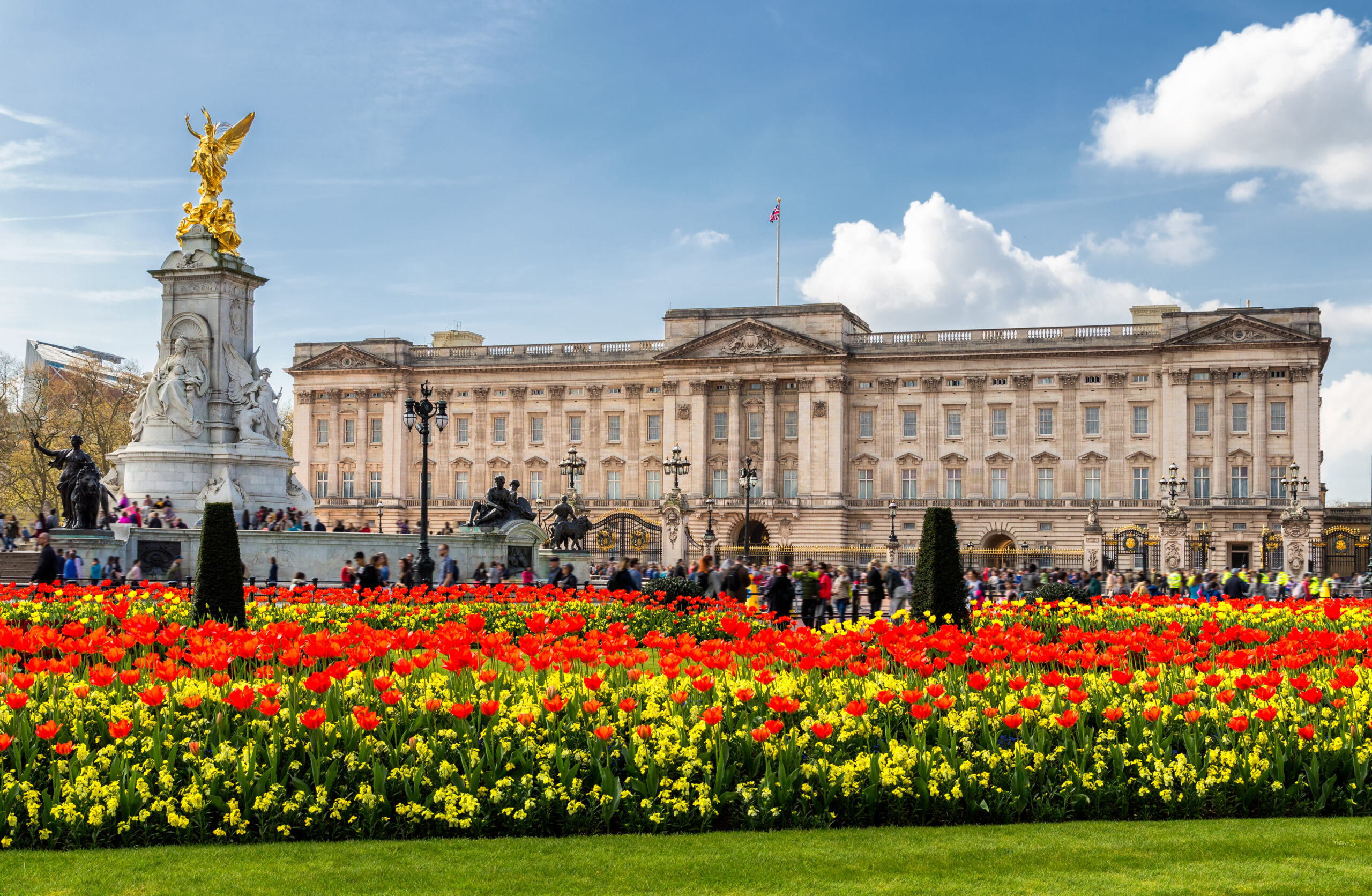

Every year, millions of people stream past the gilded gates of Buckingham Palace, crane their necks at the famous balcony, and take roughly the same photograph. They see the same polished stone façade, the same guards in bearskin hats, the same crowds pressing against the railings. Almost none of them walk away knowing that the building behind all that ceremony is genuinely, fascinatingly strange.
The palace held a teenager who broke in three times and walked out each time with royal property. Its walls are technically built from 200-million-year-old dead microbes. The balcony everyone photographs wasn’t part of the original plan. Most of what tourists discover about Buckingham Palace is whatever fits on a postcard. The real stories sit several layers deeper, in its history, its construction, its wartime record, and the quietly peculiar decisions made by the people who have lived and worked there. Eight of the best ones follow.
1. It Was Never Built for Royalty
Originally known as Buckingham House, the building at the core of today’s palace was a large townhouse built for the Duke of Buckingham and Normanby in 1703. The Royal Family’s official site records that George III acquired it in 1761 as a private residence for Queen Charlotte, and it became known as The Queen’s House. There was nothing particularly regal about the intention. George III wanted somewhere comfortable and convenient near St. James’s Palace, where official court business actually happened. Buckingham House was, in the polite language of the era, a family home.
In the early 19th century, architects John Nash and Edward Blore enlarged the building, constructing three wings around a central courtyard. Buckingham Palace became the London residence of the British monarch only on the accession of Queen Victoria in 1837. She was the first monarch to actually live there, moving in just weeks after taking the throne at 18 years old. The palace that Britain had been expanding and spending money on for decades had, up to that point, never had a ruling monarch sleep in it.
William IV, who preceded Victoria, was offered a perfectly complete palace and simply refused to move in. When the Houses of Parliament burned down in 1834, he reportedly offered Buckingham Palace to Parliament as a replacement. Parliament declined. Queen Victoria was the first sovereign to take up residence, in July 1837, and in June 1838 she became the first British sovereign to leave from Buckingham Palace for a coronation. The famous central balcony that now defines the building was added for her coronation celebrations. Everything iconic about the palace as the royal home flows from decisions made by one 18-year-old woman.
2. The Walls Are Built From 200-Million-Year-Old Fossils
The material used to build Buckingham Palace, known as oolitic limestone, is almost completely made of millimeter-sized spheres of carbonate called ooids. ANU researchers found that these building blocks were made by microbes that lived up to 200 million years ago, during the Jurassic period. At a microscopic level, the stone is a compressed graveyard of ancient organisms that predate the dinosaurs.
For decades, scientists assumed these tiny spheres formed the way a snowball does: rolling around on the seafloor and accumulating layers of sediment. The ANU research debunked that entirely. The ooids were made of concentric layers of mineralised microbes, not layered sediment as previously believed. The same Jurassic oolite was used to construct numerous other famous buildings, from those in the British city of Bath to the Empire State Building and the Pentagon. So while Buckingham Palace and the Pentagon share nothing in terms of purpose or politics, they share a building material: fossilized ocean microbes from roughly the same geological era. The palace’s limestone is not merely old. It’s ancient in the way geologists mean when they say that word, and it takes the ordinary act of looking at a stone wall and makes it something else entirely.
3. A Teenager Broke In Three Times – and Walked Away Each Time
Edward Jones, also known as “the boy Jones,” was an English teenager who became notorious for breaking into Buckingham Palace several times between 1838 and 1841. Jones was just fourteen years old when he first broke in, in December 1838. He gained entry to what was, in theory, a heavily guarded royal residence, walked around largely undetected, and left with a collection of items that would have made a Victorian novelist blush.
He was found in possession of stolen items but was acquitted at trial. He broke in again in 1840, ten days after Queen Victoria had given birth to Princess Victoria. Staff found him hiding under a sofa, and he was arrested and questioned by the Privy Council. The monarchy’s response was to conduct the hearing in secret to avoid the media frenzy that had accompanied the first arrest. It did not help. He was released in March 1841 and broke back into the palace two weeks later, where he was caught stealing food from the larders.
The Wikipedia page on the boy Jones captures just how far the story became a kind of running public comedy. The press loved him. His intrusions involved hiding in chimneys, stealing undergarments, and lingering undetected for cumulative stretches that deeply unsettled the royal household. Queen Victoria reportedly checked beneath her bed for years afterward. Eventually, unable to deter him legally, the government had him quietly shipped off to sea duty in the Royal Navy. One imagines the palace’s security was substantially upgraded after that.
4. Princesses Elizabeth and Margaret Ran a Girl Guides Troop Inside the Palace
The 1st Buckingham Palace Guide Company was established in 1937 for Princess Elizabeth and Princess Margaret, making the two princesses the first members of the British royal family to join the Girl Guide movement as children. The idea came partly from their governess and the Queen Mother, who felt strongly that growing up inside palace walls shouldn’t mean growing up entirely cut off from ordinary childhood experiences.
According to Girlguiding, the Queen became a Guide in 1937 at age 11, when a Guide leader called Miss V. M. Synge was invited to Buckingham Palace, where she met Princess Elizabeth, Princess Margaret, and 14 of their cousins and friends. The company first met on 9 June 1937, with Princess Elizabeth elected as seconder of the Kingfisher Patrol, Patricia Mountbatten serving as her patrol leader. The twenty girls who made up the company were children of members of the royal household and palace employees. They hiked at Windsor Forest, camped at Frogmore House, earned badges in swimming, first aid, and horse riding, and used the palace’s own corridors for signaling practice.
The company was set up so the two princesses could mix with children beyond the palace walls, particularly once it became clear that Princess Elizabeth would one day be Queen. It remains one of the more quietly striking details of Elizabeth’s early life: the heir to the throne, earning her camping badge in a palace summerhouse.
5. German Bombers Hit It Nine Times During World War II – and the Royals Refused to Leave
Buckingham Palace was bombed nine times during the Second World War. The raids caused considerable damage to the Chapel and resulted in the destruction of the Northern Lodge, where a policeman was killed by flying debris. The palace was not caught in the crossfire accidentally. As the Royal Collection Trust records, King George VI’s diary noted after one attack: “The aircraft was seen flying along the Mall before dropping the bombs… It was most certainly a direct attack on B.P. to demolish it.”
Rather than flee the city under bombardment, King George VI and his wife Queen Elizabeth remained at Buckingham Palace in solidarity with those living through the Blitz. It was a highly symbolic decision and received considerable attention in the press. After one particularly close call, the Queen is widely reported to have said she was glad the palace had been bombed, because it meant the royal family could now look the East End, the most heavily devastated part of London, in the eye. The King and Queen had been advised by the Foreign Office to immediately flee the country. Their steadfast refusal showed a commitment to the United Kingdom that the public deeply appreciated. Staying put when bombs were landing thirty yards away was not a small thing.
6. It Has 775 Rooms – and Most People Will Never See the Half of Them
The balcony appearances and the state rooms tourists visit each summer represent a thin slice of what Buckingham Palace actually contains. The palace has 775 rooms in total, including 19 State rooms, 52 royal and guest bedrooms, 188 staff bedrooms, 92 offices, and 78 bathrooms. The sheer administrative scale of the place is easy to underestimate when you’re looking at it from behind a railing fifty metres away.
The building is 108 meters long across the front, 120 meters deep including the central courtyard, and 24 meters high. That is roughly comparable to a 23-storey building laid on its side. The 188 staff bedrooms alone suggest an in-residence workforce most small hotels would envy. The 92 offices are a reminder that Buckingham Palace is not just a home or a landmark but a functioning workplace, processing the business of the Crown daily.
The room count doesn’t capture the variety. Today, Buckingham Palace is a working building and the centerpiece of the UK’s constitutional monarchy, serving as the venue for royal events from entertaining foreign heads of state to investitures and receptions. The State Rooms open to the public each summer, but the palace’s remaining rooms carry on with the quiet, unobserved business of running a modern monarchy.
7. The Gardens Are Bigger Than You Think – and Home to a Private Lake
Buckingham Palace grounds stretch across 39 acres, with gardens surrounding the grand façade. That is a substantial private green space sitting in the middle of one of the world’s most expensive real estate markets. The gardens contain a lake, walking paths, a tennis court, and a helicopter landing area, none of which are things the average London garden manages to include.
The gardens are probably best known to the general public for the royal garden parties held there each summer, where roughly 8,000 guests at a time drink tea on the lawn. Less well known is that the lake in the grounds functions as an unofficial urban nature reserve, with herons and unusual duck breeds recorded among the resident bird species. The garden’s mulberry trees carry an additional layer of history: the site was originally a mulberry garden planted by King James I in the early 1600s, intended for silkworm cultivation. The silkworm plan never worked. The mulberry trees, or at least their descendants, are still there.
8. It Contains Its Own Police Station, Post Office, and Medical Clinic
This is the one that tends to stop people mid-conversation. Buckingham Palace doesn’t just have 775 rooms. It has amenities. Inside the palace, there is a post office, a movie theatre, a police station, and a clinic. The palace operates closer to a self-contained village than to any conventional private residence.
The reason for this becomes clearer when you consider what the palace is actually for. It hosts hundreds of events annually, employs a large permanent staff, and operates as both a working government headquarters and a functioning royal home. An on-site medical clinic makes practical sense when several hundred people are working in the building on any given day. A police station follows naturally from being one of the most security-sensitive addresses on the planet. The post office handles the extraordinary volume of correspondence that flows in and out, with an estimated 70,000 items of mail annually addressed to the royal family.
What it adds up to is a building that has, across three centuries and thirteen monarchs, quietly evolved into something no architect originally planned for: a fully operational town that also happens to be a royal palace.
Read More: Inside the Role of a “Working Royal” and Why Most Royals Don’t Qualify
More Than a Backdrop
Most landmarks are content to be symbolic. Buckingham Palace has managed to be symbolic, historically turbulent, architecturally strange, and quietly bizarre all at once, usually without anyone outside its gates noticing any of it.
The things that make it genuinely interesting are not the things that photograph well. They are the 14-year-old boy hiding under a sofa in the queen’s dressing room. They are the fossilized ocean microbes packed into every square meter of the façade. They are two young princesses practicing first aid and earning camping badges in the palace gardens, because someone decided they deserved a normal childhood. They are a king and queen sitting in a corridor, ducking away from windows while bombs fell thirty yards away, deciding to stay anyway.
The palace won’t tell you any of this when you walk past the gates. But it’s there, in the walls.
AI Disclaimer: This article was created with the assistance of AI tools and reviewed by a human editor.