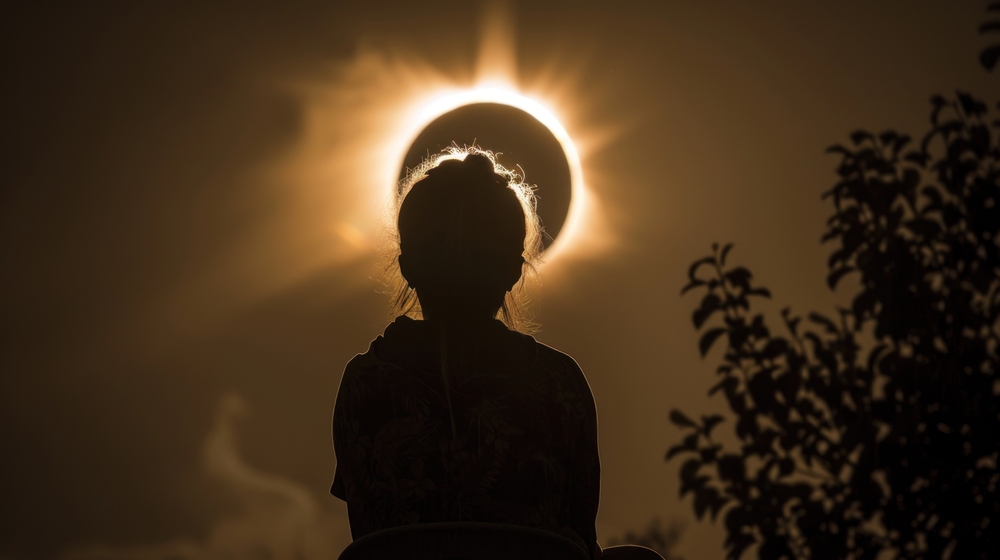

There’s a version of this that almost every one of us has experienced: standing outside during a partial solar eclipse, squinting through cardboard glasses at a crescent-shaped sun, feeling the temperature dip by a degree or two, and thinking, that was it? A partial eclipse is a pleasant curiosity. What astronomers are predicting for August 2, 2027 is something else entirely. Something that stops people mid-sentence. Something that, once witnessed, tends to reorganize a person’s sense of scale.
The story of this particular eclipse is one of genuinely rare cosmic timing, the kind where multiple factors line up in a way that simply won’t repeat for most people alive today. There’s a path involved, stretching from one end of the Mediterranean to the Arabian Peninsula, cutting through some of the most ancient and storied landscapes on Earth. There are cities that have stood for millennia that will, for a few minutes, go dark at noon. And there is a duration of darkness that sets this event apart from every other eclipse of our lifetime.
Getting there requires planning, and the window to act is already narrowing. But before the logistics, it helps to understand what makes this event so different from the ones that came before it.
Why This Eclipse Is in a Category of Its Own
The eclipse has been nicknamed “the Eclipse of the Century,” and the numbers behind it justify the label. According to NASA, the maximum duration of totality will stretch to 6 minutes and 23 seconds, making it the longest stretch of totality until 2114 from easily accessible land. To put that in perspective, the 2024 North American eclipse lasted just 4 minutes and 28 seconds at its peak. And the legendary “Great American Eclipse” of 2017? Its totality lasted just 2 minutes and 40 seconds.
The 2027 eclipse is technically the second longest total solar eclipse of the 21st century, with the longest being the eclipse of July 22, 2009. That event’s maximum duration of 6 minutes and 39.5 seconds occurred over the Pacific Ocean, with the longest stretch on land falling on the remote and uninhabited island of North Iwo Jima. In other words, the 2009 eclipse was longer in theory but essentially unwatchable for ordinary people. The 2027 event offers its record-breaking duration to anyone willing to travel to some of the most accessible and scenic parts of the planet.
The long duration comes down to cosmic geometry. The eclipse occurs about 2.5 hours before the Moon reaches perigee, its closest point to Earth, which makes the Moon’s apparent size larger than usual. That enlarged silhouette means the Moon can block the Sun for an extended stretch as it sweeps across the solar disk. Meanwhile, the point of greatest eclipse falls in a region where the Sun hangs nearly overhead, which adds precious extra seconds to the shadow’s sweep.

The last comparable duration occurred in 1991, and the next won’t arrive until 2114. Anyone who misses 2027 will need to live to 116 years old to get another shot at totality of this length on land.
The Path: A Line Through Ancient Places
Totality will begin over the eastern Atlantic Ocean and travel across the Strait of Gibraltar between Spain and Morocco, continuing across parts of North Africa and the Middle East. According to the National Solar Observatory, the total solar eclipse will cross Spain, Gibraltar, Morocco, Algeria, Tunisia, Libya, Egypt, Saudi Arabia, Yemen, and Somalia, with cities under the path of totality including Cádiz, Tangiers, Gibraltar, Benghazi, Luxor, and Jeddah.
Duration grows as the shadow moves east. Tarifa, at Spain’s southernmost tip, receives just under five minutes of totality. By the time the shadow reaches Egypt, the numbers are remarkable. Luxor lies almost directly in the path, offering 6 minutes and 19 seconds of totality under August skies with average cloud cover below 1%. The Karnak Temple complex, the Valley of the Kings, the feluccas on the Nile – all of it goes dark for over six minutes.
The August 2027 total solar eclipse is expected to draw large numbers of tourists and become the most photographed astronomical event in history. As of December 2025, regions in southern Spain and Morocco were already reporting early hotel sell-outs, with travel operators predicting a multi-million-euro surge in tourism.
The human scale of this event is hard to grasp. An estimated 89 million people live in the path of totality – at least double the 44 million who lived within the path of the April 2024 solar eclipse in North America – and one estimate suggests over 200 million people could attempt to watch it.
Where to Actually Stand
Location strategy matters more for this eclipse than most. The difference between a good view and a clouded-out disappointment comes down to knowing what the weather data actually says.
The best news comes from the Egyptian stretch of the path. Eclipsophile, which publishes detailed climate analyses specifically for eclipse planning, reports that few eclipses come with a guarantee of cloud-free skies, but parts of the 2027 path across North Africa come very close, with a broad area of clear conditions along the track, particularly over Egypt and Libya. For those wanting virtual certainty, Siwa Oasis or the Bahariya Oasis in Egypt both have almost no prospect of cloud and appear relatively immune from dust storms.
The western end of the path tells a different story. Around the Strait of Gibraltar, where cruise ships and tour operators are concentrating, average August cloud cover hovers near 30 percent, with localized low-pressure systems funneling moisture into the Strait. Spain and Morocco offer shorter totality durations and less reliable skies. The optics are beautiful, the culture is extraordinary – but if your priority is actually seeing the corona, Egypt is where the science points you.
The path does skim the northern edge of the Sahara Desert, which lends its character to the weather picture: hot, dry, sunny, and occasionally dusty. Dust, rather than cloud, is the more realistic concern in the desert stretch. Meteorologists note that the same desert air that drives temperatures toward 43 degrees Celsius also responds quickly when sunlight cuts out during totality. There are some helpful ways to make sure you catch every lasting moment.
What You’ll Actually See
People who have never witnessed a total solar eclipse often struggle to understand why veteran eclipse chasers travel to remote corners of the globe, sometimes multiple times per decade, chasing the same event. The answer lies in the sequence of phenomena that unfold in the final seconds before the Moon fully covers the Sun – a sequence so compressed and so unlike anything in ordinary experience that it tends to produce an involuntary, physical reaction.
It begins with what’s known as Baily’s Beads. According to Science Notes, Baily’s Beads are a string of bright points where sunlight streams through the Moon’s valleys, named after the British astronomer Francis Baily. They appear in the seconds leading up to totality, caused by sunlight passing through the valleys and between mountains on the Moon’s irregular surface. The Moon is not a smooth sphere – its surface is a jagged landscape of craters and ridges, and those ridges act like a stencil, letting through fragments of sunlight even as the disk itself is nearly covered.
Those beads then disappear and collapse into a single bright spot of sunlight resembling a giant diamond in the sky, with the Sun’s atmosphere forming the ring’s band – a moment known as the diamond ring effect, which signals that totality is almost upon you. At that instant, eclipse glasses come off. The Moon then passes directly between the Earth and Sun, completely blocking the solar disk. The sky darkens as if it were dawn or dusk, birds and other animals may act strangely, stars and planets appear in the sky, and the Sun’s outer atmosphere – the corona – blazes from beyond the Moon’s edge.
During the 2027 eclipse, Venus will definitely be visible if the sky is at all transparent. Mercury will be several degrees to the west of Venus, and Venus will appear alongside Jupiter in the constellation Gemini. In other words, the sudden darkness won’t just reveal one or two faint stars – it will produce a briefly visible planetary tableau in the middle of a summer morning.
The Safety Conversation You Need to Have Before You Go
The excitement around this eclipse has generated a good deal of misinformation circulating online, and some of it can cause real harm. The rules around eye safety during a solar eclipse are simple but non-negotiable.
Looking directly at the Sun is unsafe except during the brief total phase, when the Moon entirely blocks the Sun’s bright face, and that only occurs within the narrow path of totality. Before and after totality, the only safe way to view the Sun is through special-purpose solar filters, such as certified eclipse glasses or hand-held solar viewers. Homemade filters and ordinary sunglasses, even very dark ones, are not safe for solar viewing.
The critical moment to remember: the only safe time to look without eclipse glasses is during totality itself. Even a sliver of direct sunlight will damage your retinas. As totality ends and that diamond ring reappears, glasses go back on immediately.
There’s an additional celestial footnote worth knowing: the path of the 2027 eclipse will be crossed by the path of another total solar eclipse less than seven years later, on March 20, 2034, at a point on the southeastern coast of Egypt. These intersections are unusual – the average interval for any given spot on Earth to see a total solar eclipse is about once every 375 years. A small part of Egypt will effectively win the cosmic lottery twice in under a decade.
What to Do Now
The gap between reading about this eclipse and actually experiencing it is purely logistical – but the logistics are tightening fast. As of December 2025, a year and a half before eclipse day, regions in southern Spain and Morocco were already reporting early hotel sell-outs. Egypt, with its superior sky conditions, is likely to follow suit as the event draws closer and awareness grows.
The practical calculus is this: totality is experienced inside a narrow corridor, and every kilometer you are outside that corridor means a partial eclipse instead of the real thing. Positioning matters more than comfort; a dusty camp chair on the centerline in the Egyptian desert will deliver a better experience than a five-star hotel in Tangier with cloud cover.
The next total solar eclipse after 2027 arrives on July 22, 2028, visible from Christmas Island, the Cocos Islands, parts of Australia, and New Zealand – but its totality will be shorter. A longer eclipse on easily accessible land won’t occur until June 3, 2114. The 2027 eclipse, with over six minutes of totality, reliably clear skies above some of the world’s most iconic landscapes, and access to hundreds of millions of people who could realistically get there, is genuinely unlikely to be repeated in most people’s lifetimes.
Start planning now. Book early. Choose Egypt if the sky is your priority. And when the Moon finally slides into place and the world goes quiet, put the camera down for at least a few seconds. Some things are worth seeing with your own eyes.
AI Disclaimer: This article was created with the assistance of AI tools and reviewed by a human editor.