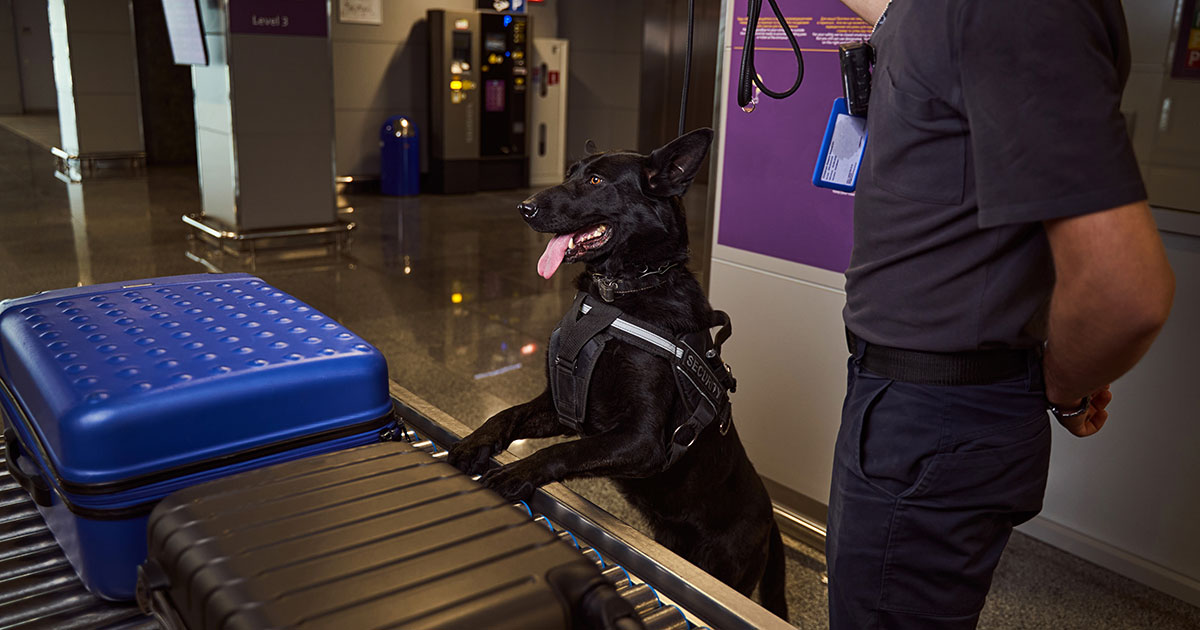

Imagine spending six years showing up every single day with the same partner. You read their moods before they say a word. You trust them with your safety. You know their habits, their quirks, the particular way they signal that something is wrong. Then one day, the job is done. What happens next?
For most TSA explosives detection dogs, the answer involves a very good boy, a crowded airport room, and an absolute avalanche of tennis balls.
It sounds like a scene from a feel-good film, but it’s entirely real. Across the country, TSA canine handlers have been throwing retirement parties for their partners that are equal parts ceremony and pure joy. And the reason these celebrations have captured so many people’s hearts has less to do with the tennis balls than with what they represent: years of a bond so close, so daily, and so genuinely mutual, that sending a dog into retirement deserves exactly this kind of send-off.
Seven Years of Work, One Final Search
Ari, an eight-year-old German Shorthaired Pointer, worked at Indianapolis International Airport since 2018, spending the last five years with handler Keith Gray. In April 2025, when Ari’s time came to retire, Gray organized one last exercise. On April 17th, Gray set up a suitcase for Ari to find. When Ari found it, TSA employees surprised him by dumping boxes of tennis balls for him to play with. Ari will spend his retirement at home with Gray, alongside his dog brother TTirao, who is also a retired TSA canine.
Ari’s story isn’t unique. It’s a pattern. At Reagan National Airport in 2024, a training aid was concealed in a large room and Messi, along with his handler, searched the room. When Messi “hit” on the device, he was showered with tennis balls tossed his way by the other canine handlers. Messi was thrilled. Messi was the longest-serving passenger screening canine at the TSA, having served for six years before finally retiring. At Chicago O’Hare in May 2025, it was the same story: Panka, an eight-year-old German Shorthaired Pointer, had worked with handler Pete Kligerman for nearly six years. To celebrate her retirement, team members showered her with toys and tennis balls after her final training exercise, signaling the end of her service career.
The tennis balls aren’t random. Dogs in the TSA program are trained using reward-based methods, and for most of them, a ball is the ultimate payoff after a successful find. The retirement party simply takes that reward and multiplies it by about three hundred.
What It Takes to Get There
Understanding how much these dogs have given starts with understanding how much went into training them. TSA trains each of its explosive detection canines at the TSA Canine Training Center, located at Joint Base San Antonio-Lackland in San Antonio, Texas. Considered the “Center for Excellence” for explosives detection canine training, the TSA National Explosives Detection Canine Team Program is the Department of Homeland Security’s largest explosives detection canine program.
Each year, roughly 300 new canine recruits and their handlers complete an intense 16-week training course at the center. The facility itself is a $12 million operation with over 25,000 square feet of space, seven classrooms, a 100-seat auditorium, and kennels for roughly 350 dogs. The training environment is deliberately designed to mirror the real world. Its most distinctive feature is 17 indoor training venues built to replicate real-world transportation environments, including airport gates, checkpoints, baggage claim areas, air cargo facilities, light rail cars, and even the interior of a passenger aircraft.
On average, it costs $33,000 to train an explosives detection dog and handler team, and $46,000 for passenger screening teams. Not every recruit makes it through. About 80% of assigned canines successfully graduate from the TSA Canine Training Center program. The ones that don’t graduate aren’t cast aside. Dogs that don’t make it through the program are offered for adoption through the TSA’s Canine Adoption Program. They might have been cut because they were overly playful or didn’t take commands adequately – which, for a dog, really does sound more like a personality trait than a failure.
Canine teams may consist of transportation security specialists or local and state law enforcement officers who are paired with explosives detection canines and work in airports, mass transit systems, maritime and cargo facilities across the nation. TSA has more than 1,000 canine handler teams deployed in support of security and screening operations nationwide.
The Patch That Means Everything
One detail in these retirement ceremonies carries more weight than it might appear. When a TSA dog officially retires, the handler removes the “Do Not Pet” patch from the dog’s working harness. After Rex alerted on a scent on a decoy passenger at his Milwaukee retirement party, his handler Regina Eisenberg removed his “Do Not Pet” patch from his harness, officially signaling that the dog was no longer a working canine and could be petted. There was no shortage of guests eager to pet the newly retired dog.
It’s a small gesture, but it redraws the entire relationship between the dog and the public in an instant. For years, that patch has been a quiet instruction to strangers: this animal has a job, and that job requires focus. Taking it off says something different. It says: the work is done. You can say hello now.
What comes next matters enormously for the dog. Research published in Frontiers in Veterinary Science found that when a working dog’s tasks are no longer rewarded or are actively discouraged in retirement, the dog may become frustrated and anxious. In essence, the dog may need to be re-trained to not function as a working dog. As researchers have begun to understand more about canine cognition, there is growing evidence that the loss of purpose associated with retirement may carry an emotional toll. The structure and routine of the job, for a dog that has known little else, isn’t something to simply switch off.
This is one reason continuity matters so much in the TSA program. The most common outcome after retirement is also the most reassuring one.
A Retirement That Looks Like Home
According to TSA’s Canine Coordinator, “the handler or supervisor will submit a request to retire the canine and generally will ask to adopt [the dog].” The determination is made by TSA’s National Explosives Detection Canine Team Program in consultation with the agency’s Canine Training Center and veterinary professionals as needed.
In most cases, that request is granted, and the dog simply moves from being a work partner to a household companion – without ever changing address. The same person who spent years reading the dog’s signals in a busy terminal is now the person handing over the evening meal and the spot on the couch.
Occasionally, handlers can’t take their dogs home. Life changes, financial constraints, or simultaneous retirement can all create complications. A TSA canine headquarters coordinator described it as rare but real: “It may be a family situation, or the handler is retiring simultaneously and a pet may not fit into their retirement plans. It may also be a financial consideration. Adopting a former working canine comes with some very specific veterinary needs.” When that happens, TSA has partnered with outside organizations to find a permanent home, including Project K-9 Hero, which has helped cover over $30,000 in medical costs for several TSA canines since 2016.
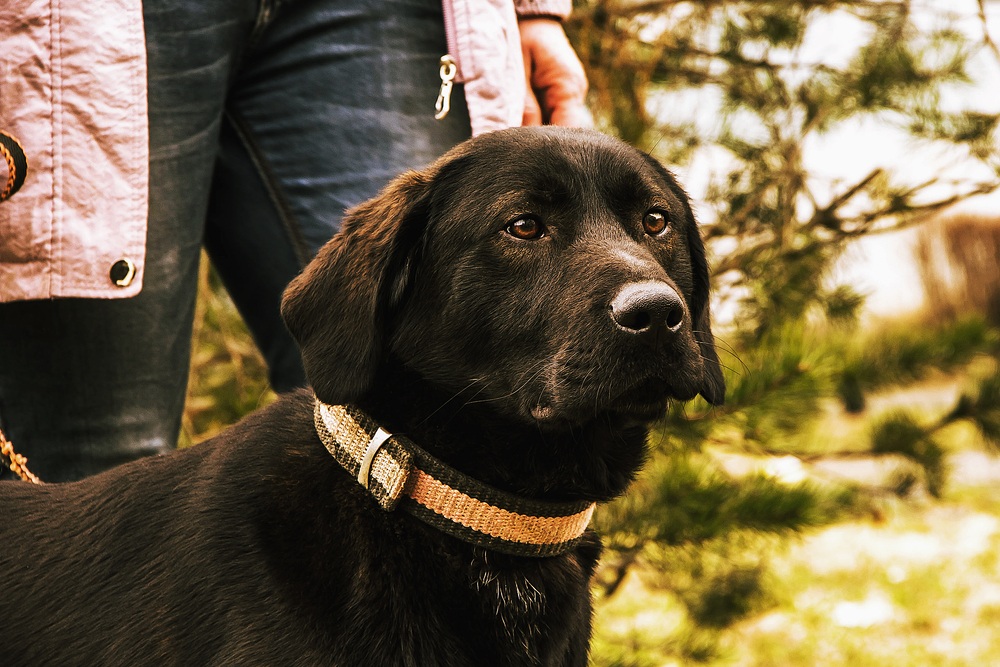
For those dogs who do retire to their handler’s home, the transition can look almost comically serene. One retired TSA canine named Rex, adopted by a family after his handler couldn’t take him in, now wakes up around 6 a.m., stretches, and takes a two-and-a-half-mile walk before breakfast. The rest of the day is spent lounging, napping, and sniffing around the house. He still sometimes seems to think he’s on the job.
The Bond That Makes This Make Sense
None of this – the ceremonies, the reunions, the careful adoption processes – would mean as much if the relationship between handler and dog weren’t genuinely deep. And the science suggests it is.
A strong canine-human bond forms between a dog and a handler while they perform jobs together, and that bond is required to safely and quickly complete the work. Many handlers also live with their canine partners, which deepens the connection between both parties. What this produces over months and years is something that functions less like a professional arrangement and more like a close friendship with a different communication style.
A 2026 study published in MDPI’s Animals journal examined what happens to animal-assisted services volunteers when their dog partner retires or dies. When service is intrinsically motivated and integrated into one’s sense of self, the loss of a dog partner who enables that service can generate both relational grief and role-based loss, helping to explain experiences of prolonged distress and grief. For TSA handlers, the retirement of a dog doesn’t just mean the end of the working relationship. It’s a shift in identity, daily rhythm, and the structure of the day itself.
One TSA canine coordinator put it plainly: “Executing this mission builds a bond between the handler and canine that is undeniably unique and stronger than most people will ever experience with a four-legged friend. We understand the bond firsthand and will always exhaust all efforts to care for our partners while on duty and see to it they have a comfortable and well cared for retirement.”
The simple act of petting a dog releases oxytocin, the hormone associated with relaxation and bonding, fostering emotional resilience in humans. For handlers who have spent years working beside an animal trained to detect invisible threats in crowded spaces, that bond runs considerably deeper than most people’s afternoon walk with the family pet.
What This Means
There’s something worth sitting with in the way these retirement parties are designed. The TSA could simply process a dog out of service and move on. Instead, handlers build little ceremonies that speak directly to the dog’s own experience: one final search, one final reward, then an explosion of every dog’s favorite thing. The whole ritual is structured around what the dog would want.
That says something about how these partnerships actually work. Dogs and their handlers form a close bond that allows each to interpret the other’s body language correctly. The signals a dog gives when it “hits” on a scent – small pauses, tail flicks, puffing air with the nose – are different for every dog, and take dedicated, sustained training from the handler to learn how to correctly interpret. Years of that kind of attention creates a two-way relationship, not just a tool being operated by a technician.
When Ari bounded after those tennis balls in Indianapolis, or when Messi was showered with them at Reagan National, or when Panka got her pile of toys at O’Hare, the people in those rooms weren’t just clapping for a retiring colleague. They were acknowledging something a little harder to put into words: that an animal gave a significant portion of its life to a job it understood in its own way, beside a person who understood it in return. The party was the least they could do. And based on how enthusiastically the dogs took to the tennis balls, it seems the dogs agreed.
AI Disclaimer: This article was created with the assistance of AI tools and reviewed by a human editor.