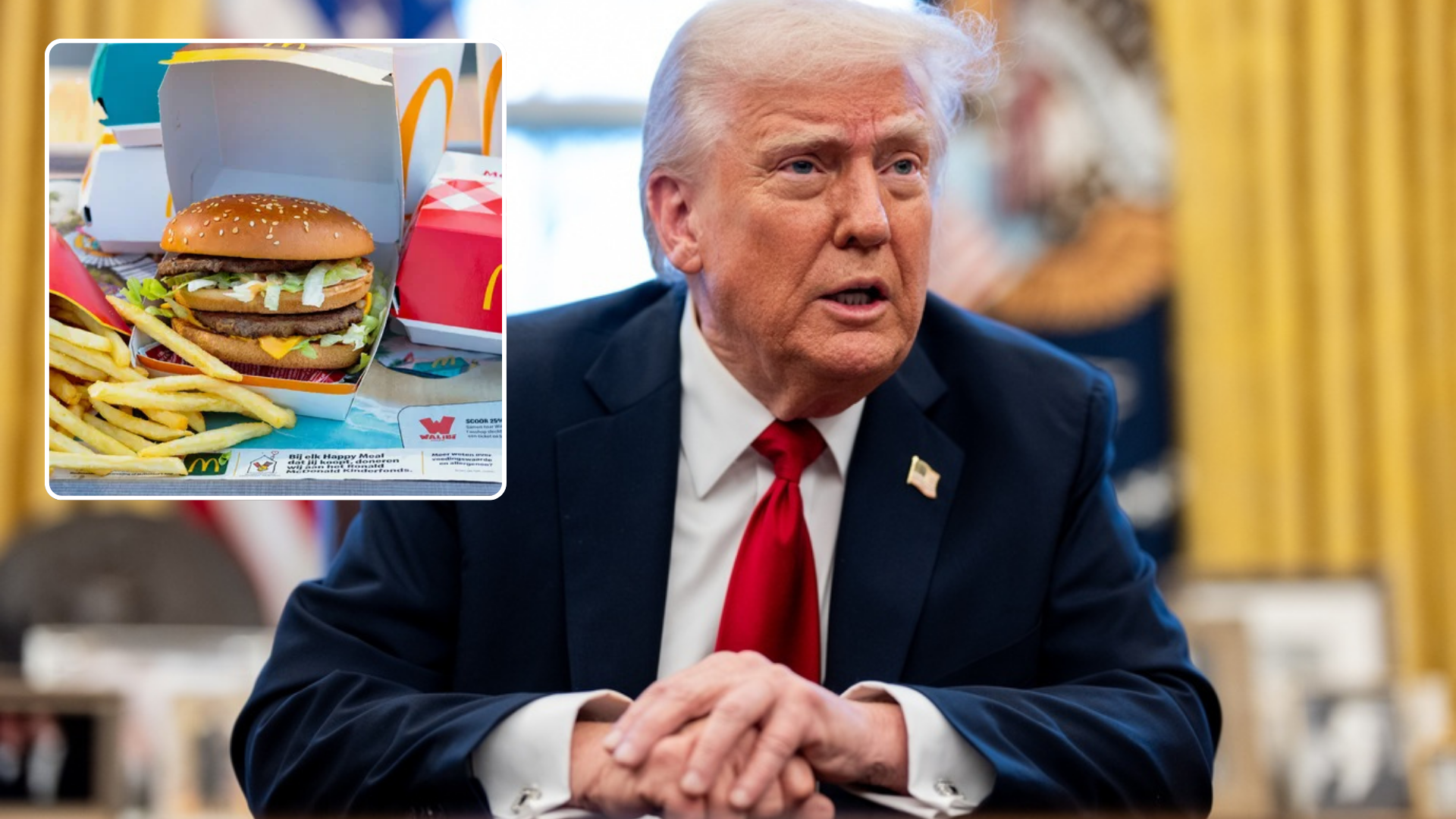

Picture yourself scrolling through the news on a Tuesday morning, coffee going cold beside you, when a headline catches your eye: the President of the United States has apparently told his doctor that Diet Coke kills cancer cells. Within hours, cable pundits are building entire segments around it. Social media is doing what it does. By lunchtime, it feels like half the country is either outraged or doubled over laughing – depending on which side of the aisle they’re sitting on.
But here’s the thing that tends to get lost in the noise: who actually has access to this information from the inside? Who actually eats with the man, travels with him, and watches what lands on his plate? For the most part, those people aren’t talking into cameras. So when someone who genuinely knows offers a detailed, specific, slightly surprising account of what President Trump’s diet really looks like day-to-day, it’s worth paying attention – not for the politics, but for what it tells us about the health of a 79-year-old man running the world’s most demanding job.
In April 2026, Dr. Mehmet Oz sat down with Dr. Marc Siegel for an interview that covered exactly that territory. What came out of it was a picture of President Trump’s diet and lifestyle that didn’t map cleanly onto the version most people had in their heads. Here are five things that came out of that conversation – plus what the science actually says about each one.
Observation 1: The Diet Coke “Cancer Killer” Comment Was a Joke
According to Dr. Oz, Trump has a habit of handling pushback with humor. During a conversation in which Oz gave him some grief about his diet soda habit, Trump responded: “What are you talking about? This stuff will kill grass. That’s why I think it probably kills cancer cells.”
Oz’s take was clear: “It was a joke. Obviously, no one is going to argue that diet soda has that impact.” He added that he found it funny that people seemed unable to read the room: “Nothing about that comment is dangerous or harmful.” White House Press Secretary Karoline Leavitt confirmed she had heard the joke before and said she believed most people took it in the right spirit.
Dr. Oz revealed these observations to Dr. Marc Siegel during an interview on SiriusXM’s “Doctor Radio Reports.” Siegel has hosted the SiriusXM show Doctor Radio Reports twice a week since March 2020. He is a clinical professor of medicine at NYU Langone Medical Center and serves as the medical director of NYU’s Doctor Radio on SiriusXM. In short, this wasn’t a tabloid report. It was a candid exchange between two physicians – one of whom spends significant time at the president’s side.
The April 2026 exchange happened in the context of an ongoing public discussion about Trump’s dietary habits – one that Oz joined precisely because he actually has access to the reality behind the headlines. Dr. Mehmet Oz, currently serving as CMS administrator, revealed five things about President Trump’s diet during the Doctor Radio Reports interview – and the first one was that a joke was being reported as a genuine medical claim.
The broader reaction told its own story. A video of Donald Trump Jr. and Oz discussing the president’s diet soda claims was posted to X by Republicans Against Trump in April 2026 and had been watched over 630,000 times at time of reporting. That’s a lot of traffic for a joke about lawn care.
Observation 2: Humor Is Actually Good Medicine
The real upshot of the Diet Coke joke may not be dietary at all – it may be psychological. Oz’s observation that Trump tends to deal with critics through humor rather than defensiveness is, from a health standpoint, not a bad trait to have.
Studies show that laughter has a significantly positive effect on mental health, helping to reduce anxiety, depression and stress – partly by triggering the release of dopamine, oxytocin and endorphins, chemicals associated with pleasure, motivation and learning. Some studies suggest that laughter can help to not just alleviate but actually reverse the body’s stress response.
Research has found that humor stimulates multiple physiological systems that decrease levels of stress hormones, such as cortisol and epinephrine. Those are the hormones that, over time, put strain on the cardiovascular system, dampen immune function, and make just about every chronic health condition worse. A president’s job is, by definition, one of the most stressful on the planet. The ability to find something funny – genuinely funny, not performed – is a genuine coping mechanism, not a character flaw.
While many of the health benefits of laughter are especially helpful later in life, we tend to laugh less as we age. In fact, children laugh approximately 400 times a day, while adults only manage around 15 times. Seen that way, a president who regularly makes himself and those around him laugh is doing something his body genuinely benefits from.
Observation 3: The Fast Food Logic Has Some Science Behind It
This is the one that surprised people the most, and it’s where the Dr. Oz Trump health interview got genuinely interesting. The public image of Trump’s diet – McDonald’s bags, Diet Coke by the case – has always been treated as an obvious health negative. But Dr. Oz offered context that most coverage of this topic ignores.
Dr. Oz told Siegel directly: “Sometimes he eats junky food. He says this to me, and others have heard this as well – when he’s on the road his main goal is to not get sick from a meal that’s not well-prepared. Going to the larger chain fast-food joints allows him to buy food that’s very standardized, very safe, and allows him to keep going at full speed.”
That’s not a ringing nutritional endorsement, obviously. But it’s a practical argument – and there’s data to back the food safety part of it. Research from the University of Pennsylvania found that chain restaurants committed an average of around six violations per health inspection, compared to an average of nine for non-chain locations. The standardization that makes fast food culturally maligned is also, in public health terms, a genuine advantage when it comes to consistency and food handling. Research has explored how restaurant chain status relates to food safety inspection outcomes – and chain restaurants generally come out ahead on compliance.
When it comes to what he eats away from the campaign trail, the picture looks different. Oz told Siegel: “When he eats on his own, back at Mar-a-Lago or the White House, he eats plenty of healthy foods that he has access to and that he generally consumes. I don’t think it’s fair to say that he has a ‘bad diet.'”
What does President Trump eat according to Dr. Oz? The short answer: healthier at home than most people realize, and strategic about fast food on the road rather than simply indulgent. That’s a more accurate picture than the one usually painted.
The counterpoint is real, though. Despite the MAHA movement’s 2026 Dietary Guidelines calling on Americans to ‘prioritize whole, nutrient-dense foods’ and ‘dramatically reduce highly processed foods,’ Trump continues to drink Diet Coke daily and is a known advocate of fast food. In January 2026, HHS Secretary Robert F. Kennedy Jr. said on a podcast that Trump ‘has the least healthy eating habits of anyone in the administration,’ specifically citing McDonald’s, candy, and Diet Coke consumed ‘at all times.’ RFK Jr. runs the MAHA movement – so that’s a pointed critique from within the same administration.
Observation 4: Demanding Work May Actually Protect the Brain
One of the more striking things Oz told Siegel was about Trump’s work ethic. He described the president as someone who calls at all hours, maintains intense focus, and is genuinely driven by wanting to execute his job well. From a cognitive health standpoint, that level of mental engagement may be more protective than it sounds.
A study from the Norwegian Institute of Public Health and Oslo University Hospital shows that people with cognitively demanding jobs during their 30s to 60s have a lower risk of mild cognitive impairment and dementia after 70 years of age than people with less cognitively demanding jobs. Having a routine job with little mental stimulation was linked to a 66% higher risk of mild cognitive impairment and a 37% greater risk of dementia after the age of 70, when compared with having a job with high cognitive and interpersonal demands.
High job control and high-skilled jobs are linked to lower dementia risk. There is growing research that suggests the jobs people have can impact their risk of dementia, with more complex jobs or those that require high levels of decision-making or creativity being more protective.
The presidency is about as cognitively demanding as it gets. Daily high-stakes decisions, constant problem-solving, managing an enormous range of relationships and competing interests – it’s exactly the kind of work that research associates with a stronger cognitive reserve. People with a history of cognitively stimulating occupations during their 30s, 40s, 50s, and 60s had a lower risk of mild cognitive impairment.
Observation 5: The “Calls at All Hours” Detail Is a Red Flag
Oz mentioned in passing that Trump calls at all hours of the night – framing it as evidence of his dedication and drive. Siegel, to his credit, flagged what that actually implies about the president’s sleep.
Americans who regularly sleep fewer than seven hours a night may be cutting their lives short, according to extensive research that examined sleep patterns and life expectancy across every county in the United States. As a behavioral driver for life expectancy, sleep stood out more than diet, more than exercise, more than loneliness – indeed, more than any other factor except smoking.
A meta-analysis of 79 cohort studies found that short sleep duration – defined as fewer than 7 hours per night – was associated with a 14% increase in mortality risk compared to getting 7 to 8 hours. That’s not a trivial number, especially for a 79-year-old. A 2025 study from Uppsala University found that just three nights of 4.25 hours of sleep increased inflammatory proteins in the blood, raising the risk of heart disease – even in healthy young men. If the effect is that dramatic in young adults, it’s worth taking seriously in someone approaching 80.
The sleep issue is arguably the one area where the Dr. Oz and Dr. Marc Siegel Trump health interview raised more concerns than it resolved. Oz described it as a sign of commitment. Siegel saw it as a health risk. Both things can be true simultaneously – and in this case, the research lands firmly on Siegel’s side of the argument.
What This Picture Actually Adds Up To
So what does President Trump eat according to Dr. Oz, and what does his lifestyle look like from someone who’s actually in the room? The Dr. Mehmet Oz reveals Trump diet observations as follows: more varied and health-conscious at home than publicly assumed, strategically pragmatic on the road, fueled by genuine humor, operating at high cognitive intensity, and probably undersleeping.
That’s not a clean bill of health. But it’s also not the cartoonish fast-food-and-nothing-else picture that tends to dominate coverage. The reality, as usual, is more complicated and more interesting.
The bigger takeaway might be about how we think about health in general. A major 2025 analysis by researchers at University College London, published in BMC Psychiatry, examined data from over 384,000 adults and found that occupational complexity accounted for 73 percent of the association between higher education and lower dementia risk. Work itself – the kind that demands real cognitive engagement – is a health variable. So is laughter. So is sleep. Diet is only one piece of a picture that has many moving parts.
Dr. Oz’s take on Trump’s diet is reassuring in some respects, sobering in others. But the most useful thing about it may be the reminder that health isn’t a single metric – it’s the sum of habits, choices, pressures, and biology all pushing and pulling at once. For a 79-year-old still working at the pace Oz describes, that balance is worth watching carefully. Even if he does insist the Diet Coke is doing him some good.
A.I. Disclaimer: This article was created with AI assistance and edited by a human for accuracy and clarity.