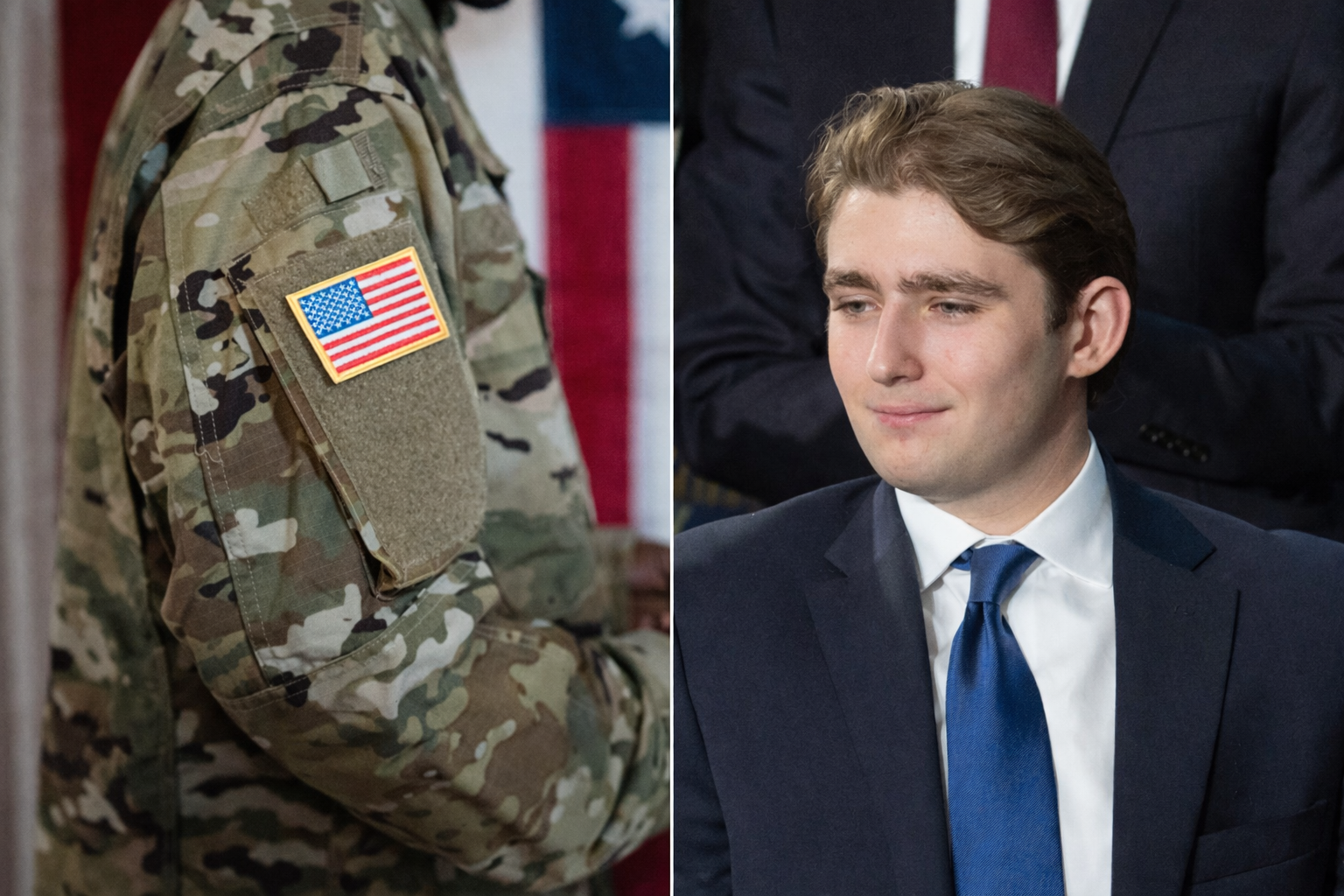

The anger around Barron Trump and a possible military draft is not really about one young man standing in a registration line tomorrow morning. It is about a much older American argument: who is expected to serve, who gets exceptions, and whether families with power are judged by the same rules as everyone else. The two source pieces you pointed to both build their story around the same basic tension. Online critics have been pushing #SendBarron, asking why the son of a president tied to military escalation should not face the same risks as ordinary families, while a height-based military standard has been floated as a reason he might not qualify for service in the first place.
That framing has made people furious because it lands on a nerve the country has hit before. Americans have been arguing about draft fairness for generations, especially when the children of presidents, senators, and wealthy families seem distant from the burdens placed on everyone else. In Barron Trump’s case, the controversy is intensified by two things at once. First, he is currently in the age range that matters for Selective Service registration. Second, the most viral claim about why he might avoid service is not a dramatic illness or an obvious disability, but a technical physical standard related to height and military fit. That makes the situation feel, to many critics, less like bad luck and more like another example of a system that can bend differently depending on who is involved.
Still, a lot of the commentary has been messy, exaggerated, or flatly wrong. The United States does not currently have an active military draft. Registration and induction are not the same thing. Men in the relevant age group still have to register with Selective Service, but registration alone does not mean they will be called into uniform. If a draft were ever activated again, Congress would have to authorize it, a lottery would determine the order of call, and those selected would then go through military processing, including physical, mental, and moral screening. That means the real question is not whether Barron Trump can avoid registration through some special loophole. The real question is what would happen later, if a draft actually returned and if his number came up.
What makes the whole episode more combustible is the family history sitting behind it. Barron Trump is not being discussed in isolation. People are reading his situation through the long shadow of Donald Trump’s own Vietnam-era deferments, including the bone spur medical exemption that has been debated for years. Once that history enters the room, the story stops being just about height regulations or draft mechanics. It becomes about whether one politically powerful family is once again being linked to a medical escape hatch, while other people’s children would be expected to carry the actual burden. That is why the outrage has grown so quickly. The details matter, but the symbolism matters even more.
Why Barron Trump Became the Focus
Barron Trump became the center of this debate for a simple reason: he is old enough for people to imagine him inside the Selective Service system, and he is prominent enough for that imagined scenario to become a political symbol. The Hearty Soul piece says he is 20 and attending NYU’s Washington campus, and the wider coverage around the controversy treats him as someone of draft age whose position in a presidential family naturally invites scrutiny when war talk rises. Critics online have leaned into that symbolism with hashtags, parody websites, and demands that presidential families should not be insulated from the consequences of military policy. It is not a legal argument as much as a moral one. People are asking whether the children of powerful leaders should feel even a fraction of the risk imposed on everyone else.
That kind of reaction has a long history in American politics. Whenever the possibility of war expands, the public starts looking not only at policy but at proximity. Who will actually serve? Who will be called? Who will be protected? Public anger rises fastest when it looks like leaders speak easily about force because their own families are unlikely to pay the same price. Barron Trump fits into that emotional pattern whether he asked to or not. He is a public figure by family connection, not by policy role, but that has never stopped Americans from turning presidential children into symbols during periods of military tension. In that sense, the current controversy is entirely familiar. The names change, but the argument is old.
What the Two Source Pieces Are Actually Arguing
The Hearty Soul piece argues that Barron Trump could potentially avoid conscription because of a rare military height rule and places that claim inside a larger online movement demanding he be treated like any other draft-eligible male. It also connects the present uproar to Donald Trump’s own Vietnam-era deferments and suggests that the current backlash is fueled by both family history and the optics of a president’s son benefiting from a technical standard that most people never think about. The Yahoo-linked celebrity coverage, which was indexed in search results under the headline about Barron facing more calls to be drafted after a loophole exposed the reason he could be exempt, clearly circulated the same narrative frame. In both cases, the central idea is the same: a height-based rule is being presented as a possible route away from military service, and people are angry because it feels unfair on its face.
But both pieces sit inside an online environment where dramatic framing moves faster than careful explanation. The viral version of the story often jumps straight from “he might be too tall” to “he gets a pass,” when the actual draft process is more layered than that. A physical standard can matter without amounting to an automatic, special, or secret exemption. It can also matter at a later stage, rather than at the registration stage. That distinction is where much of the confusion begins. The provided stories are useful for understanding why people are angry and what claim is driving the outrage. They are much less useful if read as if the matter has already been officially decided. It has not.
There Is No Active Draft Right Now
The first thing that has to be said clearly is that the United States does not currently have an active military draft. The Selective Service System still exists, and almost all male U.S. citizens and male immigrants ages 18 through 25 are required to register, but registration is only the standby framework. It is not the same thing as conscription. The Selective Service itself says that even though a man is registered, he will not automatically be inducted into the military. In a crisis requiring a draft, men would be called in a sequence determined by random lottery number and year of birth, and then they would be examined for mental, physical, and moral fitness before being deferred, exempted, or inducted. That matters because it means Barron Trump, like other men his age, would first be part of the registration system. The question of fitness, exemption, or waiver would come later only if a draft were actually triggered.
This matters because social media tends to collapse the whole sequence into one emotional headline. A lot of posts make it sound as if someone either is or is not “draftable” right now. That is not how the system is structured. Selective Service also says that even men with disabilities or medical conditions are, in most cases, still required to register. The agency does not pre-classify men for service when there is no active draft. Claims for exemption or deferment come later if there is an actual call-up. So even if height became an issue for Barron Trump at a future processing stage, that would not mean he somehow escapes the system at the registration level. That distinction is one of the biggest facts missing from the angriest versions of this story.
How a Draft Would Actually Work
If the country ever returned to conscription, the process would move through a defined sequence rather than through spontaneous orders. The Selective Service System says a national emergency that exceeds the military’s ability to recruit and retain enough people would require Congress to authorize induction. After that, a public lottery would be conducted. The lottery uses birthdays and numbers to determine the order in which people are called. Selective Service explains that the first to receive induction orders would be those whose 20th birthdays fall during the year of the lottery, and if more people were needed, additional lotteries would then cover those aged 21, 22, 23, 24, 25, then 19, and finally 18 and a half. That order matters because it means not every registered man would be treated identically at the same moment.
After a number is called, the registrant would report to a Military Entrance Processing Station, often called MEPS. That is where the physical, mental, and moral review happens. At that stage, the person can also make claims for postponements, deferments, or exemptions. In other words, the draft is not just a single order followed by immediate service. It is a layered process with screening and adjudication built into it. That is exactly why the “medical reason” controversy around Barron Trump is not as simple as some posts make it seem. If a draft came back tomorrow, height would not act like a magic force field. It would become one issue in a later screening stage, where military standards and possible waivers would actually be applied.
The Height Rule at the Center of the Controversy
The specific “medical reason” driving this debate is not a disease, injury, or diagnosis in the ordinary sense. It is the possibility that Barron Trump’s reported height could put him above standard accession limits for some military service. The Hearty Soul article points to Army rules that cap male height at 80 inches, which is 6 feet 8 inches, and says Barron has been widely reported at 6 feet 9 inches. An Army medical fitness regulation indexed online likewise states that height below 60 inches or over 80 inches does not meet the standard for men. If Barron is in fact 6 feet 9, that would place him one inch above the Army threshold cited in those materials. If he is 6 feet 7, which some sources have also reported, that specific argument weakens considerably.
This is where the story turns from simple outrage into factual uncertainty. There is no publicly released official military evaluation of Barron Trump, and there is no public government confirmation of his exact height for draft purposes. The Hearty Soul piece itself acknowledges that multiple sources have reported him at both 6 feet 7 and 6 feet 9, and that the difference matters. If the lower number is right, then the most viral version of the “too tall to serve” argument largely collapses. If the higher number is right, then the issue becomes real, but still not necessarily final. Height limits are part of accession standards, but standards and outcomes are not always the same thing.
Why a Height Rule Is Being Called “Medical”
People hear “medical reason” and imagine a doctor diagnosing an illness. That is part of why the phrase has sounded so suspicious and infuriating in this case. But in military processing language, physical standards and medical fitness are often linked under the broader umbrella of accession screening. The Army medical fitness material indexed in search results treats excessive height as a cause for disqualification in the same regulatory framework that covers other physical criteria. That means the internet is not inventing the idea from nothing. A height issue can indeed sit inside the system of medical standards used for enlistment or induction.
Still, the phrase can be misleading because it suggests a dramatic personal ailment when the actual issue is mechanical fit and operational practicality. Military systems are built around equipment, vehicles, protective gear, cockpit dimensions, and physical environments that assume a certain range of body sizes. Someone can be healthy, athletic, and perfectly able-bodied in ordinary life while still falling outside the standard range that military accession rules anticipate. That does not mean the person is weak or sick. It means the system was built around limits that make extreme size, on either end, a practical problem. So the phrase “medical reason” is not exactly false, but it hides more than it explains.
Would Height Automatically Keep Him Out
No, not necessarily. That is one of the biggest holes in the loudest versions of this story. The Hearty Soul article itself, after building the viral height argument, also points to the existence of waivers and says extreme height may change the form service takes rather than prevent service altogether. It uses David Robinson as the clearest example. Robinson entered the Naval Academy at 6 feet 7, received a waiver, and later became too tall for standard sea duty, eventually serving in a shore-based role rather than being treated as someone who simply could not serve at all. That historical example matters because it shows the difference between standard eligibility and absolute impossibility.
So even if Barron Trump were officially measured above the Army’s standard maximum, the next question would not be “case closed.” The next question would be whether a waiver existed, whether any branch would consider one, and whether his physical profile and the needs of the service made some role possible. That is also why this issue produces such mixed reactions. For critics, a waiver could look like favoritism. For defenders, it could look like ordinary military procedure applied to an unusual body type. The system allows judgment calls in specific circumstances, which is exactly what makes people suspicious whenever a famous name enters the process.
Why People See This as a “Loophole”
The word loophole is doing a lot of work in this debate. Technically, a height limit is not a loophole. It is a written standard. A waiver is not a loophole either. It is a formal mechanism built into the system. But from the outside, those distinctions often do not matter much. People hear “too tall to serve” and conclude that an absurd technicality is blocking a wealthy, well-connected young man from facing risks others could face. That perception is especially powerful because the issue sounds so random. A medical deferment for a serious condition may feel understandable to many people. A deferment or disqualification tied to being one inch over a height line feels to them more like an escape hatch than a necessity.
What turns that irritation into outrage is the larger political context. If the son of an ordinary family had an unusual height issue, most people would never hear about it. Here, the case is being interpreted against war talk, presidential power, and Trump family history. Once that happens, technical standards stop feeling neutral. They start feeling symbolic. People no longer see a rule. They see a class divide between the families who send children to war and the families who issue the orders. That interpretation may oversimplify the actual procedure, but it explains why the word loophole has stuck so firmly to the story.
Why the Donald Trump History Matters So Much
Barron Trump is carrying political history he did not create. Much of the present anger is inseparable from Donald Trump’s own Vietnam-era draft record. The Hearty Soul piece recaps that record in familiar terms, four educational deferments followed by a medical deferment in 1968 for bone spurs in his heels. It also revisits the long-running criticism that the diagnosis has never been firmly substantiated by records available to the public and that the podiatrist who issued the note had a business relationship with Fred Trump. Those details have circulated for years because they go directly to the question of whether privilege can manufacture or smooth out a medical exception.
That older story matters because it gives the current Barron debate an inherited structure. For critics, this is not a fresh controversy. It looks like a sequel. First the father avoided Vietnam through bone spurs, now the son may avoid a hypothetical future draft through height. Even if the legal facts are different, the political optics are brutal. The repetition of “medical reason” across generations feels, to angry observers, like a family pattern. That is why online calls such as #SendBarron carry so much emotional force. They are not only about Barron. They are also a backdoor argument about Donald Trump and whether his family has ever truly stood in the same line as ordinary Americans when military sacrifice is on the table.
Similar Situations From the Past
American anger about elite families and military service did not begin with the Trumps. During the Vietnam era, draft deferments became one of the most divisive social issues in the country. College deferments, medical deferments, National Guard routes, and various forms of influence all became part of a broader public belief that the burden of service fell unevenly. Some young men went to war while others, often from more privileged backgrounds, found lawful ways around it. That imbalance did lasting damage to public trust because it made the draft feel less like a shared civic burden and more like a system navigated differently depending on class, connections, and timing.
There are also examples that cut in the other direction and help explain why people invoke them now. Franklin Roosevelt’s sons served during World War II, and Princess Elizabeth famously joined Britain’s war effort as a young woman in uniformed service. More recently, critics of Barron Trump have cited figures such as David Robinson to argue that unusual height does not automatically remove someone from service. Whether those comparisons are perfect is beside the point. They serve a rhetorical function. They remind the public that some prominent families have historically leaned into military obligation rather than appearing shielded from it. Once those examples are raised, any possible exemption for a president’s son becomes emotionally harder for critics to accept, even if the underlying rule is legitimate.
What the Real Draft Question Should Be
The loudest online version of this story asks the wrong question. It asks, “Can Barron Trump dodge the draft because he is too tall?” That question is dramatic, but it skips over the mechanics that actually matter. The more accurate question is this, if the United States reinstated the draft, if Barron Trump’s lottery number came up, and if his physical measurements put him outside standard accession limits, what would the military do next. The answer is not automatic exemption. The answer is processing, evaluation, and possibly a waiver determination depending on exact measurements, service branch, and available role. That is much less emotionally satisfying than a viral slogan, but it is closer to how the system works.
That also helps explain why the story keeps splitting into two tracks. One track is legal and procedural. The other is symbolic and political. Procedurally, there is no confirmed active draft, no official physical determination, and no final answer on whether Barron Trump would be disqualified, waived, deferred, or inducted in some future scenario. Symbolically, though, many people feel they already know what the case means. To them, it confirms a hierarchy of sacrifice. Those two tracks are colliding, and that collision is what gives the debate its heat. Facts alone have not cooled it because the anger is not fed by facts alone. It is fed by memory, class resentment, and family history.
Final Thoughts
The reason this story has taken off is not that Barron Trump has already been excused from a real draft. He has not. The reason it has gained attention is that it lands right at the intersection of war anxiety, family privilege, public memory, and a highly technical rule that sounds absurd when reduced to a headline. The provided source pieces capture the emotional core of the controversy very well. People are furious at the idea that a president’s son could fall outside military service for a “medical reason” that sounds more like a measurement than a condition. But once the actual draft process is added back in, the picture gets more complicated. Registration is still required for almost all men in that age range. A draft would require congressional action. A lottery would determine the order of call. MEPS screening would come later. Claims for deferment, exemption, or waiver would then be reviewed.
What makes the debate so combustible is not just the rule itself. It is the history attached to the Trump name and the country’s long memory of how military obligations have often felt unequal in practice. Donald Trump’s bone spur deferment remains part of the backdrop. Vietnam-era resentment remains part of the backdrop. Examples of powerful families who did serve also remain part of the backdrop. All of that turns Barron Trump’s reported height into something much larger than a physical measurement. It becomes a proxy fight over whether sacrifice in America is really shared. That is why people are angry, and that is why the story will keep circulating even without an active draft on the table right now.
This article was created with the assistance of AI tools and reviewed by a human editor.