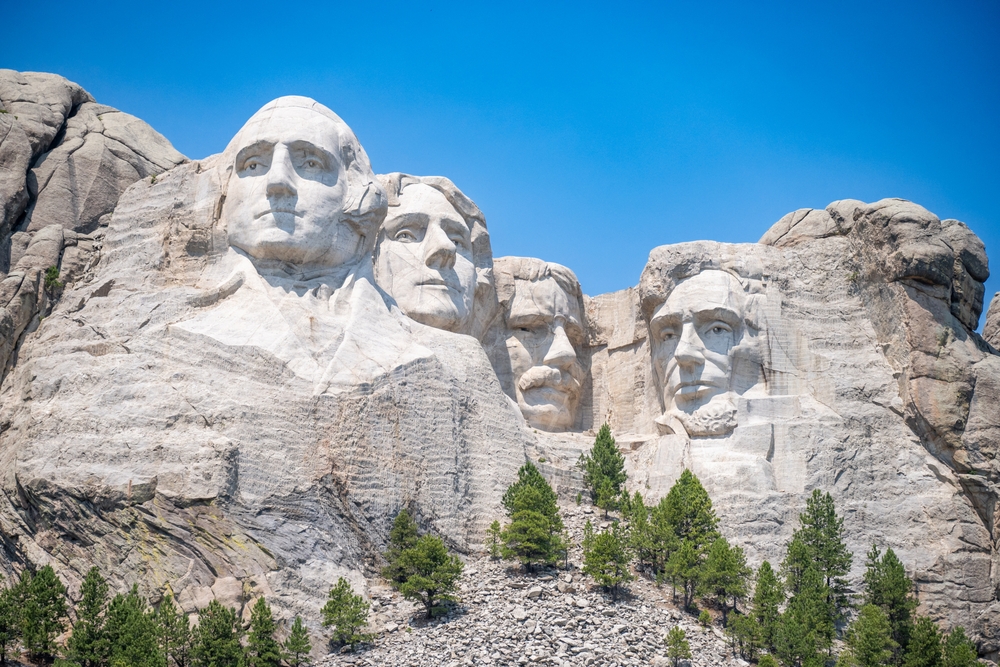
A proposal to carve President Donald Trump’s likeness into South Dakota’s Mount Rushmore National Memorial has run into a wall of legal, historical, and physical obstacles that experts say make the idea far more complicated – and likely far less achievable – than its supporters suggest. The debate intensified after Florida Republican Representative Anna Paulina Luna introduced H.R. 792 on January 28, 2025, directing the Secretary of the Interior to arrange for a Trump addition to the famous mountain. The proposal revived a conversation that has surfaced repeatedly in American politics, but this time with notable backing: Interior Secretary Doug Burgum told Lara Trump on her Fox News program that the mountain had room for another face. In June 2025, Northeastern Global News published a detailed analysis of the legal and procedural barriers that would stand between any such proposal and reality.
Mount Rushmore is a federally protected memorial located in the Black Hills of South Dakota. It sits on the National Register of Historic Places, a government designation that gives it formal preservation protections under federal law. The National Historic Preservation Act (NHPA), enacted in 1966, requires federal agencies to consider the effects of their actions on any property eligible for that register – and Mount Rushmore sits squarely within that definition.
The National Environmental Policy Act (NEPA), signed into law by President Richard Nixon in 1970, adds another layer. It requires federal agencies to assess the broadest possible environmental, cultural, and social impacts of their actions before proceeding. Together, these two laws create a review process that no president can simply bypass by executive order.
The Legal Wall Around Adding Trump to Mount Rushmore
Answering the question of whether it is legal to add Trump to Mount Rushmore requires understanding how federal law protects historic places. According to Jeremy R. Paul, a professor of law and former dean of the Northeastern University School of Law, any changes to Mount Rushmore would very likely require an act of Congress. The site’s listing on the National Register of Historic Places places it under layers of federal protection that the executive branch cannot unilaterally override.
Related Videos:
Finds coverage of the specific legal and historical obstacles facing the proposal to add Trump to Mount Rushmore.
Even if Congress passed Luna’s bill – which Paul characterizes as unlikely – that would only be the starting point. The Mount Rushmore Trump proposal legal obstacles do not end with legislation. The administration would still face mandatory environmental and stakeholder reviews under NEPA and the NHPA before a single drill could touch the granite. On top of that, the White House could face lawsuits from stakeholders, including tribal nations or environmental groups, that would need to play out in court before any alterations could proceed. Tribal nations and Indigenous groups in particular would have strong legal grounds to challenge such a proposal.
The National Park Service is the essential gateway for any changes to the memorial. Paul stated plainly that the National Park Service is the starting point for anything Trump might want to do with Mount Rushmore, and the service reports to the Secretary of the Interior. That chain of authority makes the process bureaucratically dense. The Department of the Interior’s own Secretary’s Standards for the Treatment of Historic Properties – a set of federal guidelines governing how historic places must be managed – focus explicitly on maintaining and repairing existing historic materials rather than adding new construction or undertaking major alterations. A new face carved into the mountain would almost certainly fall outside those standards. Under those standards, the historic character of a property must be retained and preserved, and the replacement of intact or repairable historic materials – or alteration of features and spatial relationships that characterize a property – must be avoided.
Luna’s bill was referred to the House Committee on Natural Resources after its introduction, and it never made it out of committee. Still, the proposal attracted enough attention to prompt a serious legal examination of what adding any president to the memorial would actually require.
The Rock Itself Says No
Even setting aside the question of can Trump be added to Mount Rushmore legally, the mountain presents a physical problem that may be even more definitive. Even if the legislation passed, the famous mountain does not have enough rock suitable to be carved for Trump’s – or anyone else’s – face. “It comes down to the geology, the engineering,” said Paul Nelson, a retired engineer who oversaw the rock monitoring system at Mount Rushmore.
This is not a recent discovery. Sculptor Gutzon Borglum – the man who spent 14 years creating the memorial from 1927 to 1941 – recognized the problem before the monument was even finished. Borglum wrote in May 1936 that the “stone limitations are so serious, that I doubt if it would be possible to change the composition, which is fixed, in any way to include a fifth head.” The rock that appears visually open beside Lincoln and Washington is, according to engineers, deeply fractured and not suitable for precision carving.
The carving for Jefferson’s face initially started to Washington’s left but had to be moved to his right to find stone that was acceptable. That adjustment happened during the original construction. The usable granite is not simply wherever it looks available from the ground. Borglum himself had to adapt his plans repeatedly as the project advanced, and he even had to pare back plans to sculpt the shoulders of the four presidents as work progressed over 14 years.
The National Park Service has concluded that there is simply no more carvable space on the mountain. The NPS worked with an engineering firm in past decades to explore the structural integrity of the rock face, and there is no more carvable space, a spokesperson told the Argus Leader in 2020. Dan Wenk, who served as superintendent at Mount Rushmore for over a decade, put it in terms that cut straight through the political noise. “It’s a wonderful thing to speculate about, who could or should be on Mount Rushmore, but it can’t be done,” Wenk said. “Would you add another figure to da Vinci’s ‘The Last Supper?’ I don’t think so. You don’t change great art.” Wenk said that while it may look like there is space next to Lincoln or Washington, the rock is “not suitable for carving,” as it is “very fractured, it’s very soft.”
Has Anyone Officially Proposed Adding Trump to Mount Rushmore?
Yes – and this is not the first time a sitting president has been linked to the idea of a fifth face on the mountain. During his first term, Trump made clear he would embrace the idea of joining four of his predecessors on Mount Rushmore. The current push, however, is more formal than anything seen before.
Covers the Indigenous land rights and treaty issues central to why adding a face to Mount Rushmore faces significant barriers.
On January 28, 2025, Congresswoman Anna Paulina Luna introduced legislation to arrange the carving of President Donald J. Trump on the iconic Mount Rushmore National Memorial in South Dakota. The bill aimed to honor President Trump, the 45th and 47th President of the United States, for his transformative impact on America. Luna framed the proposal in terms of presidential legacy, arguing that Mount Rushmore should reflect Trump’s contribution to American history.
Interior Secretary Burgum added fuel to the debate. “Well, they certainly have room for it there,” Burgum told Lara Trump on her Fox News show when she asked whether Trump could be on Mount Rushmore one day. That statement drew widespread attention, and considerable pushback – especially from engineers who have spent years studying the mountain’s geology.
This is also not the first time Congress has entertained presidential monument addition proposals. In 1960, New York Republican Sen. Kenneth Keating proposed adding both then-President Dwight Eisenhower and former President Franklin D. Roosevelt to the monument. After Ronald Reagan left the White House in 1989 and again following his death in 2004, many advocates pushed to add him to Mount Rushmore. None of those campaigns succeeded – and the sculptor’s answer of “No” has never quite penetrated the American imagination, and nearly 100 years after drilling began, proposals to add to the sculpture keep coming.
The Historical Controversy Behind the Mountain
The Trump Mount Rushmore addition proposal does not exist in a historical vacuum. The ground beneath the monument carries a weight that goes far beyond its four granite faces, and any serious discussion of altering it requires confronting that history.
In the treaty signed on April 29, 1868, between the U.S. government and the Sioux Nation, the United States recognized the Black Hills as part of the Great Sioux Reservation, set aside for exclusive use by the Sioux people. The Treaty of Fort Laramie, as it is known, was supposed to guarantee the Lakota permanent access to their sacred homeland. The Lakota Sioux know the site where Mount Rushmore was carved as the Tȟuŋkášila Šákpe, or “Six Grandfathers,” and, along with other Native American tribes, consider the location culturally significant.
The Supreme Court in 1980 agreed the land on which Mount Rushmore sits was illegally seized. Although the high court ordered the federal government to pay the Sioux an “award of interest” on the value of the land, the tribe has never accepted those funds, instead demanding the return of the lands themselves. The Lakota People’s Law Project estimates the value of that award, held in trust by the federal government, is now worth more than $1 billion. The Sioux refusal to take that money – even as it has grown to a billion-dollar sum – reflects a principle rather than a financial calculation. The Black Hills are not, in the view of the Lakota, something that can be compensated for with a check.
Against that backdrop, the proposal to add a fifth presidential face to the mountain carries a particularly heavy historical controversy. Nick Tilsen, a member of the Oglala Lakota tribe and the president of NDN Collective, told The Associated Press: “Mount Rushmore is a symbol of white supremacy, of structural racism that’s still alive and well in society today.” Adding a new face, for many in the Lakota community, does not represent national honor – it compounds an already unresolved injury.
This is also part of why legal challenges from tribal nations would carry real weight in any court proceeding. Indigenous land rights, treaty obligations, and cultural preservation are areas where federal courts have recognized standing for tribal groups to sue. Any attempt to alter Mount Rushmore over tribal objections would almost certainly face legal challenges that could take years to resolve.
What the Sculptor’s Family Thinks
Commissioned by Congress in 1925, construction on Mount Rushmore began in the late 1920s under the direction of sculptor Gutzon Borglum. The National Park Service took over the project in 1933, and it was completed in 1941. Lincoln Borglum, Gutzon’s son, helped oversee the completion of Mount Rushmore as its first superintendent.
The Borglum family’s perspective on the current debate is not favorable to the idea of additions. Robin Borglum Kennedy, the granddaughter of the memorial’s creator, has been direct about where she stands. Kennedy told the New York Times that she is deeply opposed to any changes to the memorial. “It was conceived as a tribute to the ideals of America, not to any one man,” she told the Times. That framing is worth sitting with. The four presidents already carved – Washington, Jefferson, Theodore Roosevelt, and Abraham Lincoln – were chosen by Borglum to represent specific chapters in American history: the founding, expansion, preservation, and development of the nation. The selection was not arbitrary, and it was never intended to be open-ended.
The NPS has repeatedly stated that Mount Rushmore is a completed work of art. “Adding an additional face to an existing piece of art is just not what the artist had in their own conception,” said Barna, who also worked as a geologist for the U.S. Bureau of Mines, Energy Department, and Nuclear Regulatory Commission. That argument carries particular legal weight in the context of the Secretary of the Interior’s preservation standards, which treat historic properties as records of their time – not platforms for new content.
There have been legislative efforts to enshrine stronger protections for the memorial. In 2023, South Dakota Rep. Dusty Johnson introduced a bill called the “Mount Rushmore Protection Act” that would prohibit any federal funds from being used to alter, change, destroy, or remove any name, face, or other feature on the memorial. The National Park Service opposed the bill on the grounds that it might make it harder for the agency to properly care for the monument. That opposition underlines an interesting tension – even the NPS, while opposed to additions, does not want to be locked out of its own maintenance authority.
What the Mount Rushmore Addition Proposal Tells Us About Presidential Monuments
The Trump face on Mount Rushmore debate is, in many ways, a proxy for a broader argument about how Americans memorialize their leaders – and who gets to decide. The four presidents currently on the mountain were not honored immediately after their time in office. Historical reputation, not political popularity in a given moment, shaped their selection.
The Mount Rushmore historical controversy surrounding any addition is not just bureaucratic. It touches on fundamental questions about public art, Indigenous rights, completed works of creative vision, and the difference between honoring history and rewriting it. These are not abstract concerns. They are the exact questions that federal law – through the NHPA, NEPA, and the Secretary of the Interior’s preservation standards – was designed to force any administration to address before picking up a drill.
Diana Trujillo’s NASA story on The Amazing Times explores another instance where American ambition, institutional decision-making, and the weight of public memory intersect – a reminder that the stories we choose to enshrine matter, and that how we make those choices matters even more.
The Trump Mount Rushmore addition proposal, for now, sits exactly where almost every previous Mount Rushmore addition proposal has ended up: stalled in committee, contradicted by geology, constrained by law, and complicated by a history the mountain itself cannot escape. That is not a political judgment. It is the sum of what the experts, the engineers, the lawyers, and the land itself have to say about it.
Read More: Little Known Truths About the Challenger Disaster You Probably Never Knew
—
A.I. Disclaimer: This article was created with AI assistance and edited by a human for accuracy and clarity.