

Some images hold more than meets the eye. At first glance, they seem simple, almost ordinary, yet something about them keeps the mind searching. The picture below is one of those images, and what you see first can tell you more than you might know. It’s gone viral for a reason—it makes people pause, tilt their heads, and question what exactly their brain is focusing on. There’s no trick or hidden timer, just a frozen moment that quietly reveals how perception works.
When two people look at this image, an interesting thing happens. Some notice one thing immediately, while others are drawn to something entirely different. That difference isn’t random; it comes from how the brain organizes detail, shape, and shadow. The mind fills in gaps, matches patterns, and decides what feels most familiar first. That first impression often says more about someone than they realize.
So before reading any further, take a moment to really look. Let your eyes wander across the scene and notice what pulls you in first. Don’t force it or overthink—just observe and let your perception settle naturally. Ready? Look closely at the image below and pay attention to what your mind recognizes before anything else.

What You Notice First Might Reveal More Than You Think
At first glance, the image looks like a peaceful winter landscape. A single tree covered in frost stands tall against a bright blue sky. But look closer, and something else starts to appear. The branches and shadows form a lion’s face, complete with eyes, nose, and mane. Some people see the tree first, others spot the lion immediately. The difference seems small, but psychologists say first impressions often trace back to how your brain prioritizes details.
Viral optical illusions like this one catch attention for a reason. They play with how perception connects to personality. The human brain doesn’t process everything equally. It filters, highlights, and guesses what matters most. The result is that two people can look at the same image and have completely different experiences. Those instant preferences often reveal the lens through which a person interprets the world.
In this illusion, the choice between seeing a tree or a lion mirrors two distinct ways of existing. Seeing the tree first often belongs to people who value privacy, observation, and emotional depth. They’re drawn to subtle patterns and understated strength. Those who see the lion first tend to be driven, assertive, and confident. They focus on the whole rather than the details, spotting opportunity and challenge before anything else.
Neither perception is right or wrong. Both reveal how the brain balances caution and boldness. In real life, those traits shape everything from communication styles to decision-making. The question isn’t only what you see, but how you interpret what you see—and that makes this illusion more than just a visual trick.
If You See the Tree First

If the first thing that caught your eye was the snow-covered tree, you likely lead with introspection. You notice tone before volume and meaning before noise. People like you often observe before reacting, and that careful processing creates emotional intelligence that others may not easily see. You’re not necessarily shy, but you protect your inner world. You prefer depth over display, and that shows in the way you connect with people.
Those who see the tree first often take time to open up. The roots of their thoughts run deep, and trust has to grow before it’s shared. In friendships or relationships, they notice small inconsistencies others miss. That sensitivity isn’t weakness—it’s awareness. The tree symbolizes growth through stability, and those who recognize it first tend to build their lives on quiet consistency rather than showmanship.
Seeing the tree first also suggests that your attention gravitates toward structure and foundation. You see patterns, not just pictures. Where some rush toward the most striking image, your focus lands on what holds everything together. This tendency often appears in creative work, problem-solving, or planning. You may not crave the spotlight, but your insights shape the outcome more than most people realize.
Why Some People See the Tree First
From a psychological point of view, the brain’s selective attention system explains why some people focus on the tree. The visual cortex scans for familiar outlines—shapes that fit into known categories like “tree” or “landscape.” Those who favor realism or context usually process images through that pathway first. Their cognitive style prioritizes grounding before interpretation. That’s why even in social situations, they prefer understanding a person’s background or intent before responding.
However, the same sensitivity that makes you perceptive can sometimes make you hesitant. Overthinking becomes the cost of caution. The tree-first observer can get stuck in analysis, replaying scenarios or trying to predict outcomes. Still, that habit also leads to emotional maturity. You rarely act impulsively, and when you speak, it carries weight. Your calm approach often steadies others during uncertainty.
The Symbolism of the Tree

People who identify with the tree’s symbolism often choose careers or hobbies that allow reflection. Writing, design, psychology, research, or environmental work tend to align naturally. These fields reward patience and observation—the same strengths this illusion reveals. Socially, you might prefer smaller circles where you can connect genuinely rather than constantly adjusting to group dynamics.
The beauty of this perspective is its grounding power. You see the world as a collection of interconnected systems. You value growth that feels authentic, even if it’s slow. The tree-first mind recognizes that life doesn’t always need to roar to have meaning. Sometimes presence itself is enough.
If You See the Lion First
If the lion’s face appeared before the tree registered, you likely lead with confidence and vision. You’re the type who walks into a room and senses direction before conversation even begins. Seeing the lion first suggests a brain wired for dominance recognition—meaning you’re attuned to power, courage, and leadership. You respond to challenges with instinct rather than hesitation.
Those who spot the lion immediately tend to have a proactive mindset. They value movement and results. Their decisions come faster because they rely on intuition as much as logic. Where others analyze possibilities, they see opportunity. The lion’s face represents authority, focus, and self-belief—all traits tied to assertive personalities who influence rather than follow.
Neuroscientific research shows that people who interpret dominant shapes or faces first tend to have heightened activation in the amygdala and prefrontal regions responsible for emotion and decision-making. That doesn’t mean aggression; it means quick recognition of hierarchy, motivation, and risk. The lion-first viewer usually thrives in environments that demand fast thinking or leadership under pressure.
Still, the lion’s perception comes with duality. Strength without awareness can turn into control. Those who see the lion first sometimes forget to slow down, missing details in pursuit of the bigger picture. The balance lies in remembering that influence grows from listening as much as leading. The lion may symbolize dominance, but it also symbolizes protection and responsibility. The best leaders channel that energy toward creating safety for others, not just success for themselves.
Seeing the lion also suggests a natural resistance to fear. You likely handle uncertainty with resilience, preferring action over avoidance. People drawn to this symbol often take on roles that involve vision and persuasion—entrepreneurs, strategists, athletes, or performers. They’re motivated by challenge, not comfort. Their confidence tends to inspire others, even if it occasionally intimidates.
The Lion Reveals Leadership
Socially, lion-first individuals tend to command attention without forcing it. Their energy sets the tone in groups. They’re not always loud, but their presence signals decisiveness. However, because their focus is often external—goals, results, status—they can sometimes neglect emotional nuance. The illusion reflects that balance. Just as the lion’s face blends into the tree, strength depends on stability. A confident person needs grounding as much as a reflective person needs courage.
In relationships, the lion-first personality values loyalty and respect. They’re protective of those they care about but expect mutual integrity. Conflict doesn’t scare them, dishonesty does. They prefer partners and friends who match their energy or challenge them intellectually. The lion view reveals someone who doesn’t just survive change—they direct it.
Ultimately, seeing the lion first means your mind is tuned to power in all its forms—personal, emotional, and social. You see potential before you see limitation. That ability to act with conviction often turns dreams into plans and plans into results. The trick is learning when to pause and notice the tree behind the roar.
Why the Brain Creates Optical Illusions
Beyond personality tests, optical illusions like this one show how perception builds reality. What someone sees first often depends on how their brain organizes information. Vision isn’t just about eyes—it’s about interpretation. The human brain uses shortcuts called heuristics to fill in gaps, predicting what an image should represent. That process saves time but sometimes sacrifices accuracy.
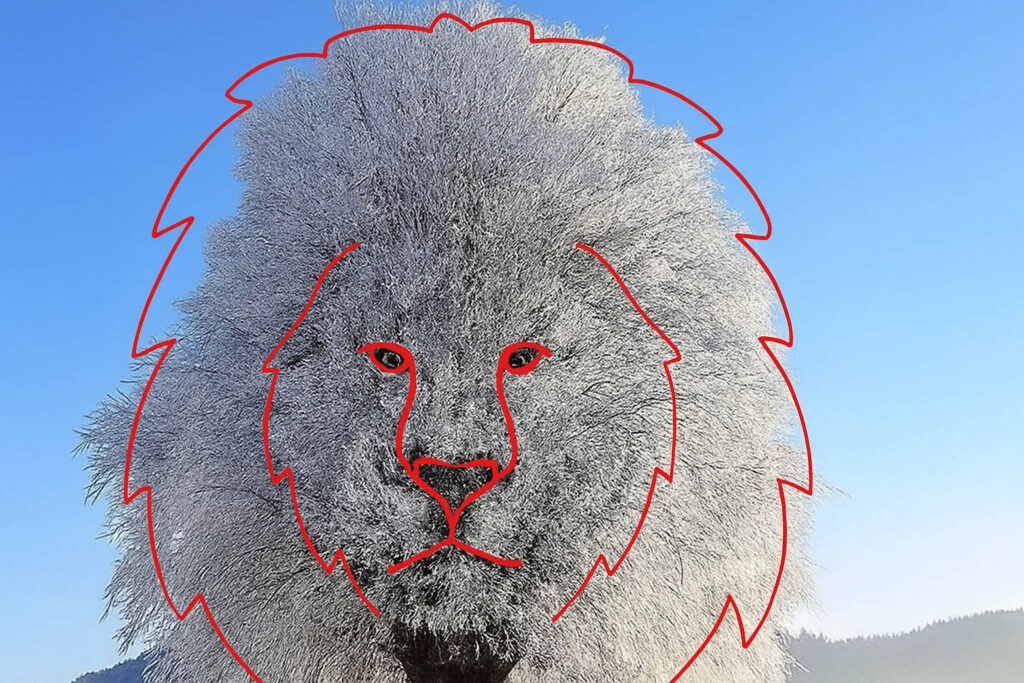
In this illusion, the branches and shadows form the outline of a lion’s face. The brain’s pattern recognition system, particularly the fusiform gyrus, searches for familiar features such as eyes and symmetry. Humans evolved to detect faces quickly because it was essential for survival. Recognizing expressions helped our ancestors sense danger or empathy. That’s why some people immediately see the lion—their brain detects an implied face before it fully analyzes the object.
Those who see the tree first rely more on contextual interpretation. Their brain processes the image as part of the landscape rather than an isolated pattern. This difference comes from the brain’s top-down versus bottom-up processing systems. Top-down processing uses memory and expectation to shape perception. Bottom-up relies purely on sensory input. Tree-seers use context; lion-seers use instinct. Both systems work together in everyday life, influencing everything from reading facial expressions to navigating traffic.
Optical illusions also highlight how visual perception interacts with emotion. Studies show that mood affects what people notice. When anxious, the brain prioritizes threat-based imagery. When relaxed, it focuses on neutral or pleasant shapes. That means someone might see the lion during moments of confidence or stress, while someone else sees the tree when they crave peace. The image becomes a mirror for state of mind as much as personality.
The Reason Behind the Fascination
Another reason illusions fascinate people is that they reveal the limits of awareness. The brain processes visual data 30 to 50 milliseconds before consciousness catches up. In other words, by the time you “see” the lion or the tree, your brain has already decided what to emphasize. That tiny delay explains why two people can argue over what’s visible—both are right, but their brains chose different priorities.

Scientists use illusions to study neural adaptation, which refers to how the brain adjusts to repeated stimuli. When you stare at an illusion for too long, the effect can fade. The brain stops responding because it has resolved the ambiguity. That’s why, after understanding how an illusion works, it rarely surprises you again. The novelty disappears once the mind decodes the pattern.
This adaptability serves a purpose. It keeps perception efficient and prevents sensory overload. Imagine if every reflection, shadow, or shape demanded full attention. Illusions exploit that filtering system, temporarily tricking the brain into interpreting contrast or alignment differently than usual. They remind people that perception is flexible, not fixed.
From an artistic perspective, optical illusions tap into the human desire for discovery. They engage curiosity while teaching something profound: reality isn’t entirely objective. The same tree can become a lion depending on who looks and how they look. This understanding bridges science and psychology, showing how deeply vision and identity intertwine.
The Science Behind It All
In modern neuroscience, researchers use brain-imaging tools like fMRI to study what happens during illusion recognition. When people identify two different interpretations of the same image, separate neural circuits light up, suggesting a competition between visual hypotheses. The winner becomes conscious experience. This internal tug-of-war defines much of human perception, from reading emotions to interpreting ambiguous situations in life.

Illusions also inspire practical applications. Understanding visual misdirection helps improve design, navigation, and even medical diagnostics. For example, radiologists study visual bias to avoid missing anomalies in scans. Drivers benefit from understanding depth illusions that occur in fog or at night. Artists and architects use optical manipulation to create perspective and motion in static structures. What began as curiosity now shapes how humans build and protect their environments.
Philosophically, optical illusions remind people that certainty often hides complexity. Just because something appears one way doesn’t mean it’s the only way to see it. That flexibility of thought mirrors emotional intelligence. The ability to shift perspective—whether from tree to lion or from assumption to understanding—defines growth.
In education, teachers use illusions to explain cognitive bias. They show that perception depends not only on sensory input but also on expectation and memory. Once students experience seeing two interpretations in a single image, they understand how easily assumptions shape thought. That realization extends beyond vision into how people process opinions, beliefs, and even relationships.
Revealing the Truth
The fascination with optical illusions will likely never fade because they tap into something ancient: the brain’s desire to find meaning in patterns. Humans are wired to make sense of chaos. When an image challenges that instinct, it sparks both confusion and wonder. Whether it’s a tree blending into a lion or two faces hidden in a vase, illusions remind everyone that truth can hold more than one form.
Read More: If You’re Smart, You Can Solve This Math Puzzle Without a Calculator
Disclaimer: This article was written by the author with the assistance of AI and reviewed by an editor for accuracy and clarity.