

The ongoing war between Ukraine and Russia has Ukraine’s allies scrambling to provide security guarantees. However, Kyiv has begun building their own military defence to protect themselves from Russian aggression. In August 2025, Ukrainian defense company Fire Point unveiled a new cruise missile that military analysts believe could reshape modern warfare. The missile, called the Flamingo, carries devastating destructive power and costs a fraction of the cost to make than traditional missiles, like Tomahawks. Fire Point developed the FP-5 Flamingo in under 9 months.
The Flamingo carries a 2,300-pound warhead and 2,000-mile range, surpassing the capabilities of the American Tomahawk. Yet Flamingos cost a fifth of the Tomahawk, which costs a hefty $2.2 million per unit. This combination of power and affordability represents what Pentagon strategists call “affordable mass”: highly capable weapons that are cheap enough to be produced in massive quantities.
Birth of a Strategic Game-Changer
Fire Point has become a key figure in Ukrainian defence in the war against Russia as a rapidly growing producer of combat drones. The company’s team is an assembly of unconventional staff members, all brought together after Russia’s 2022 invasion. Engineers, architects, and game designers make up the staff. None of the members in the company had any background or experience in the defense industry.
Iryna Terekh, the company’s chief technology officer, previously manufactured concrete outdoor furniture. “We did not want to go public with this one, but it seems to be the right time,” Terekh told Politico in August 2025. The team designed the weapon from initial concept to battlefield testing in under 9 months. They named it Flamingo after early prototypes came from the factory painted bright pink. “You don’t need a scary name for a missile that can fly 3,000 kilometers,” Terekh explained. The unusual colour stems from an internal joke within the company about women’s unspoken roles in the male-dominated weapons industry.
FP-5 Development Specifications
While Fire Point has not yet released details on the FP-5’s guidance system, they have proven their capabilities with the FP-1 attack drone. The smaller FP-1 attack drone has performed well during combat and provided a basis for the development of the Flamingo. Similar equipment used in the FP-1 will most likely be used to construct the FP-5. Like the FP-1, the FP-5 will most likely include satellite navigation resistant to jamming and possibly a camera-based optical guidance system.
According to the makers, the FP-5 has an accuracy of around 50 feet, which is less accurate than the Tomahawk. However, precision has little effect when you have a large number of missiles. Ukrainian President Volodymyr Zelenskyy praised the Flamingo, calling it “the most successful missile we have” and promising expanded production. Denmark announced plans to produce solid rocket fuel for the missiles. The Danish government suspended 20 regulations to enable the facility’s December 2025 opening.
How Ukraine Built a Junkyard Superweapon
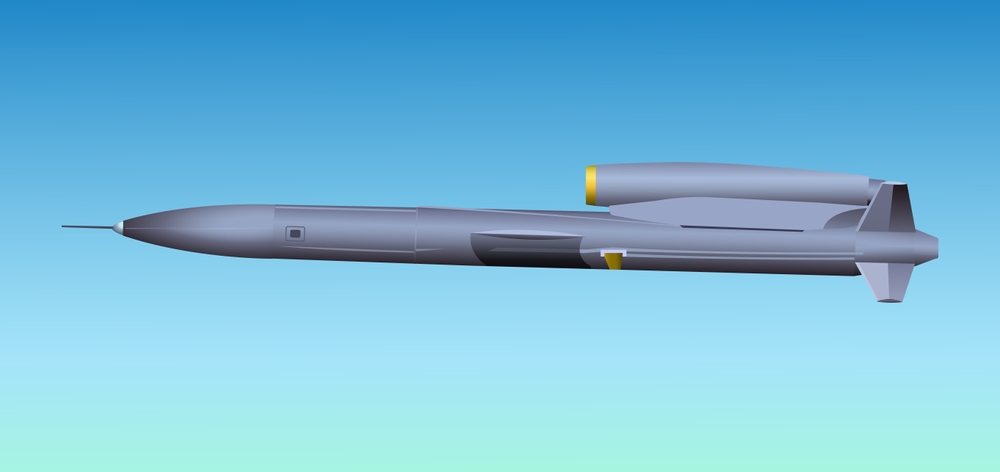
The Flamingo measures approximately 12 to 14 meters long with a 6-meter wingspan. Fire Point constructed the fuselage from carbon fiber composite materials spun in single pieces. A solid-fuel booster provides initial thrust from ground-based rail launchers. The missile then relies on an Ivchenko AI-25TL turbofan engine for sustained flight. Fire Point sourced their material from scrapyards and discovered thousands of these engines in Ukrainian landfills and storage facilities. The engines originally powered Czech-made L-39 Albatros jet trainers across post-Soviet nations. Engineers refurbished expired engines by replacing titanium components with cheaper alternatives.
The warhead comes from Soviet-era FAB aircraft bombs in Ukrainian stockpiles. Ukraine possesses massive quantities of these munitions but few aircraft to drop them. The 1,150-kilogram payload contains approximately 450 to 550 kgs of high explosives. This represents more than double the Tomahawk’s 454-kilogram warhead capacity. The Flamingo cruises at approximately 850 to 950 km per hour at extremely low altitudes. It flies as low as 50 meters above ground to evade radar detection. The guidance system combines GPS satellite navigation with inertial navigation and electronic warfare resistance. Fire Point claims accuracy within 50 meters of target coordinates. While less precise than the Tomahawk’s 14-foot accuracy, the massive warhead compensates effectively.
Battlefield Debut Delivers Devastating Results
Ukrainian forces launched the Flamingo’s first combat mission on August 30, 2025. Three missiles targeted a Federal Security Service outpost near Armyansk in northern Crimea. Launch footage showed the weapons firing at sunrise from Ukraine’s coastline. Solid boosters propelled the missiles skyward before turbofan engines engaged. Satellite imagery later revealed extensive damage to the Russian facility. One missile struck the main barracks building directly. Another impacted approximately 100 to 200 meters from hovercraft storage areas. The third missile’s fate remains unclear, but it is likely that it exploded nearby. Impact craters measured 13 to 15 meters in diameter across the compound.
Ukraine subsequently used Flamingos against Russian oil refineries deep inside Russian territory. The Economist reported these attacks in early October 2025. Flames engulfed refinery facilities after missile impacts. On October 9, President Zelenskyy confirmed combined strikes using both Flamingo and Neptune missiles. Russia claimed its first Flamingo shootdown on October 10, 2025. Russian forces allegedly destroyed two missiles using Buk air defense systems. They reported the missiles traveled at 100-meter altitude and approximately 600 kilometers per hour. These mixed results suggest the Flamingo faces challenges penetrating well-defended Russian airspace.
Comparing Firepower: Flamingo Versus Tomahawk
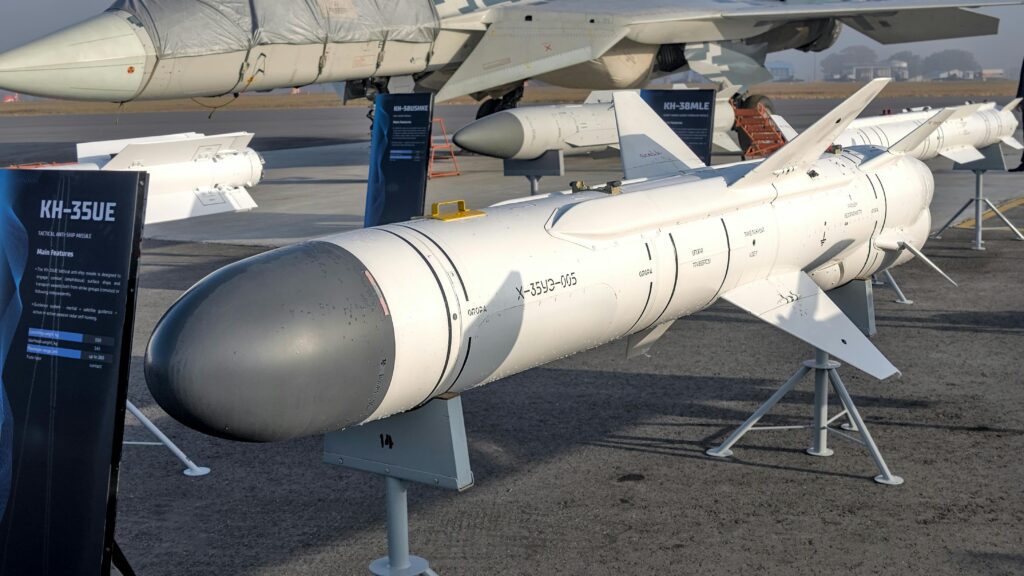
The American Tomahawk cruise missile was first used in service during the 1991 Gulf War. It became the United States’ primary long-range precision strike weapon. The Navy and Air Force have fired Tomahawks in Afghanistan, Iraq, Syria, Libya, Yemen, and Somalia. Tomahawks measure 20 feet in diameter with a 9-foot long wingspan. It carries a 1,000-pound warhead over approximately 1,600 kilometers. The Tomahawk cruises at nearly 600 miles per hour while hugging terrain at 100-foot altitude. Advanced guidance systems typically deliver precise strikes, usually within14 feet of the designated target. The Navy’s 2026 budget allocated $84 million for 40 Tomahawk missiles. This equals $2.1 million per missile including launch canisters.
The Flamingo substantially exceeds Tomahawk capabilities in range and payload capacity. Its 3,000-kilometer range is nearly double that of the Tomahawk’s reach. The 1,150-kilogram warhead delivers approximately 2.5 times the Tomahawk’s explosive power. Fire Point claims production costs around $500,000 per missile as most of the material is sourced from junk or scrap metal. The FP-5’s cost is one-fifth of the Tomahawk, which sits with a staggering $2.1 million price tag. However, the Flamingo sacrifices accuracy for affordability and payload. Fifty-meter precision seems modest compared to the Tomahawk’s pinpoint accuracy.
The cost differential enables Ukraine to acquire substantially larger quantities of missiles. In traditional defense procurement and production, priority is placed on high capability over quantity. The Flamingo reverses this equation by prioritizing mass production. Pentagon officials increasingly recognize that modern conflicts require missile inventories measured in thousands. The United States launched 135 Tomahawks against Yemen in 2024. Russia produces over 200 missiles monthly and has previously launched 700 drones in a single night. This reality drove American interest in Ukraine’s affordable mass production approach.
Scaling Production to Industrial Warfare Levels
Fire Point began serial production in mid-2025 at approximately 30 missiles monthly. By September 2025, output increased to 50 units per month. The company announced ambitious targets to manufacture 7 missiles per day by this year’s end. This equals approximately 210 missiles per month or 2,520 annually. President Zelenskyy pledged substantial production increases by December 2025. “We will have many more of them,” he told reporters in August. The president emphasized that Ukraine would wait until producing “hundreds of them” before revealing additional details. Independent military analysts initially questioned these production claims. However, Fire Point’s proven drone manufacturing success lent credibility to their missile ambitions.
Fire Point initially relied on refurbished AI-25 engines from surplus stockpiles but later established its own engine production facility. All other missile components prove relatively simple to manufacture and scale. The carbon fiber fuselage takes only 6 hours to produce. Denmark has lifted restrictions and supplied Ukraine with rocket fuel to address another critical supply chain requirement. These arrangements position Fire Point to potentially outdo combined U.S. and Russian cruise missile production.
The company operates production facilities at multiple secret locations across Ukraine. This geographical distribution protects against Russian targeting and destruction. Rapid training programs prepared these employees for missile assembly work. Fire Point sources over 90% of components from Ukrainian suppliers when possible. This strategy reduces dependency on foreign supply chains vulnerable to disruption. The company secured substantial Ukrainian government contracts exceeding $1 billion. European nations, including Poland, Denmark, and Lithuania, expressed interest in potential purchases.
Strategic Implications for Ukraine’s Defense
The Flamingo provides Ukraine with immense heavy-strike capabilities against Russian targets. Prior to August 2025, Ukraine relied primarily on drones and limited Western missile supplies. Drones carry small explosive payloads insufficient for hardened infrastructure. Storm Shadow missiles from Britain reach only 560 kilometers. The Flamingo solves this capability issue. Its 3,000-kilometer range threatens approximately 90% of Russia’s arms manufacturing capacity. Ukrainian forces can coordinate Flamingo strikes with drone swarms to overwhelm air defenses. This combined arms approach maximizes penetration probability despite individual system limitations.
Fabian Hoffmann described the Flamingo as “Ukraine’s strongest security guarantee“. He calculated that 3,000 to 5,000 missiles could destroy upward of 25% of Russia’s economic output. “Further Russian aggression becomes untenable” under such circumstances, Hoffmann assessed. This strategic impact extends beyond the current conflict to post-war deterrence. A well-armed Ukraine can prevent renewed Russian invasion attempts after peace agreements. The missile arsenal demonstrates that Ukraine possesses credible self-defense capabilities. This reality strengthens Ukraine’s negotiating position substantially in peace discussions. Terekh emphasized that the weapon serves defensive purposes exclusively. “We have no aggressive intentions; we’re ready to protect our sovereignty,” she told Politico.
Ukrainian public opinion demands visible results from military operations against Russian aggression. Citizens want evidence that Ukraine inflicts meaningful damage on invaders. “People want results; they want to see Red Square on fire,” Terekh acknowledged. However, she stressed that Ukraine maintains ethical targeting standards, unlike Russian indiscriminate attacks. Military installations, economic infrastructure, and logistics hubs constitute legitimate strike objectives. President Trump suggested greater openness to Ukrainian deep strikes in October 2025. “It is very hard, if not impossible, to win a war without attacking an invaders country,” Trump wrote.
International Defense Industry Transformation
Ukraine’s defense sector grew from $1 billion annually to $35 billion between 2022 and 2025. Drones represent approximately one-third of Ukraine’s defense production output. Missile production remains smaller but is growing rapidly toward strategic significance. The government supports development of additional cruise missile variants beyond Flamingo. Multiple missile systems provide targeting flexibility and prevent over-reliance on single platforms. Technology licensing arrangements could provide substantial revenue from international partners. Ukrainian intellectual property possesses significant commercial value after battlefield validation. Fire Point had secured government contracts exceeding $1 billion by October 2025. The company employs 2,200 workers across manufacturing and development operations.
Technical Challenges and Operational Limitations
Fire Point acknowledges ongoing technical challenges with the Flamingo system. Pre-launch preparation time currently exceeds optimal specifications. Approximately 20 minutes elapse between launcher arrival and missile departure. This delay exposes launch units to Russian counter-battery fire and targeting. More rapid deployment procedures require additional development and testing refinement. Accuracy improvements remain critical for future mission success. Current performance suggests the claimed 50-meter circular error probably needs validation. Extended testing against well-defended targets will reveal true system capabilities. Electronic warfare resistance requires ongoing evaluation and enhancement against evolving threats.
The missile’s large radar signature presents survivability challenges. The top-mounted engine creates distinctive visual and radar characteristics. Russian air defenses can potentially detect the Flamingo at extended ranges. Combined operations utilizing multiple weapon types improve penetration probability significantly. Ukraine coordinates missile strikes with drone swarms to overwhelm defenses. This combined arms approach compensates for individual system limitations. Development of stealthier variants could enhance future survivability prospects. Advanced composite materials and design modifications could reduce radar detectability. Hypersonic variants remain potential future development objectives. However, current manufacturing emphasizes production volume over technological sophistication.
Initial combat results revealed mixed performance under operational conditions. Three missiles launched against Armyansk achieved varying degrees of success. Only 2 missiles reached the target area successfully. One achieved impacts within stated manufacturer specifications. The other landed 100 to 200 meters wide of the intended targets. Ukraine transitions from light drones and mini-cruise missiles to heavier platforms. That technological leap inevitably produces growing pains requiring iterative improvements. The collected combat data provides valuable feedback for system enhancements. Fabian Hoffmann noted that despite imperfections, the strike demonstrated minimum viable capability.
The Future of Affordable Mass Warfare
The Flamingo missile’s affordability, combined with its substantial capability, challenges traditional procurement routes. In the midst of a crisis, smaller, less funded companies have stepped to the forefront and reshaped modern warfare. Through innovation, Ukraine has demonstrated military procurement does not require enormous development budgets. The missile redefined what constitutes acceptable guidance accuracy in modern warfare. The Flamingo’s massive one-ton repurposed warhead compensates for its limited precision limitations when produced in large quantities. This concept could influence military strategy and procurement for decades forward.
American and European Manufacturers Show Interest In Flamingo’s Capabilities
American and European manufacturers increasingly acknowledge these lessons from Ukrainian innovation. The Pentagon’s affordable mass initiatives directly respond to Ukraine’s demonstrated success. Anduril and other startups pursue similar approaches with substantial venture capital backing. Traditional defense contractors announced major process re-engineering initiatives. However, many analysts question whether legacy companies can truly transform their business models. Bureaucratic procurement processes resist rapid change even when strategic necessity demands adaptation. Palmer Luckey argues that fundamental cultural differences prevent established contractors from achieving true innovation.
Emerging Competitors Worldwide
International competition may eventually emerge from other manufacturers worldwide. Russia and China possess cruise missile experience and substantial industrial capacity. China reportedly produces affordable missiles in impressive quantities already. Western manufacturers continue developing low-cost variants to compete in evolving markets. Ukraine’s first-mover advantage in affordable mass production will diminish over time. However, Fire Point maintains operational experience from actual combat deployments. This battlefield-tested expertise provides a lasting competitive advantage over theoretical development programs. The humble “junkyard” missile ultimately became a geopolitical game-changer. Ukraine transformed the economics of warfare within a single remarkable year.
Read More: 15 Legendary Treasures Still Missing in the United States