
There’s a particular kind of buyer’s remorse that only Costco can produce. It’s not the usual kind – the thing you regret buying. It’s the remorse you feel when you realize you’ve been walking past the same shelf for months and never picked up the item that would have quietly changed how you shop. You start doing the math on what you’ve spent at regular grocery stores and feel a low-level sting you can’t shake.
Costco has built a genuine mythology around bulk buying, and a lot of it is warranted. But not everything on those warehouse shelves earns its place in your cart. Plenty of items are only a deal if you actually use them before they expire or before your family stages a quiet revolt. The real wins are specific: a handful of products that genuinely hold up on quality, price per unit, and practical, week-to-week usefulness.
These are ten of them. Not the ones that look impressive stacked on a pallet. The ones that make actual financial sense and that you’ll reach for until they’re gone.
1. The Rotisserie Chicken
If any single product explains why Costco has the grip it has on its members, it’s the rotisserie chicken. Priced at $4.99 in the United States, that number hasn’t budged for years, even as food prices everywhere else have climbed. The chicken is a loss leader – a product sold at or below cost specifically to pull members into the store. And it works spectacularly.
Costco revealed to its investors that it sold 157.4 million rotisserie chickens worldwide in fiscal year 2025, equivalent to 13.1 million per month or over 431,000 every day. That’s not a product with a loyal following – that’s a cultural institution. To keep the price that low, Costco took the step of vertically integrating its chicken supply chain. In 2019, the company opened a dedicated chicken processing plant in Nebraska, operated by Lincoln Premium Poultry under Costco’s direct oversight, capable of processing two million chickens per day.
From a practical standpoint, the value stretches well past dinner on night one. Costco birds are about three pounds each, larger than most grocery store equivalents. Strip it down after dinner, and you’ve got the makings of chicken salad, fried rice, tacos, or soup stock without spending another cent or another hour in the kitchen.
2. Eggs
Eggs at Costco have had a rough couple of years, and not because the quality dropped. Egg costs saw a 37% increase in just one year, according to the Consumer Price Index, driven by the avian influenza H5N1 – better known as bird flu. More than 40 million egg-laying chickens died in 2024, about 13% of the national total. At the height of the shortage, shelves were bare and shoppers were rationing their finds. But Costco still managed to undercut most competitors – and that gap is relevant again now that prices are settling.
A five-dozen pack of conventional large white eggs was recently priced at $18.99, working out to about $3.80 per dozen. For context, a local grocery store selling a dozen white cage-free Grade A eggs for $6.29 is roughly what Costco charges for 24 of them at $8.49. The math alone makes it worth it if your household goes through eggs at any reasonable pace.
The key is the pack size. Costco sells eggs in quantities of two dozen and five dozen, not the standard 12-count most people default to. If eggs are a weekly staple in your house – breakfast, baking, weeknight omelets – the five-dozen pack disappears faster than you’d expect. If you’re a single-egg-on-Sunday person, this is one to skip.
3. Almond Flour
Anyone who bakes gluten-free or follows a low-carb diet has already noticed how quickly almond flour drains a grocery budget at regular supermarkets. It’s one of those ingredients that’s become mainstream enough to be everywhere but premium enough to stay expensive. Costco is one of the few places where the math actually breaks in your favor.
Costco’s almond flour is typically priced in the $10 to $15 range for a three-pound bag – a smart option for anyone who uses it regularly, and buying in bulk at that size saves money in the long run. Elsewhere, a standard one-pound bag tends to run $12 to $15, while bulk retailers like Costco can bring the per-ounce cost down significantly, often to the $0.50 to $0.65 range.
The Kirkland Signature Blanched Almond Flour is made from finely ground almonds that are first blanched – briefly boiled to remove the skins – which gives it a consistency close to wheat flour. The one thing to keep in mind: almond flour’s high fat content means it can go rancid if stored in a warm pantry for too long. Transfer it to an airtight container and keep it in the fridge or freezer, and it’ll stay fresh for months.
4. Frozen Shrimp
Frozen shrimp is one of those Costco finds that earns its place through pure convenience. It thaws fast, cooks in minutes, and functions in an almost comically wide range of meals – stir-fry, pasta, tacos, curries, or simply garlic and butter in a hot pan. Having a large bag in the freezer is essentially having a backup dinner solution at all times.
Costco’s shrimp comes in both raw and cooked varieties, and both can be found frozen or previously frozen. The count number on the bag describes the shrimp size: a 21-25 count means that’s how many shrimp make up a pound, so a lower number means a larger shrimp. For most cooking purposes, the 21-25 count is the versatile choice – substantial enough to anchor a meal but not so large they become fussy to cook evenly.
The value case for buying shrimp in bulk at Costco is straightforward. The bags are generous in weight, the price per pound consistently beats what you’ll find in the regular seafood section at most grocery chains, and shrimp is one of the most freezer-friendly proteins out there. Pull out what you need, leave the rest frozen, and the bag will serve you well over multiple weeks.
5. Canned Tomatoes
Canned tomatoes are arguably the most unglamorous item on this list – and one of the smartest investments you can make at any warehouse store. They don’t expire quickly, they form the base of an enormous number of meals, and buying them in bulk ensures you’re never standing in front of an empty pantry trying to improvise something out of nothing.
Costco’s Kirkland Signature canned tomato options offer solid nutritional value, great flavor, and a price point that makes organic cooking accessible. While some might argue that fresh is always best, canned tomatoes are ideal for soups and sauces. The Kirkland Signature diced tomatoes are USDA-certified organic, with no added preservatives, at a low-sodium price point that makes organic cooking more financially realistic than it usually is.
The practical argument here is simple: if you make pasta sauce, chili, soup, shakshuka, braised meat, or anything that starts with a can of tomatoes, you’ll use these. Having a case of them at home means the starting point for dinner is always there, and you never have to make an emergency grocery run because you’re out of one foundational ingredient.
6. Olive Oil
Olive oil is one of those items where you feel every dollar when you’re buying a small bottle – and where the Costco bulk model genuinely pays off over time. The math is simple: you go through it constantly, the quality of the Kirkland Signature version holds up against far pricier brands, and the price per ounce is difficult to beat anywhere else.
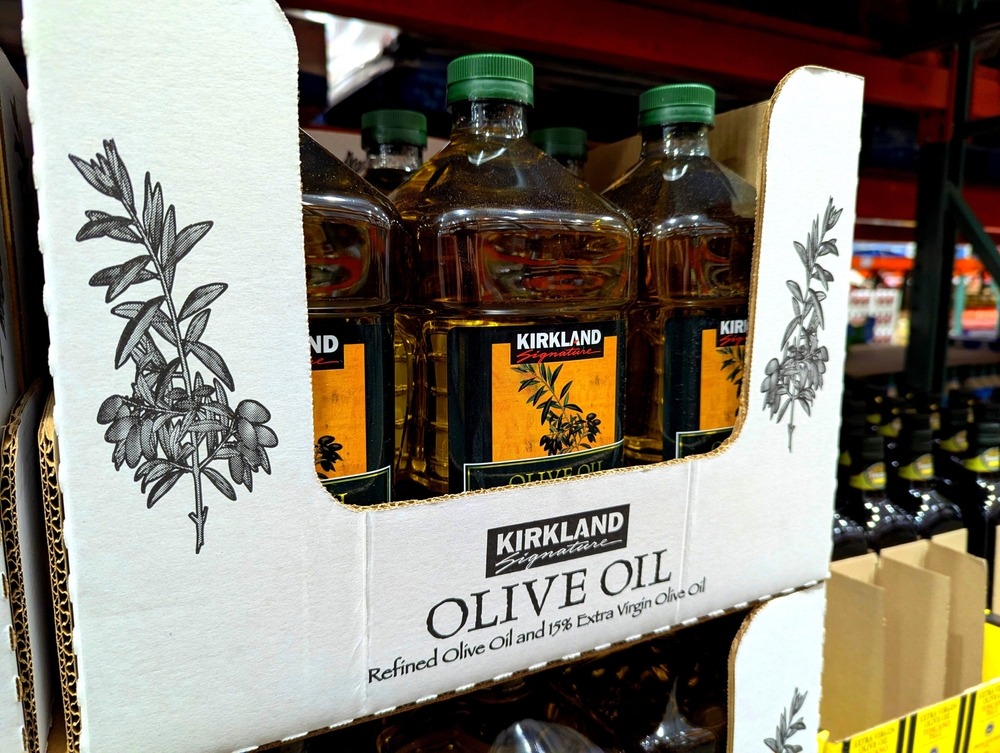
The Kirkland Signature Organic Extra Virgin Olive Oil in the 2-liter bottle is currently priced at $20.99 online, working out to $10.50 per liter. Prices across the board have climbed over recent years, driven by severe droughts in Spain, Italy, and Greece, the world’s top olive-producing regions, which reduced harvests significantly. But even with those pressures, Costco’s bulk model continues to deliver relative value. A recent visit to a Costco found the large 2- and 3-liter bottles of extra virgin olive oil selling at about $0.24 to $0.27 per ounce – roughly half the typical price of comparable supermarket extra virgin olive oil.
For olive oil, the savings compound over a year of use. You’re not just getting a better price on a single bottle – you’re cutting your cost per use on every roasted vegetable, every sauté, every salad dressing you make between now and when the bottle runs out. That 2-liter bottle won’t feel like much when you first carry it in from the car, but you’ll be glad it’s there.
7. Avocado Oil
Avocado oil has moved from specialty health food store staple to mainstream kitchen essential over the past few years, and the reason is mostly practical: it has one of the highest smoke points of any commonly used cooking oil, which makes it the right choice for high-heat cooking. Searing, roasting, stir-frying – these are all methods where a lower smoke-point oil will start to degrade and produce off flavors before your food is done.
The issue has always been the price. At most grocery stores, avocado oil is positioned as a premium product and priced accordingly. Costco changes that equation meaningfully. If you’ve been using avocado oil only for certain recipes while defaulting back to something cheaper for regular cooking, buying it in bulk at Costco is what finally makes it a genuine everyday oil. The price per liter at Costco lands in a range that makes regular use financially realistic rather than a special occasion luxury.
If your go-to method involves a hot skillet – and the crispy, golden sear on chicken or vegetables you actually want – a high smoke-point oil is the difference between the result you’re chasing and something a little greasy and flat. Buying avocado oil in bulk at Costco removes the hesitation that comes with reaching for the expensive bottle every night.
8. Salmon
Salmon is one of the most nutritious proteins you can eat regularly, and also one of the most reliably expensive. The Costco salmon counter is one of the places where warehouse pricing makes the most tangible difference to a family food budget, because the per-pound gap between Costco and standard grocery stores is real and meaningful.
At standard supermarket chains like Ralphs or Kroger, comparable fresh farmed salmon averages $16.99 or more per pound, while Costco’s fresh farmed Atlantic salmon runs around $12.99 to $16.00 per pound – making it a clear winner on price per pound, even before accounting for bulk savings. The fresh farm-raised Atlantic salmon fillet comes in one large piece approximately 10 to 12 inches long by 6 inches wide, so you can cook it whole as a large roast or portion it into individual fillets of any size.
A 3-pound piece at $12.99 per pound comes to about $38.97 total. Cut into 6-ounce fillets, you get eight portions at roughly $4.87 each – a fraction of what a single fillet would run at a grocery store fish counter. The smart move is to buy a full piece, portion it at home, and freeze what you won’t use within two days. It freezes exceptionally well when individually wrapped, making it well-suited for meal prep throughout the week.
9. Ground Beef
Ground beef is the kind of item that feels almost too obvious to mention – until you look at the per-pound price difference and realize how much you’ve been quietly overpaying at the standard grocery store. Costco’s meat prices per pound, particularly for USDA Choice cuts, are consistently below those of regular grocery stores, and large packs can be divided and frozen in meal-sized portions to lower the per-meal cost and reduce the number of shopping trips you need to make.
The key to making a big pack work is the same principle that applies to the salmon: you’re not cooking it all at once. You’re portioning it out, wrapping each portion flat in freezer bags, and pulling one out as needed. A two- or three-pound portion thaws overnight in the fridge and works for burgers, meatballs, pasta sauce, tacos, stir-fry, or anything else that starts with browning some beef in a hot pan.
For households that eat meat regularly, this is one of the cleanest bulk-buy wins Costco offers. The price per pound is lower, the quality is consistent, and the only real overhead is ten minutes of portioning and labeling before you put it in the freezer.
10. Kirkland Signature Mixed Nuts
There’s a version of the snack aisle where everything is either too salty, too processed, or priced like a premium product that doesn’t deserve the label. Costco’s Kirkland Signature mixed nuts manage to sidestep most of those problems. The canisters are large, the nut-to-filler ratio is favorable, and the price per ounce lands well below what you’d spend on a comparable product at a specialty or health food store.
Mixed nuts are also one of the genuinely sensible bulk buys because they have a reasonable shelf life when stored properly, they’re calorie-dense enough that a canister lasts longer than it looks like it will, and they function in more contexts than just snacking – on oatmeal, in salads, as a topping for stir-fry, or alongside a cheese board when you have people over unexpectedly.
The practical case is less about the cost per serving and more about the quality-to-price ratio. At Costco, you’re getting a product where the almonds, cashews, and macadamia nuts aren’t an afterthought padded out with cheap fillers. That’s the kind of detail that’s easy to miss at first – and hard to unsee once you’ve noticed it.
What to Do With This List
The common thread across all ten of these items is that they earn their place not because they’re impressive or exciting but because they’re things you’ll actually use. The value proposition at Costco is only real when what you’re buying fits your household’s rhythm – the proteins you reach for, the pantry ingredients you always need, the oils and staples that run out before you’ve had a chance to restock.
Start with one or two categories where you already know your household’s consumption is consistent. Salmon, olive oil, ground beef – if any of those are weekly staples in your kitchen, the math justifies the bulk buy almost immediately. The savings on any single item won’t change your life. The savings across a year of buying the right things in the right quantities will add up to something genuinely meaningful.
The mistake most Costco members make isn’t buying too much – it’s buying the wrong things in bulk while walking past the items that actually deliver. The rotisserie chicken goes in the cart on autopilot for good reason. The rest of this list deserves the same kind of automatic, unthinking loyalty.
AI Disclaimer: This article was created with the assistance of AI tools and reviewed by a human editor.